It feels strange to say that I haven’t left the UK since the EGOS conference in Tallinn in 2018, but it’s true. Not very surprising, given how much I dislike travelling and, you know, the global pandemic, but still an odd thing to have been unplugged from the conference circuit since EGOS in 2020.
I attended the stream attached to System Change, Not Climate Change: Alternative Futures for a World beyond Environmental Crisis, and surprised myself by having a good time. There were enough papers to fill out more than one subtheme – a good sign in and of itself – so we were split up into three groups and I stayed in the second with colleagues like Steffen Böhm, Maria Ehrnström-Fuentes, Daniel Nyberg, and John Murray. There was a lot of interesting work presented as part of the stream – really interesting projects on the different types of ignorance that actors demonstrate when talking about sustainability, issues with the proliferation of concepts around sustainability, insights on how climate change denial movements are organized, future imaginaries in the coal industry, the role of democracy, waste management, the hydrogen industry, indigenous perspectives around stewardship or regenerative agriculture, questions of sustainable use of space, or alternative banking/currencies. I enjoyed the chance to think through these problems with colleagues.
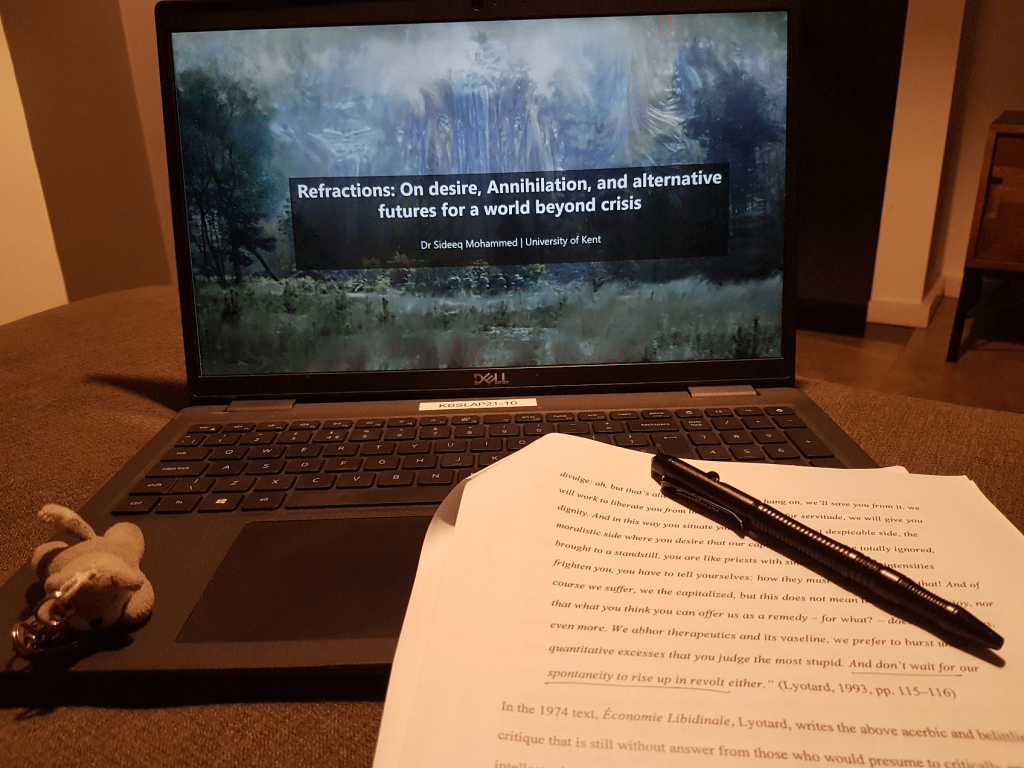
I presented a paper titled “Refractions: On desire, annihilation, and alternative futures for a world beyond crisis”. Here’s the abstract:
In this paper, we will practice the method of storying, of weaving together different threads of cultural production that have become salient in order to both construct and deconstruct modes of thinking that are germane to the contemporary milieu. We will draw together Jeff VanderMeer’s novel, Annihilation, with the writings of Jean-François Lyotard, Gilles Deleuze, and Felix Guattari, events surrounding the pollution of English water systems by Southern Water, and anthropocene theorizing, in order to construct a robust account of the libidinal economy of contemporary storyings. We develop the central thematic of Annihilation in order to unpack how the relationship between desire and capitalism produces “refractions” – schizms and mutations of desire that transform creative and constructive attempts at producing sustainable futures beyond crisis into the reinforcements of systems that produce crisis. Consequently, we will argue that self-destruction in the anthropocene is a joyous and affirmative activity, verging on an imperative for capitalized subjects and that pursuing the various refractions of desire is all that is left for “the human” in the anthropocene.
I’m really interested in what’s happening with British waterways at the moment – the complex and entangled politics that’s emerging around the dumping of sewage in the waterways of the Southeast of England. It’s something that I’m hoping to spend more time with and develop beyond the scope of this paper.
When I presented it, I gave everyone a simple provocation to make sense of the text
“The idea that “the human” is an intelligible thing that exists unchanged in and by the anthropocene is an absurdity. Physically, filled with microplastics, fluorocarbons, radiation, and shit, and affectively animated by capitalism’s inherent assemblies of hopefulness, the human and its assumed agency is little more than a refraction of some other desiring.”
I’m very much in the space of trying to think through the centrality of our conceptualizations of the human subject to the problems that we face in the anthropocene. The idea of the “anthropos”, the human, that’s central to the anthropocene problematic assumes an agency, and an independence from capital that I think is a barrier to understanding (and solving?) the problem. I think that it may have been a useful provocation, particularly given that many colleagues were very much working in the space of looking at alternative modes and practices of engagement that might lead to “the good life” (i.e. one that created less ecological destruction), yet in most cases “the good life” was a form of capitalism with a slightly different ethic or set of practices to those that we have now; we’d only need to raise people’s awareness and critical consciousness to bring it about. This anthropocentric focus saves the world “for us” (or some subset thereof) but fails to remedy the core of the problem.
This is why I suggested, by way of a comment, that in the closing discussion it would be wise to think about the following:
For every single paper that we presented here, the challenge that I give to all of us, is to think about how someone more malicious and cunning might take what you’ve studied (indigenous knowledge, community activism, bottom up empowerment, shifting to renewables, alternative money, radical policy, strategies for activism and resistance etc. etc.) and use it against us. In each case can we ask how someone can use this in order to continue to generate profits and perpetuate capitalism?
It is the virulence of capital that remains persistently underconsidered and I don’t think that colleagues could work with that idea. We’re all attached to the premise that our little resistances snowball into larger ones.
There was also much discussion around whether “Anthropocene” was the right label anymore – whether we should follow Moore and others and call it the “Capitalocene” or follow Haraway and call it the “Chthulucene”. It was all that I could do to not be narcissistic and just suggest that we call it Annihilation. “Annihilation” is timeless and despatialized, encompasses the effects of Earth system changes on human, non-human, and artificial forms of life, includes the voices of the global south, and people of colour, and feminist perspectives because while different groups may be annihilated at different rates, everyone dies due to catastrophic failure of Earth systems and unlike debates around “climate change” vs “climate crisis” it gets the message across. I don’t think that this is a message that colleagues might have been able to work with – not without dismissing it as doomerism. The scope of the changes to the Earth system, however, necessitate some thought about what it might mean to annihilate and be annihilated. Indeed, I think that Chris Wright made a cognate point in the final sessions, saying that one challenge that we face is that we frame climate change as a problem that is solvable but to believe that we face a simple problem, that it is a problem that can be solved, is a fallacy. I don’t think that anyone took it up and tried to work with what he said.
I enjoyed Cagliari. Yes, I feel a profound sense of betrayal because eduroam didn’t connect for me – and the one constant that’s supposed to exist in an academic’s life is that eduroam works wherever you go. And yes, it was horrendously hot, and the first thought that I had when I got off the plane was how much I wanted to go home. However, the food was great – I had some of the best pasta that I can remember – and the no internet meant that there was some space to think and listen to one thing at a time, which I can’t remember having done for some months. So much of my life at the moment involves careening from one problem to the next, that it was just nice to sit for a while, look at the different patterns of moss and growth on the rocks by the sea, and think about annihilation.

 Sideeq Mohammed