Reflections

May you always live in interesting times…

May you always live in interesting times. This piece of apocrypha reads like a blessing and a curse, a disbarring of the joys of an uneventful peace in favour of a condemnation to always be busy, to always live in times of tumult and change. Between Brexit, rising business uncertainty, and the assorted harbingers of economic recession, the broader macro system seems to be in “interesting” states indeed, but there are many interesting little things going on in my life at the moment. While none of them might inspire a full entry in this research log, as an agglomeration they indicate a cross-section of my life, and by virtue of this indicate the kinds of experience that I think are important to chronicle because what it is that an “academic” does is still a nebulous and difficult to fathom thing for many people. This is perhaps not helped by the fact that I often fascetiously say that my job is to spend the majority of my waking time reading alone and then occasionally talk to people about what I read and/or tell them to go read things that I read. Perhaps in trying to enumerate some of the things that I’ve been doing recently, some of this might become clearer.

Think Kent Lecture

So in April this year, I accepted an invitation to do a recorded lecture about my research as part of the “Think Kent” series. I still have no idea why I did this. At the time I remember putting myself forward, thinking that there would be some kind of screening process during which someone would say, “We’re not sure that your research is the right fit for this kind of thing.” These are public facing videos that reflect the University trying to put on a good face and show its importance and competencies to the world, so surely (I reasoned) they’d pick someone whose work doesn’t sound like a hallucinated fever-dream, an intentionally maddened play of concepts and nihilistic provocation based on the work of an obscure French philosopher. They would certainly pick someone who doesn’t refuse to make their work “business relevant”. Surely, someone who will neither confirm nor deny that they go out of their way to try to produce work that is difficult for management to co-opt wouldn’t get chosen? Clearly, I was mistaken because I soon found myself in an empty lecture theatre being filmed.

There is a perplexing surrealism to speaking to an empty room. I’ve gotten used to “performing” from doing Not Above Evil videos but this wasn’t pretending to play a piece of music that I’d obsessively recorded. It was one shot at saying something vaguely coherent. Looking at the finished product, I can tell that I am some kind of odd mixture of nervous and uncomfortable because of the space that I’m in and the curious way that the empty room is making my voice echo. Anyone who knows me will know how slowly I’m speaking here because I’m hyper-aware of the fact that my words are being recorded to be viewed in perpetuity. However, if for whatever mad reason, someone is looking for information on Deleuzian ethnography, or working with concepts, then this is not a bad start. I ended up speaking about the two papers that I’ve already published, going on a bit of a tirade on time as a concept and a bit of a tangent on microfascism. Things certainly could have gone worse.


Msc HRM marketing video.

I’ve also been showing up in the school’s marketing material for the Msc Human Resource Management– which is again perplexing because technically I’m not a permanent employee and didn’t sign a release but perhaps it’s best not to think too hard about these things. Indeed, I know that I was chosen because I was the only person around on the day of filming who couldn’t think of a good enough reason to say no when asked, rather than because they picked an intentional diversity tickbox/the youngest member of staff, or indeed because I’m a particularly good lecturer. In fact, as I watch myself autistically spin my clicker and giggle to myself – clearly enjoying my own humour regardless of anyone else’s experience – I pity every student who’s had to do the same thing.


Organization in the Anthropocene.

I’m still working on my paper on the Anthropocene. I haven’t submitted it yet and am toying with the idea of turning it into a book. I need to come to a decision soon because a) the deadline for conferences is coming up and I need to get my abstracts in and b) I only have one paper in review at the moment and need to start getting things in so that they can be published before the end of 2020. Still, I reflect on my Anthropocene paper more than other things that I’m interested in at the moment, not because of the excellent books that I’ve read since the start of November, including:

  • On Fire: The Burning Case for a Green New Deal by Naomi Klein
  • The Uninhabitable Earth by David Wallace-Wells
  • The Great Derangement: Climate Change and the Unthinkable by Amitav Ghosh
  • Down to Earth: Politics in the New Climatic Regime by Bruno Latour
  • Climate Machines, Fascist Drives, and Truth by William E. Connolly
  • Staying with the Trouble by Donna J. Haraway

Nor indeed because I have stopped laughing to myself at the absurdity of Sir Tim ‘I did not believe in climate change until they got a little girl to explain it to me’ Clark (an oversimplification of his comments, but still if they’re not going to try to scale back on the number of flights then I’m going to make jokes). Rather, my interest lies in a niggling thought related to a Guardian report from early this year where an Extinction Rebellion protest clashed with a working class driver just trying to do his job. Frustrated at being held up, the driver said “Nothing changes anyway, we’re fucked, none of this will work, mate,” I admire the driver’s optimism. He says what we are all scared to: that the rallying cry that I’ve heard from environmentalists over the last decade of “It’s not too late to change!” is the greatest marketing slogan ever invented. A company that can tap into the environmental market stands to make millions, while preserving the very system of capitalism that is rendering the planet uninhabitable. Nothing about this analysis is new. Wright and Nyberg were telling us in 2017that corporations can’t lead the fight against climate change, but the confrontation of the climate protesters interested in the future of the human race versus the man driven by precarity to have difficulty caring about anything beyond the present is one that I can’t stop thinking about.


Leadership and Schizoanalysis

I greatly dislike contemporary leadership research. Whenever I discuss it, its desperately difficult to avoid using words and phrases like self-flagellation, circle-jerking, fellatio- scholarship, and useless wank. So much of it is borne out of a crass and intensely problematic kind of tendency to deify particular individuals as great leaders or is a product of the desire to be such reflected in a chronicling the traits, behaviours, language habits, fashion sense, gender, and so on, of the great leader. While the psychosexual politics of our continued hero-worshiping of  leaders does interest me, the pseudo-intellectual pontification and grandstanding of “this is what it takes to be a great leader” is desperately dull. At times, I narcissistically feel that I’m the only person who can see that, for example, Enron’s Jeffery Skilling and Theranos’s Elizabeth Holmes, are exactly the same – not in terms of their traits, or style and so on, but in terms of the ways in which their behaviours are not only produced and legitimated but necessitated by the mores of contemporary capitalism; taking advantage of capitalism’s own hubris to construct a reality that people can invest in; one that they will believe because a great leader sold it to them. History repeats itself; we keep going in circles and doing the same thing. I had an idea to write a paper about this, ostensibly chastisizing the CMS community for being complicit in the production of a social fabric that was not only amenable to the whims to toxic leaders but which required these individuals because they are the means by which contemporary capitalist organization generates profits.

I did not, however, think that any journal would take that kind of polemic so I was stuck with it sitting on the shelf until I could find some way to publish it. Then Gerardo Abreu Pederzini, a colleague here at Kent, approached me and asked me to write a chapter for an edited book on thinking about leadership in new ways. The rest is history. I’ve put the chapter on my academia.edu page, but it’s available on Google Books, Amazon and so on. I’m really surprised by how quickly the book was put together and I’m grateful to Gerardo, not only for including me, but for placing my mic-drop on leadership scholarship as the last chapter of the book.


CB312 – Introduction to Management
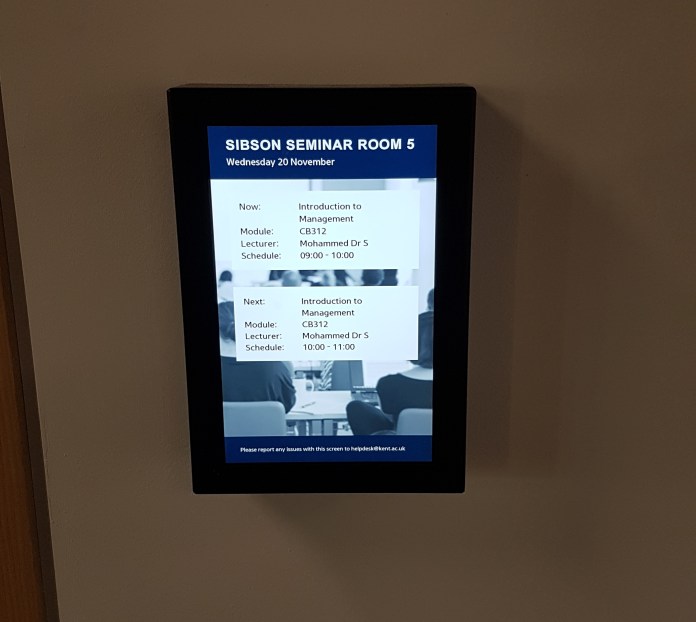
20191120_100103

For reasons that I don’t understand, seeing my name on the door makes me unreasonably happy.

An update on what I’m doing at the moment wouldn’t be complete without discussing CB312, my first year undergraduate module. My first taste of what it was going to be like to deal with this course came early in September when administrative staff got in touch to tell me that the course was oversubscribed. There were 500 enrolled and the largest lecture theatre only sat 471. What I wanted to say was that we’d never have all 500 students present, but I let myself get convinced to do two lectures, a smaller on for 30 students and the main one for the others. It’s currently Week 10 and attendance at both is around 50%. Moral of the story: trust your instincts.

It’s more work than one would think to manage such a large and ultimately unruly group of students; all of the little questions and queries add up to a lot of emails. Still, more work than them are my own anxieties and desires for control. While I’m teaching 8 of the 24 seminars seminars, on a module of this size I have to rely on seminar leaders to teach the rest. I want to instruct them on what to do but I know that I should be respecting these ambitious and indeed very bright young researchers by letting them do their own thing and figure out their own ways of teaching, but my obsessive tendency to want things to be a particular way has proved to be a lot to constrain and I’m constantly trying to make what I say to them sound more like advice and less like instructions – difficult given that all that I want to do is give instructions.

Fortunately, I can still give instructions in my classroom. I often reflect that my classroom is one of the few places where I belong by default, where my rules are the correct modes of conduct, my interests justified by my curriculum, and my prejudices are legitimated throughout the marking criteria. The problem with first year undergraduates, of course, is that they don’t have enough of a sense of what they’re supposed to be doing in order to listen to instructions. Indeed, few things in academia make one more cynical than having to deal with first year undergraduates.

A few weeks ago, CB312 sat a formative exam consisting of one of three fairly basic essay questions. The number of dead family members, sudden cases of diarrhoea, period pains, generic illness, broken alarm apps, pets in distress, and other excuses that I’ve had to deal with over the was mind boggling. It’s difficult to not become cynical (as many colleagues do) and to see them all as individual people with legitimate problems and needs. What I find particularly difficult, of course, is when they inevitably ask me whether they can sit the exam at a different time or place and I have to say no. This hurts not just because I have to be the “bad guy” and fall back on a bureaucratic impersonality that is unconcerned for their difficulties, but because the Module Guide explicitly says:

Please note that if you miss your allocated test time for any reason you will be marked as absent and receive a grade of zero for this assessment. You will not be able to sit the test at any other time or place.

There are instructions there. Why can’t they just read them?

Actually marking these essays has been equally disheartening. There is a corporeality to marking that is unacknowledged. My neck and shoulders are sore because of the way that I tend to hunch over the student’s essay paper and my jaw hurts from the way that I grind my teeth when I’m under stress. Most concerningly, I gave a series of instructions – or rather a list of things that I expected every essay to include. The number of students who didn’t pay attention to these directives, or read them and ignored them, or couldn’t do them, is an inducement to the most acute form of despairing. Every 2:2 that I’ve given out so far has been accompanied by a comment which tried to hide my sadness that I gave a list of requirements (e.g. has a definition, is able to discuss the key principles of the topic, contains a discussion of a case study example) that the essay was not able to include.

Such are, I think simply the burdens of teaching a course like this. I love my classroom and it is unquestionably where I belong but delivering the big lecture is psychologically draining in ways that are difficult to articulate. Something about the knowledge that any slip-up, any misremembered detail, any ambiguity will be memorized and reproduced on a final year exam creates an ineffable air of pressure. I can’t say that I won’t be glad when it’s over, but I am indeed looking forward to my much more relaxed final-year undergraduate course next semester.


Things that aren’t reading

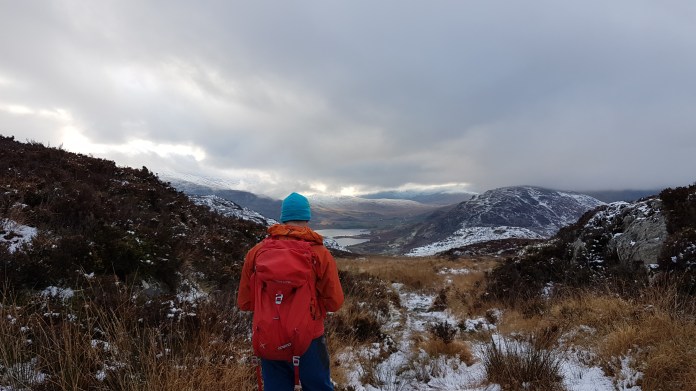
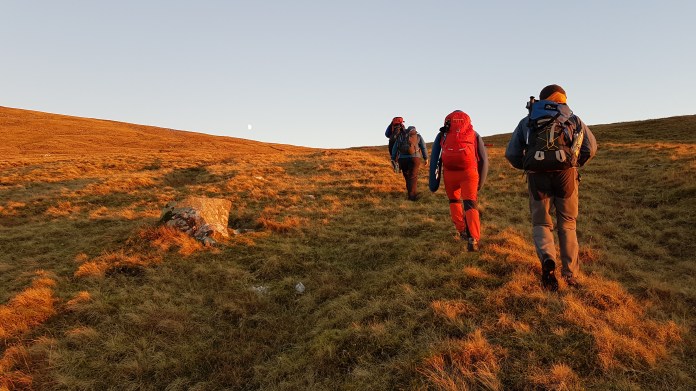
I’ve continued to go out with the IMC and a couple of weeks ago we went out to Snowdonia for a training/assessment weekend.
20191109_144623

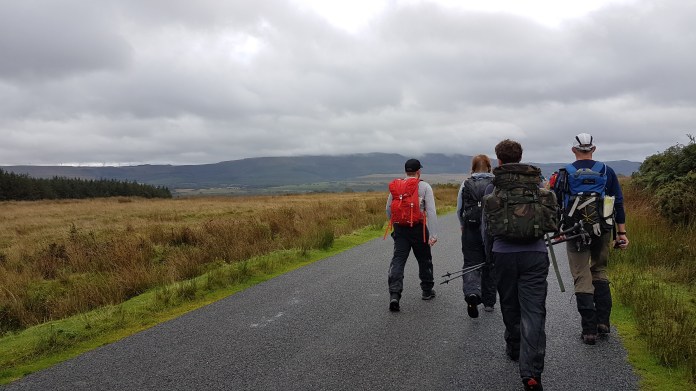
November 2019: Training with the IMC near Llyn y Coryn.

I reflect on how guilty I used to feel about taking “time off” from work (even weekends) in order to hike or practice with my band in what is perhaps the most troubling reflection of how overwork gets legitimated in the academic community. The guilt of not reading is informed by the fear that someone in the room tomorrow will be cleverer than you are, having read more books, thought more about a given social or political problem and so on, and I’ve never been able to get over it. However, a combination of factors – not the least of which is me getting too old to give a shit – have meant that I don’t worry about that as much any more and I’m all too happy to spend the weekend wandering around the hills and continuing to develop my topographical understanding.

Hiking.jpg

Photo Credit: Neil Pickford

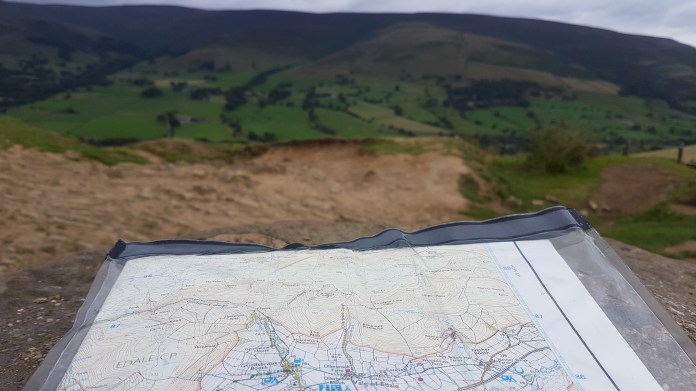
Special thanks to Neil Pickford who seems all too willing to continue to take impressive pictures of me staring at maps.


Time in my office

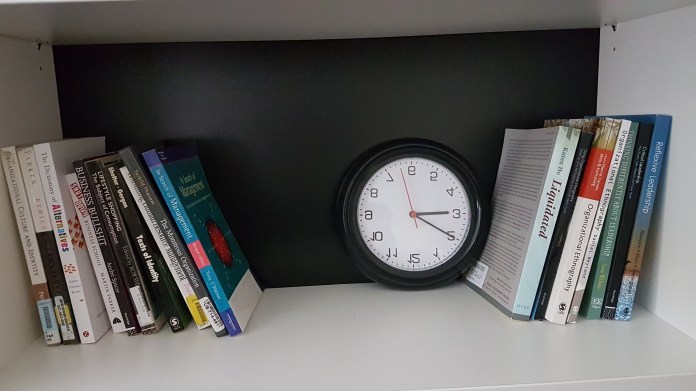
I finally achieved a long standing dream of mine of having an upside-down backwards clock. There are now two ticking clocks in my office and I refuse to syncronize them, their mildly off-time (ha) ticking reminds me of a heartbeat and I pretend that the Dark Lady of the sonnets has pulled me into her bosom and I am listening to the tumultuous beating of her heart – some kind of primal rhythm beyond understanding or comprehension. This is a small and at least vaguely absurd thing to be passionate about, but I don’t care. Look at how cool my clock is.
20191107_151103

Look at this clock.

I spend a lot of time in my office at the present. Reading, writing, marking papers, responding the emails, filling out forms, and so on – all of the things that constitute an academic job but there never seems to be enough time to do all of the things that I want to and there’s always another book to read. Still, since time is upside down and backwards, it means that everything is ok.
Standard
Reflections

Hiking and Cartography

I have been getting back into hiking. I never really fell out of love with it, but didn’t get much time to do it while I was doing my PhD.

20190830_091536.jpg

My trusty battered map-case on Hollins Cross – August 2019.

Recently, however, I’ve had great weekends in the Peak District, Snowdonia, and the Brecon Beacons with transport and company supplied by the IMC. Indeed, though I don’t usually celebrate birthdays, I spent my 30th on the top of Kinder Scout, with a book and a hip-flask of Lagavulin. It was the happiest that I’ve been in some time. Being alone on a mountain with no one around for several kilometres, fits into a perverse fantasy that I have of myself as retiring to be a “wise man on a mountain top”, who people come to ask what the secret of happiness is, to which I respond with by quipping “the secret of happiness is when people leave you alone on your mountain…”


20181117_161208

Hiking near Drosgl with the IMC – November 2018.

I’ve also been working on my micro-navigation skills, and have forgotten how much detail of a landscape one can elaborate out of the cartographic lines on a map. I enjoy staring at maps more than I used to (thanks to Neil Pickford for what is now one of my favourite photos of myself: me staring at a map). A small bump in a contour line on a 1:25000 map is a dip in the side of the mountain that confirms direction – the corner of a fence line a way to recognize a bearing. The map-world-eye interface is something that I regard with increasing curiosity, not just because it is a thing that I enjoy in which I lack expertise, but also because it is breathtaking in its nuance and complexity; an exercise in of lineological divination. Rather than reading a world that is already there, the map-eye-world assembly is continuously birthing itself; terrain and endless undulating gradients constituted from the significations of lines.

20190928_141752

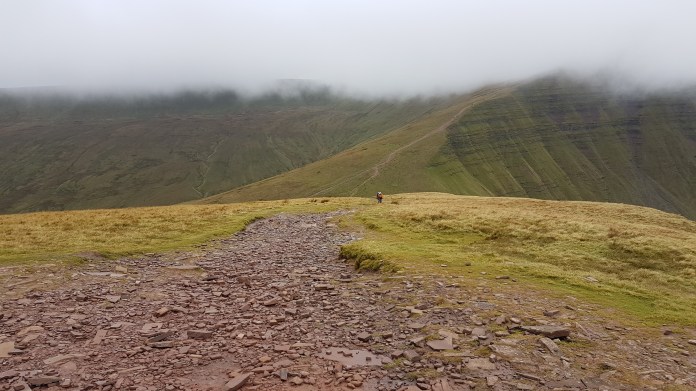
Pen-y-fan seen from Cribyn – September, 2019.

Predictably (or at least thematically given the nature of this research log) this made me reflect on some of Deleuze and Guattari’s commentary on cartography. At several points in A Thousand Plateaus they make reference to works of classic psychoanalysis and comment that Melanie Klein or Freud himself lacked a full understanding of cartography but perhaps the most fruitful way to understand the importance of the cartographic to Deleuze and Guattari is to consider their commentary on the educator Fernand Deligny. They say the following:

Fernand Deligny transcribes the lines and paths of autistic children by means of maps: he carefully distinguishes “lines of drift” and “customary lines.” This does not only apply to walking; he also makes maps of perceptions and maps of gestures (cooking or collecting wood) showing customary gestures and gestures of drift. The same goes for language, if it is present. Deligny opened his lines of writing to life lines. The lines are constantly crossing, intersecting for a moment, following one another. A line of drift intersects a customary line, and at that point the child does something not quite belonging to either one: he or she finds something he or she lost— what happened?—or jumps and claps his or her hands, a slight and rapid movement—and that gesture in turn emits several lines.’ In short, there is a line of flight, which is already complex since it has singularities; and there a customary or molar line with segments; and between the two (?), there is a molecular line with quanta that cause it to tip to one side or the other. As Deligny says, it should be borne in mind that these lines mean nothing. It is an affair of cartography. (A Thousand Plateaus. p.222-223)


Thinking about lines, cartography, and schizoanalysis, is of course nothing new (indeed, I’m currently excited to see what Barbara Glowczewski’s new book is going to say in this regard). Even I went through a period of being almost obsessively interested in lines and what Tim Ingold calls “lineology“. Here the question of the line returns as that of  trajectory, movement, and life. A life composed of and by lines, trajectories, vectors, and various moving offshoots. This, we note is a radically different way to how most of us will think about questions of who we are. Most of us imagine ourselves to be stable things that change little over time, points on a complex social map (to dredge up a dated image from the sociology of Peter Berger) that intersects with various identities and demographics.

20190829_185649

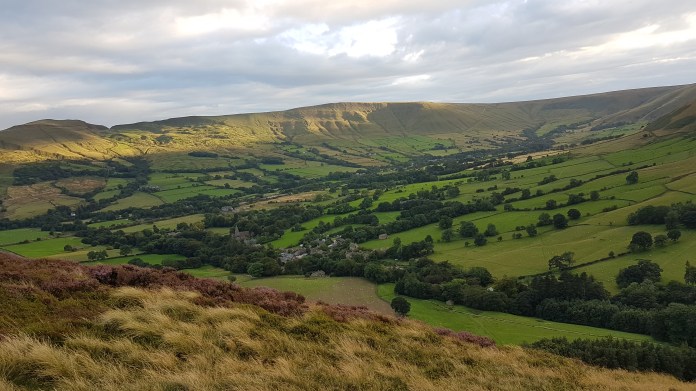
Edale seen from near Ringing Roger – August 2019.

Thinking through the logic of lines, life is not understood as a static thing, something with a truth, or an identity to be defined, discovered, or connected to a place, a people, or a collective. It is a line shooting through time, “constantly crossing, intersecting for a moment,” running across various gradients and through various spaces. Deleuze and Guattari thus ask: “What are your lines? What map are you in the process of making or rearranging? […] Which lines are you severing, and which are you extending or resuming?” (A Thousand Plateaus, p.203), in other words, what are you becoming? They are asking a question about what your life will have looked like, once all of the trajectories, connections, criss-crossings and revolutions have been made known, inscribed on a diagram like Deligny’s that showcases how lines come alive.

20190929_134339

Walking with the IMC on the way back from Sqwd yr Elra – September, 2019.

I view this with fascination in the most banal sense whenever I view my Google Timeline which will often chart my movements between home, scout meetings, The University, and Sainsbury’s, carving a blunt trajectory of my moving around.  I would love to see a system that accurately does this while I am hiking, mapping out the criss-crossings as I move over different footpaths, contour lines, and landmarks in a curious mirroring of the different subjects, ideas, and lines of thought through which I pass as I get older, “my lines” involved in more and more messy criss-crossings with those of the other people in my life.


This entanglement/disentanglement interests me for obvious reasons; not the least of which are existential. A community that you leave behind and never interact with is an entanglement which one’s life radically tangents from, a romantic tryst over the summer is a brief convergence or period of time in which you run in parallel followed by a spiralling and jettisoning. A vocation becomes a predictable series of knots and tangles that are familiar to others, a series of knowable notches that can be read like a map. What mad patterns would we end up scrawling out if we could diagram our lines. There is almost a poetry to this kind of lineology, one that we’ve yet to be able to fully find in words.

Standard
Notes from the Conference Circuit, Reflections

Notes from the Conference Circuit 2019: Capitalistic perspectivism

One of my favourite ideas comes from the work of Brazillian anthropologist Eduardo Viveiros de Castro: Cosmological Perspectivism. Based on his ethnographic work, Viveiros de Castro recounts the creation mythologies of Amerindian peoples which suggest that there was a time when the earth contained only people, and that through various adventures, misadventures and encounters, these people were transformed into the flora and fauna that we know today. The quote that I love which explains this comes from a 1998 paper, Cosmological Deixis and Amerindian Perspectivism, but appears in different forms throughout his body of work:

“being people in their own sphere, non-humans see things as ‘people’ do. But the things that they see are different: what to us is blood, is maize beer to the jaguar; what to the souls of the dead is a rotting corpse, to us is soaking manioc; what we see as a muddy waterhole, the tapirs see as a great ceremonial house” (p.477-478)

The core idea that is being communicated here, the one that fascinates me the more that I think about it, is an absolute metaphysical relativism that challenges us to reflect that other human and non-human beings do not see the world as we do, that ‘experience’ is itself heterogenous, tout court, and the world understood thus becomes not a place of unstable signifiers but of unstable referents, one that has only difference at every level. That another being  may look at the very same thing that ‘I’ see, and see something radically different is best understood, as Latour describes it, a bomb thrown into a Western metaphysics with the potential to upend the ways in which we think about the social milieu in general and ethnographic encounters in particular.

20190708_073026.jpg

Penny and I enjoying Royal Holloway’s beautiful campus at the Deleuze Studies Conference

I’ve written about this before on this blog and I bring it up again, because while at this years conferences I became interested in a particular and perhaps related question, namely, “How does capitalism see the world?” My paper at EGOS was at least partially about the ways in which capitalist axiomatization is complicit in the production of a perverted desire for annihilation and one audience member was, to use his term, “embarrassed” by the way in which I tend to speak of speak of “capital” as a having a coherent existence, desires, logics and so on. If I reflect on this tendency to speak sloganistically (e.g. “Capital places no extra-monetary value on human life,”) I might tease out a tendency in Deleuze and Guattari – following Marx – to do the same (indeed, other Deleuze scholars do the same thing) but more pointedly, while I might acknowledge that capital has different flows, fluxes, counterflows, resistances, schisms, and bifurcations, I genuinely ask any reader to think of the last time that they did something that was not in the service of a firm’s agenda of profit maximization. When was the last time that you acted against the best interests of capital? The absolute heterogeneity of our experiences starts to look quite perversely the same when we think about it as all being in the service of capitalist revenue maximization. Indeed, the difficulty that we all experience in answering such a question should give us pause to reflect that every potential act of rebellion, creative thought, radical offshoot and so on, creates a new market that is (with the appropriate time lag) eventually capitalized upon, everything is eventually subordinated to profitability. If this is the case, how can we ever speak of individual subjects or agentic action, given that supposedly free agents will never exercise any radical freedom, only ever serving the interests of capital to greater or lesser extents.

20190629_072009

Studiously making notes. Penny judges my handwriting far too harshly.

As such, I have what I think is a perspectival thought. What is it like to be capital? Capital does not perceive the same reality that humans do. Capital looks at an ecological crisis that involves a warming planet, acidified oceans, drought, wildfires, more powerful hurricanes, and rising oceans and sees opportunity to maximize profits by responding to a new demand for sustainable businesses or products. What to us is a public health crisis of drug use and addiction, capital sees an opportunity to make profits by at once expanding the pharmaceutical industry in order to sell the drugs and also own the prisons and rehabilitation centres where people are sent for punishment/treatment. Where we see an expression of acceptance and love by those who have not been accepted, those whose love was once outlawed by the state, capital sees an opportunity to maximize profits by cornering the LGBTQ+ market through participation in Pride. 

What is it like to be capital? It is to be the Great Optimist, always hopefully watching out for a new opportunity. It is to see the world only in terms of possibilities for multiplication, for connection, for proliferation, to grow infinitely. Capital exists with a purely virtual ontology, a numerico-techno-potentiality, it can become any thing and has a passport to go anywhere. As the condition of axiomatization, facilitating unequal exchange, capital is itself never axiomatized. It is a flow endlessly, circum- and extraplanetary. Whereas a traditional Western metaphysic might tell us that humans see humans as humans, animals see animals as animals, and capital sees capital as capital, Capitalistic Perspectivism suggests to us that capital sees humans, animals, and capital as opportunity – as resources that can be used in order to generate more capital. Capital sees the world only in terms of possibilities for multiplication, for connection, for proliferation. Capital is in this sense the great equalizer. Its perspectivalism means that it does not see humans in the sociopolitical contexts that other humans do. Rather, it sees them as resources that it uses to further its own growth and proliferation. Capital does not care if humans are whie, black, or brown. If they are abled or disabled. If they are LGBTQ+ or straight. If they are human or non-human Indeed, capital does not even ask if they are alive or dead as both are equally resources for capital’s growth and expansion. Capital’s only question is “How can I continue to grow?” or “What assembly’s of resources will allow me to grow the most?”The ethics of capital is thus Spinozist, asking what combinations will healthily increase my body, what will decrease or harm it and since capital overs over all things, these ethics are purely immanent.

Understood in this way, the operations of the contemporary social fabric make more sense. Capital only ever sees one thing, potential for growth. That is it. Capital cares about nothing other than its own survival and in expanded size there is less of a possibility of diminution and disappearance. It is this naked and comically exaggerated self-interest that I think Hietanen et al (2019) are talking about when they talk about the capitalized subject or the “one who has completely embodied capitalism’s monstrous desire of indefinite accumulation (‘I am productivity itself!’). […] all possible subjectivation is replaced by the desire of capital itself.” While the term itself is becoming increasingly passé, this is what it means to be a good “entrepreneurial, neoliberal subject”, to be one with capital. To want what it wants. To see only from its perspective. And who among us does not?


Standard
Notes from the Conference Circuit

Notes from the Conference Circuit: Desire and Breakfast

In L’Abécédaire de Gilles Deleuze, Claire Parnet presses Deleuze to explain his and Guattari’s concept of desire; challenging him to explain it in clearer terms. He says “you don’t desire someone or something, you always desire an aggregate. It’s not complicated.” This formulation of desiring-production has always stuck with me and I often think about it in the course of everyday life. Desire is not about lacking or wanting an object or a person, desire desires an assemblage. I had cause to reflect on this when I was in Edinburgh for EGOS and got sick of eating breakfast at the hotel. Having had to travel more than I’d have liked to over the past few weeks, I was quite literally fed up with eating Premier Inn buffet breakfasts and wanted something better.

20190707_083417.jpg

Pictures with Penny near the outside of the Quick and Plenty Cafe.

I chose the Quick and Plenty cafe, precisely because it looked like a tiny hole in the wall on Google Maps. It was the best breakfast that I’ve had in a long time. I couldn’t have made it better myself (which anyone who knows my fondness for things done my way would know is high praise). Friends will know that I like simple food done competently, which is precisely what this was. I reflect that I enjoyed the meal, because I didn’t just desire an “authentic” Scottish breakfast (or some hyperreal simulacra in construction of authenticity) and I didn’t just want to get out of the hotel. It was the assemblage that was important. The desire was for sitting somewhere with dingy yellow lighting, on a cushion that had become so worn from use that it had to be covered over by a blanket which itself looked to be as old as I am. The desire was to order a Scottish breakfast off of a speckled, laminated menu while staring at the tangle of power cables and wires that was supporting their payment/online order/music system. The desire was to come in out of the light Scottish drizzle and feel awash with the warmth of a running stove. The desire was for watching the chef cook my breakfast in cheap looking pans on a small kitchen hob while bantering with his assistant in a thick Scottish accent, occasionally taking a phone call in which he would yell at someone (perhaps a mother, wife, or a girlfriend) that he was too busy to talk and needed to be left alone. The desire was for listening to the great care that he had for the food and to speak to him in exceptional detail about the long-standing local bakery that the rolls came from or the history of the company from which he sourced the haggis. The desire was for the glass-eyed sterility of the polished customer service interaction in my hotel to be completely upended by a space dominated by a kind of professional-unprofessional, an intermingling of diligent, conscientious care and that special kind of not giving a shit that is an artefact of Scottish dourness. This disconnect from a multinational semiocapitalist machine and reconnect to a smaller capitalist machine, one not yet alienated from itself, is a key part of this assemblage and its remobilization of consumer/tourist discourses. The desire was for reflecting on all of this while drinking instant coffee and thinking about how desire was being machined in that moment. I did not know how much I needed the food until it arrived, served in a rambunctious and unpretentious space. But this “I” invites further consideration.


20190703_212315.jpg

Definitely not day drinking at The Bow Bar.

As Deleuze and Guattari say in Anti-Oedipus:

“Desire does not lack anything; it does not lack its object. It is, rather, the subject that is missing in desire, or desire that lacks a fixed subject; there is no fixed subject unless there is repression. Desire and its object are one and the same thing: the machine, as a machine of a machine. Desire is a machine, and the object of desire is another machine connected to it. Hence the product is something removed or deducted from the process of producing: between the act of producing and the product, something becomes detached, thus giving the vagabond, nomad subject a residuum.” (p.26)

What is important to say is not only that this desire did not pre-exist the assemblage, I did not preexist the assemblage, the subject was machined along with everything else as a by-product or residuum of the machinations of desire. Subjectivity is here not that from which desire emerges, but a residuum, a by-product made in the small pub assemblage or the used-bookshop assemblage.

20190706_172644

Edinburgh had several used bookshops that we visited because they had books and I am a simple man.

In most readings, Deleuze and Guattari’s understanding of desire is thought in a way focuses on the affirmative and the joyous connections that desire brings about. Recent work (like Culp’s Dark Deleuze) has, however, begun to popularize an alternative reading to which I am partial, the darker understandings of desire, not productive and prudent, but destructive and apocalyptic; desire tearing itself apart. Desire for annihilation, for destruction, for even death. Perhaps that’s why desire was producing a person with high cholesterol and mild liver damage…

Breakfast at Quick and Plenty was the start to the best morning that I’ve had (outside of my house) in a long time. I want to go back to Edinburgh as soon as I can, and I know where I’m having breakfast when I do.

Standard
Notes from the Conference Circuit

Notes from the Conference Circuit: Is well ethical, innit bro?

Perhaps one of  the hardest things in the world to accept is that other people might consider the same information as we do and arrive at different conclusions. Most of us are so sure of the efficacy of our thought processes that it may not ever occur to us that they may be flawed or problematic. This is a less lucid and self-aware reflection than it seems to be, because I am here simply trying to think about how it is possible for anyone to still believe that “ethical capitalism” is possible. I have taken to openly saying to students and colleagues that “anyone who seriously believes in the possibility of a contemporary corporation acting with genuine ethical concern is either dangerously delusional or an irretrievable idiot; I don’t know which is worse.” This never fails to be a divisive comment – not only because it is very heavy-handed but also because it plays fast and loose with the term “ethics”, so I wanted to offer a clarification. Without a digression into contemporary moral philosophy (which I am not well-read enough to sustain), an “ethical capitalism” – as most would understand it – would be a form of capitalism that seeks not only the increase of private wealth but also places value on human and social well-being. This is an impossibility. Here’s Peter Bisanz writing for the World Economic Forum, which I quote at length because it is important:

“Call it what you like: conscious capitalism, responsible capitalism, ethical capitalism – the better way to practice capitalism is to move the needle towards creating long-term socio-economic and environmental value: a business model with a higher purpose, where businesses build deep, trust-based relationships with their customers, employees, suppliers, investors and society. The bottom line benefits too from this kind of ethical, values-driven capitalism. Businesses adopting this model attract more customers, reduce operating costs through energy efficiency and lower waste, boost employee loyalty and enjoy engaged workforces that share the corporate vision, aspirations and goals.”

The paradox here should be obvious but isn’t is this is a popular refrain within many academic circles – “being ethical is profitable”. The logic of wanting a business model with “a higher purpose” and wanting a business to continue to maximize the benefits to their bottom line is never considered as mutually contradictory or fundamentally in conflict. The axioms of contemporary capitalism – perpetual growth, assimilation of paradox, market sovereignty and so on – make it impossible to even conceptualize a reality wherein a business may have to make a loss to serve a higher purpose (as an aside, this is why I’ve been so fascinated by the reaction to Jeremy Hunt’s comments about a no-deal Brexit, precisely because they break this taboo and blaspheme against the market). In this sense capitalism has an “ethic”: accumulation. Capital seeks only to grow, through whatever combinations and conjunctions it can make.

20190703_153602.jpg

On the train to Edinburgh

I read about my new favourite examples of this on the train to EGOS in Edinburgh. Here’s Bloomberg’s Peter Robinson reporting on the Boeing 737 debacle:

“The Max software — plagued by issues that could keep the planes grounded months longer after U.S. regulators this week revealed a new flaw — was developed at a time Boeing was laying off experienced engineers and pressing suppliers to cut costs.”

What recent reporting has brought to light is that increasingly, the iconic American plane-maker and its subcontractors have relied on temporary workers making as little as $9 an hour to develop and test software, often from countries lacking a deep background in aerospace development. While the entire story of the 737’s development, reads like an attempt to prove that only economic interests, as they pertain to wealth accumulation, are represented in decision making, it is this outsourcing – the kind of story that seems too moronic not to be true – that highlights what happens when the profit motive clashes with any other concern (in this case valuing human life). Profitability wins, every time. This case doesn’t really tell us anything about the blood-soaked calculus of economic rationality that the Ford Pinto case didn’t tell us in the 1970’s; laying off your experienced software engineers, and outsourcing their work to a cheaper organization in the global South and possibly directly contributing to the deaths of hundreds of people, was very likely the most profitable option, even considering the $100m payout that is supposed to go to the families of the 346 people killed by the 737 crashes. Yet one can go to Boeing’s websites and read about their social responsibility policies and how much they invest in “communities”. And if I asked my undergraduate management students, “Is Boeing an ethical company?” it is from this very page that they would quote in order to tell me that it is.

Yet, since the 1990’s, public intellectuals like Noam Chomsky have been commenting on the ways that companies like Boeing are gaming the system and using military investment to further their interests. We have long known that companies like these represent a perfection of the capitalist logic of perfidious accumulation, using any means necessary to grow and agglomerate wealth, while an entire social and political apparatus convinces us that this is merely the disembodied will of “the market”. Here “management” as a practice is itself unveiled as entangled – the decision taken on a microlevel to cut costs through layoffs and outsourcing is inextricable from the regarding of “the market” as sovereign and the profit motive as the only true and legitimate impetus to action – producing the predictable effect of people dying. This is to say nothing of the fact that we know how damaging flying is to the environment, meaning that Boeing’s profitability as a company fundamentally relies on us continuing to disregard the dangers of anthropogenic climate change.

I imagine that defenders of capitalism would say that its current predicament is the price that Boeing pays for not acting “towards creating long-term socio-economic and environmental value”. Yet we have to ask which of the axioms of capitalism Boeing is in breach of here? Is the shift in employment relations towards precarity and temporary working as evidenced by the much praised gig-economy not symptomatic of precisely the decision to seek out cheaper labour internationally? When we collectively know that we need to recycle to keep plastic out of our oceans but multiple journalistic exposes tell us that often plastic now goes unrecycled (destined for landfills or incinerators) because there’s no demand for recycling “due to poor market conditions” is this not the same logic of economic valuation privileged over everything else?

20190707_175949.jpg

Getting reading to present a paper or desire, death, capitalism and the Anthropocene

I thought about this while attending a stream on Critical Organizational Anthropocene Studies. As I heard about the very ethical and environmental things that different organizations were doing, I thought about the character Waj, from Chris Morris’s incredible film Four Lions. Waj is characterized as a well-meaning but simple man whose defining character trait is perhaps that he consistently defers decision making (and thus ethical responsibility) to his presumably more ethical and intelligent friends. The deferral of ethical judgement to an other, allowing for a reality in which one could do or condone the doing of potentially horrible things is encapsulated in what I might stylize as a refrain of the question: “Is well ethical, innit bro?”. Perhaps it evidences that I have watched the film too many times but I can hear actor Kayvan Novak saying it in Waj’s accent and could hear it at times during colleagues’ presentations at EGOS.

Indeed, though I was participating in a stream on “Critical Organizational Anthropocene Studies” not many of the presentations treated seriously the question of what a “critical” study of organizational responses to the Anthropocene might be. Many of the presentations had a hopeful tenor, or one that we might recognize as a kind of business-as-usual for capitalism – turning any form of critique or revolutionary action into something in the service of its own end – and could thus be read as complicit in mobilizing environmentalism as a vehicle by which to “save” and preserve the mores of capitalism itself. Here’s a company in the circular economy that’s recycling concrete or turning fish scales into bioplastics, or here’s one that is taking seriously the “slow food” movement and building up a community concerned with sustainable, local, everyday practices, or here’s a co-operative volunteering to sort and recycle other people’s waste, or here are some people in the global-South involved in a recycling cooperative. Is well ethical, innit bro? I at times found myself envying the optimism of my colleagues – as well as admiring their passion for their work – but I find myself to be too cynical to be hopeful that these kinds of engagements as they seek to preserve the essential logics of capitalism by merely wrapping them in a “green” casing. Indeed, in the cruellest reading these organizations and their ethical/sustainable/circular economy moves merely function to  allow capitalism to continue. But one can’t observe this, it’s too bleak, too uncomfortable a thought because of how roughly it grates against our fondness for the world that capitalism has built for us and how much it jars with the accepted mores of neoliberal subjectivity. “By trying to help you and champion those who you see as trying to bring about a better way, you may be making things worse; the main thing that you’re doing is making yourself feel better. There is nothing else that you can do.” I have to keep thinking about this, not just because it’s important but because it speaks to one of the defining features of contemporary capitalism, the assimilation of critique or its absolute reliance upon those who hate it.

20190706_153250.jpg

Enjoying the view from near Arthur’s Seat

What troubles me is that these kinds of arguments have been around for a while. Based on a decade long case study Wright and Nyberg’s (2016) An Inconvenient Truth: How Organizations Translate Climate Change into Business as Usual basically points out all of the same critiques that I might. That organizations’ short-term focus, focus and preoccupation with growth and revenue maximization make them ill-equipped to lead the fight against climate change. Most often we see organizations viewing the Anthropocene as an opportunity, seeking to profiteer off of it by providing the next new “sustainable” innovation. This was clearly put across by Andrew Hoffman in the context of a sub-plenary discussion on the Anthropocene when he said simply: “this is a great opportunity.” It was not immediately clear whether he meant that it was a great opportunity to further one’s academic career by publishing on the newest fad or whether he meant that it was a great opportunity for businesses to capitalize on a fast growing and profitable new sector but he later clarified by saying (overtly seeking to contradict Naomi Klein), and I quote:


The market is the most powerful force on the planet. If business does not solve it [the problems of the Anthropocene], it will not be solved.

The only way that we’ll see change in how organizations respond to the Anthropocene, according to a leading commentator, is via the logics of the market in a kind of eco-modernist optimism (presumably a demand for there not to be an ecological crisis will eventually be matched by a supply of “not an ecological crisis” once the time-lag is over). The role of an organizational scholar is therefore supposedly to show businesses how much money they stand to make if they start taking the Anthropocene seriously. It’s hard not to hear a simple abdication of responsibility to the other of “the market”. Is well ethical, innit bro?

Standard
Notes from the Conference Circuit

Notes from the Conference Circuit: An Introduction

Over the last few weeks I’ve been attending academic conferences. While never the easiest thing to do and not entirely unproblematic, conferences are a core part of being an academic as they allow you to catch up with colleagues (who are really the only other people who understand what the hell it is that you do) and get a handle on what research is going on in the field – a sneak peak of what will end up being published in the next few years. It’s also a great way to “network” and get a reputation for doing a particular kind of work, which if your colleagues value, they’ll consistently come to you for.

20190627_161822

Watching presentations at ICMS 2019 in Milton Keynes

I had a lot to think about at this year’s conferences and so I’m going to put my notes from them into a series of articles/essays here which I’m titling Notes from the Conference Circuit. I fully intend to populate these notes with my usual array of pictures of a Penumbra the travelling wolf because, as this research log has likely already established, I’m most likely an idiot (and I perhaps mean this only slightly in the Socratic sense).

The notion of “circuits” appeals to me as the word connotes going around, undertaking a circular journey, and finding your way home the long way ’round, all of which reflects something fundamental to the logic of conferences. Revolutionary. We go somewhere “exotic” and then spend most of our time in a hotel or university building that looks almost indistinguishable from the one that we just left, we spend time with the same group of friends that we regularly correspond with, and present our work to a hungover audience who can’t follow what we’re trying to say because we’re saying it too fast, and sketching in strokes that are too broad to stand up to scrutiny. However, conferences remain the best places to pick up the random off-shoot, the snippet or fragment of an idea that turns into something substantial a few years down the line. Most likely it will be something that you already knew or were thinking about, but you needed to hear it phrased differently, of come from a different source. You had to go around a long way to come back to where you were.

Standard
Reflections

Reflections on the Management Identity in Film

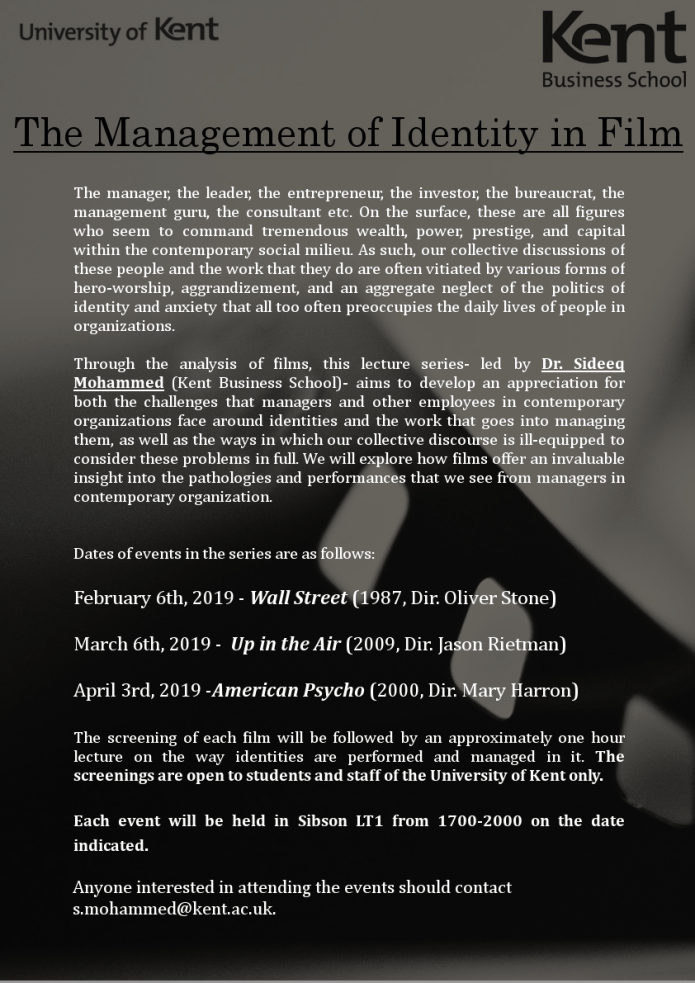
Over the last term I ran a series of film screenings for students on my final year undergraduate module. Contemporary Management Challenges, as it is called, was basically an introduction to Critical Management Studies, showcasing important concepts via which students might think about organizations and their operations, the main one being “identity”. I ran the film screenings as a way to both help the students get immersed in the module’s content and think about identity in a more relatable way, and to make myself more accessible to them.Management of Identity in Film poster.png

We looked at three films: Wall Street, Up in the Air, American Psycho and after each one I spoke for about an hour on what we could learn about managerial/organizational life based on the depictions of it in the film. There were some really enjoyable moments in the film series including saying the sentence “Gordon Gekko is who Kent Business School trains students to be” and seeing the penny drop for everyone in the room, or introducing students to the Bechdel test and seeing it click for many of them that these films which were “all about management and managing” either didn’t have that many speaking roles for women or that when the women spoke, they only seemed to speak to men…

In aggregate, I had a lot of fun with it and so have decided to share the slides for anyone who might want to think about these films critically. They’re not very detailed because that’s not really my style, but the captions might offer some useful provocation.

Standard
Reflections

Another year in Higher Education: Subversion, Silence, Scepticism, and Self-destruction

I haven’t really had time to update this blog over the last few months. Contemporary academia being what it is means that the reason for my hiatus is fairly predictable: three new modules. The first-year undergraduate, Introduction to Management module, was easy enough because I had other staff to help me manage the 450 students that I was trying to teach, and the final-year undergraduate Contemporary Management Challenges module was basically a Critical Management Studies module so I was (for once) teaching content that was close to my own work. I even spoke about Deleuze and Guattari in a few lectures which I enjoyed more than I should have. We will not speak about how my Msc Employment Relations module went because it’s over now and I still feel like I don’t know enough to teach it…

20190404_165348

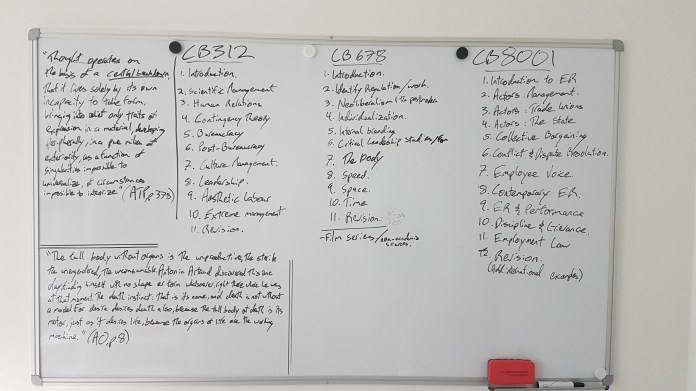
My rather crowded whiteboard.

Three modules isn’t really a huge workload; other colleagues have similar teaching responsibilities, but my research-intensive teaching style meant that I was easily working (teaching seminars, replying to emails, attending meetings, writing lectures, reading and annotating papers for classes, marking assignments etc.) for 12-13 hours every day, seven days a week, since the start of 2019. I am well aware that that is both absurd and double the number of hours that I get paid to work. Now that it’s over, I wanted to take some time to reflect on the experience. I picked out four themes that I think characterize the last few months: subversion, silence, scepticism, and self-destruction.

Subversion

In A Thousand Plateaus, Deleuze and Guattari tell us that “everything is political, but every politics is simultaneously a macropolitics and a micropolitics.” (p.213) They suggest that the politics of the state and the politics that we produce in relating to each other in the everyday are inextricably related. A fascistic state apparatus, for example, is inseparable from the ways in which we speak to, think about, and engage with each other in the course of everyday life (and vice versa). Despite this, I have never significantly invested in what might be termed “micropolitical acts of resistance”. The term is currently popular in Organization Studies and speaks to little things that we might do in the course of everyday life to disrupt, disorder, or destroy systems of control, discipline, and organization. For example, cause trouble by screwing up a performance appraisal form (and wasting organizational time in the process) that you don’t think that you should have to fill in because the contemporary obsession with maximizing performance is toxic and dangerous. There are many better explanations and examples of this because it fills organizational scholars with some odd sense of hope to know that while we they might not be able to effect large scale change in organizations, they can encourage, highlight, and give a platform to small acts of resistance. I am unsurprisingly cynical about this, not because micropolitical acts do not effect change (because they might do so eventually) but because I believe in earnest that hope for change is a dangerous self-delusion that blunts our ability to think critically. To put it in the pithiest way possible: “my friend, hope is a prison”.

I have, however, been involved in a micropolitical subversion of a kind on my final year module. The module is set up to have an assessed group presentation for 20% of the overall grade and for complex institutional and political reasons within the school, I can’t change that. As no one will be surprised to learn of a person who swears by the statement “if you want something done right, you have to do it yourself,” I greatly disliked group projects as a student. As an educator, I absolutely loathe them, not just for the predictable reason of resenting having to deal with the emotional labour that accompanies groupwork drama (e.g. students complaining that a member of their group has been missing meetings/not contributing equally, bickering, a group that gets stuck with the one student who has been missing lectures and so on), and not even for the ideological reason of finding business interference in the university to be morally problematic (groupwork falls into a category of things that the Business School does because it wants to give students “transferable job skills” or enhance “employability”). No, my objection is that they are not pedagogically useful, or perhaps not as useful as other methods, as students don’t learn skills that I think are important. I value mastery of a body of academic literature, critical or radically subversive thinking, extensive independent reading, and a group presentation doesn’t facilitate this. To be sure, students might learn about teamworking and interpersonal skills but a) if my life is in any way indicative, such skills are largely optional and b) me trying to impart or facilitate the development of such skills is the best example of the blind leading the blind that I can think of.

So here’s what I ended up doing: I tasked the groups to give a largely token 10 minute presentation that showcased a basic understanding of the topic and then made them sit down and earn the rest of their marks by leading a discussion of an academic journal article during which I kept interrupting, asking questions, requesting clarification, offering provocation, providing context that I didn’t think that it would be reasonable to expect them to know and so on. While I originally intended these “presentations” to be discussions that involved the entire class, in practice the sessions quickly devolved or evolved into the presenters having a four-on-one discussion with me about the paper that they’d chosen to present. A firing squad analogy would not be inappropriate, though I tried to keep things more pedagogical and collegiate. A close textual analysis of the kind that the “presentation” was designed to encourage has become all too rare in certain parts of the contemporary university, particularly the Business School, where we are often content to read the abstract, findings and conclusion of a paper to get the gist of it so that we can cite it. Indeed, many of us are content to look at no more than the paper’s the key words so that we can correctly drop it tactically into a paragraph of circle-jerking and tactical referencing. I wanted my students to be capable of more than that.

Reflecting on the sessions, many of the students rose to the challenge and held their own. I was genuinely impressed that some of them were able to not only answer my questions, but fire back interesting questions of their own. While I confess that the weaker students struggled and if a group didn’t have at least one strong student who could carry the conversation, then the hour was quite painful, but through all of this I realized that I could subvert the mores of assessment at the school because presentations aren’t subject to moderation. I gave grades based on what I thought was valuable, not what was on someone else’s marking criteria. The student’s seemed to enjoy it and valued that I clearly and honestly told them what I wanted. Reflecting on the past few months, there are many such small subversions that I am tempted to be proud of, even if they fair to challenge the conditions of the contemporary university.

Silence

The most stark juxtaposition that I experienced in the last few months has, of course been lecturing to a room of perhaps 250 students (it should be 450, but you can’t make people attend lectures) on a Monday afternoon and then spending all day Tuesday in silence because I didn’t have any classes. This was also possible because I moved to a different building this year which meant that I rarely saw anyone from my department. This juxtaposition reached its peak in my working week on a Thursday where I would have to teach Introduction to Management seminars, then have to go to my two hour Employment Relations lecture, then had to do two hours on Contemporary Management Challenges all before going to my Scout meeting where I somehow managed to volunteer to take lead on the Astronomy and Astronautics badges this term (50+ loud pre-teens are as much of a challenge as 250 undergraduates). It might not seem like much, but for me it was a lot of talking, juxtaposed against the fact that I’d then spend Friday to Sunday in silence, mostly reading and trying to prepare for the next week’s worth of lectures, without time to do much else. I ended up getting into a routine of doing vocal exercises on Monday mornings to make sure that my voice didn’t have that raspy quality of disuse for the first classes of the new week.

Particularly in January, once I got into the classroom it was almost as though I was trying to make up for the silences by filling every second with speaking. I recognize in retrospect that this was an artifacting of my own insecurity – me trying to make sure that I covered all of the content so that students would be able to do well on their exams. As the term wore on, I became more comfortable with the silences in the lecture theatre and was able to pause and think or let a point sit for a while so that it could have impact. This didn’t make the silences in my office any less of a juxtaposition, it just meant that I got used to all of them.

Scepticism

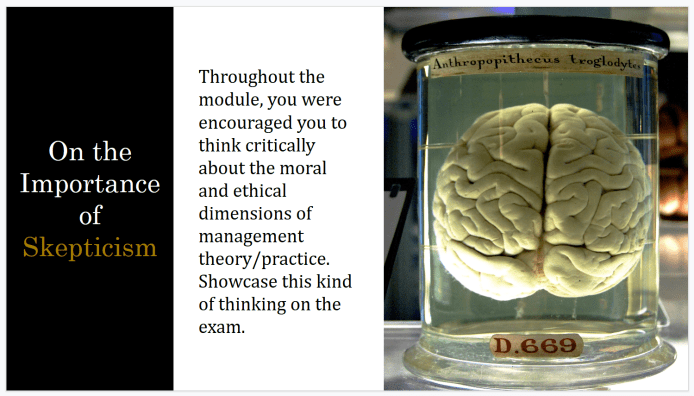
“This is where we like to talk about brain usage.” This humorous refrain became a core part of my pedagogic practice on my Introduction to Management course. I know that it’s patronizing and frankly derogatory to all of the other modules that students on that course are taking (because it implies that they aren’t using or don’t have to use their brains elsewhere), but to me it was important to keep saying it and much to my delight students started doing it by the end of the course.

brain usage.PNG

A real Introduction to Management lecture slide.

For me “brain usage” is one of the key things that students can learn from me, and me in particular. There are so many morally bankrupt things that are taught or thought in the contemporary Business School that just a little bit of “brain usage” might undermine. My students take courses on “Ethical Business” that tell them that they should be ethical, not because contemporary capitalism is currently doing irreparable damage to the planet or because it consistently exploits and disadvantages the most vulnerable members of our society, but because being “ethical” is profitable. My students sincerely believe that organizations view “people as their greatest asset”, even in the context of #MeToo and increasing attention to long hours culture (as in 996) or that “transformational leaders” are the sole cause of organizational success. This is the true terror of contemporary capitalism, not pollution or exploitation, in its focus on profitability-at-any-cost it quashes all other forms of value, and subordinates all reason to economic imperatives to the point the point where “reality” becomes an exaggerated fiction of itself. I like to believe that I did something to undermine that over the course of that module, but perhaps I am deluding myself.

Self-destruction

The fourth “S” that I was going to add to this entry was going to be “success” because the feedback from my students about the last term has been quite positive (i.e. at least all of my hard-work has been worth it). Indeed, I was particularly moved by one student’s comments, and I hope that they can forgive me for the hubris of reproducing them here:

I would like to take this opportunity to explain my journey on this module. Firstly, it is no coincidence that for the second year running that Sideeq’s module has been by far and away the most enjoyable/rewarding that I have experienced this year. I started the module apprehensive about the difficulty in which I went to see Sideeq with the mindset that I may be ‘out of my depth’. However, thankfully after seeing Sideeq I left with the mindset that I can do it and feel that I haven’t looked back since and for that I can’t thank Sideeq enough. I have been aware throughout the course that Sideeq’s door has been open in which I have utilised and enjoyed some in depth discussions regarding the course. I think the best compliment that I can pay Sideeq is that he is a lecturer that is clearly passionate about the courses he teaches which I feel has rubbed off on me, keeping me intrigued throughout as well as fully engaged. Whilst I come to an end of my 3rd year studies at the university and reflecting back, I can’t help but think of how different my overall university grade will be if I had access to the same standard of teaching throughout the 3 years, showing how much of credit he is to this university.

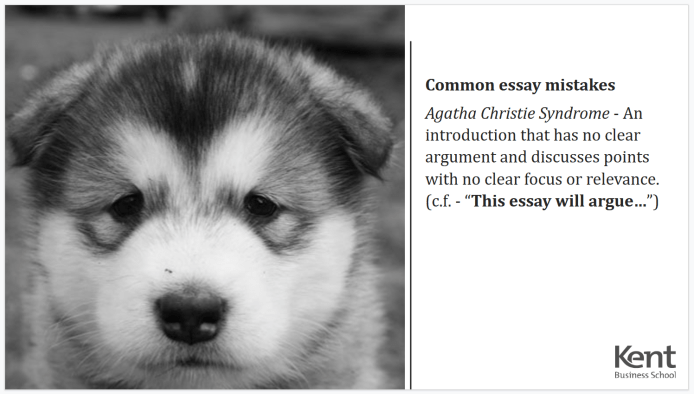
These are deeply stirring comments, and I am exceptionally grateful to the student who gave them and am very glad to have had the opportunity to make someone’s time at university better. However, I don’t quite feel successful, I feel exhausted and the “victory” here is pyrrhic. When the term ended, I spent a few days mostly lying in bed and trying to do nothing (surprising no one, I ended up reading) because I was too tired to think about doing anything else. Perhaps the last “s” should have been “Stupidity” to reflect how moronic it was to accept the job of teaching three new modules in the same semester. Indeed, the ultimate hypocrisy of the last few months has been lecturing on the way that organizations cultivate workaholic behaviours and long-hours culture while working 70-80 hours a week or speaking about the importance of having some kind of work-life balance and not allowing oneself to be amenable to corporate control while not having any work-life balance and being exactly that. If I was being charitable, however, I might suggest that“stupidity” might refer to me actually having fun on some of my modules, the following is a real slide from a lecture where I was giving essay writing advice and was accompanied by the line “Look how sad he is, that’s how your bad introductions make my heart feel,” but if stupidity is the right word then I would argue that this is a positive and healthy form of stupidity.

Real Lecture Slide

Another very real lecture slide that demonstrates that I might be an idiot.

I’m not ashamed, however, to admit that there were less positive and more self-destructive forms of stupidity at work: it took quite a scotch, sleeplessness, and nicotine to get me through the last few months. The isolation and the silence also took their own tolls that I am still trying to make sense of. A certain degree of self-destruction is perhaps also healthy, to quote Deleuze and Guattari in A Thousand Plateaus:

“What does it mean to disarticulate, to cease to be an organism? How can we convey how easy it is, and the extent to which we do it every day? And how necessary caution is, the art of dosages, since overdose is a danger. You don’t do it with a sledgehammer, you use a very fine file. You invent self-destructions that have nothing to do with the death drive. Dismantling the organism has never meant killing yourself, but rather opening the body to connections that presuppose an entire assemblage, circuits, conjunctions, levels and thresholds, passages and distributions of intensity, and territories and deterritorializations measured with the craft of a surveyor” (p.159- 160)

I definitely destroyed too much of it over the last few months. Too much, too fast. I’d like to say that I’ve learned and that I won’t do it again, but I know myself better than that.

However, the last few months have been self-destructive in other ways. In a number of recent conversations with more established academics I’ve been given instructions to the tune of “Play the game”, “Be a good boy and don’t rock the boat”, “Toe/walk the line”, “You have to conform to expectations”, “This is just how things are, you can’t be so critical all the time”. And the last potential “S” thus becomes “shame” because to my own embarrassment I’ve actually started to heed this advice, not even in the sense of looking for opportunities to “play the game” and advance my career, consolidate my position, accrue power, etc. but often in the sense of keeping my mouth shut and not causing trouble (e.g. not mass emailing a paper critiquing accreditation-obsession to other members of staff while the school was recently obsessed with getting a prestigious accreditation). Drawing on it’s feminist legacy, I’ve always seen being a critical management scholar as being implicated in a politics of “causing trouble”, and it is curious to me that I feel the need to keep causing trouble. Perhaps, as I often do, I am overthinking this but I often think that if more people over-thought their actions, the world would be a better place.

Alas that most of us, to quote the eminent Thomas Harris, “can only learn so much and live.”

Standard
Reflections

Management Gurus at Turner Contemporary and the Call of the Void

I had one of the most amazing and surreal experiences of my adult life this week.

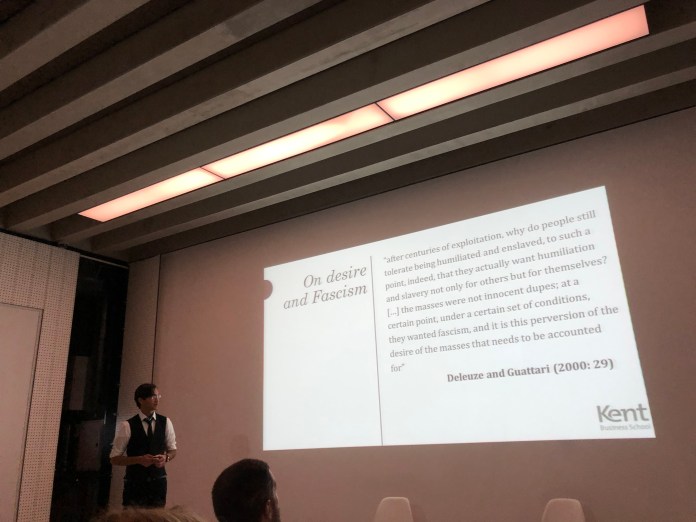
Through a set of circumstance that I can’t quite explain, I somehow volunteered/was volunteered to present my work on Deleuze and Guattari’s concept of microfascism (and how this is mobilized, preyed upon, and has a role in legitimating management gurus) to a mostly business practitioner audience at the beautiful Turner Contemporary. I’ve posted about this work before in this research log and hopefully it will be formally published soon.

IMG_0067

Presenting at Turner Contemporary – Photo Credit: Felicity Heathcote Marcz

The full presentation is available here. It conflates terms like guru, consultant, and over-includes or over-reads the history of management ideas (and various fads and fashions which have come and gone) around “involvement” but I think it worked for the audience; cultivating a scepticism towards the idea that perhaps the proposition that employees should be involved in decision making/creativity.

I don’t know how much the audience took away – and I say this not as a critique of their intelligence so much as a commentary on my inability to explain well enough. While I think that some definitely engaged with the premise of critical scepticism towards the ideas that might be sold by a management guru, I think that many in the audience balked from the first sentence: “My name is Dr. Sideeq Mohammed and I’m a critical management scholar; what that means is (among other things) that I have no interest in making your organizations more profitable, efficient, creative, innovative, or productive.” I think that that definitely got their attention. I may also have described myself as a “professional rain-cloud” during the Q&A – I think that that was imprudent but I’m not sure why.

The truly surreal part of the presentation came when immediately after, a management consultant stood up and did exactly what I just described, i.e. attempted to sell the audience the idea that making their employees more curious was a potentially magical cure for their organization’s ills. It was hard not to stare open-mouthed. A good friend and colleague who attended the presentation kept looking at me as if to say “Behave yourself” but it was too strange an encounter. O my prophetic soul! In a way I was slightly envious of his confidence, because I don’t think that I’d have been able to present in his position, particularly not able to laugh it off with a joke like “Well, I guess its my turn to speak; the embodiment of fascism in the room.” Perhaps I am overestimating how much critique I was able to vocalize.

20181023_165409

Afterwards, however, I was not reflecting on the well-established literature on the management guru’s charisma or the presentations of demagoguery. Rather, I was thinking about l’appel du vide., the call of the void. There’s interesting research on this strange phenomenon, often described as the high place phenomenon or “intrusive thoughts”. It’s the feeling of wanting to jump when on a high place. I relate it to Kierkegaard’s definition of “anxiety” and think about it in those terms, a primal fear of the freedom to die.

I was thinking about it because the Turner was also hosting an exhibition of the work of Patrick Heron at the time. I spent some time before the presentation staring at the enormous Cadmium with Violet, Scarlet, Emerald, Lemon and Venetian.

I really was quite awestruck by it, the yawning maw of the violet blob (An umbrella seen from above? A plum on a table? Cancer cell in the blood?, it is crude to speculate…) seeming to become a gaping hole into which I might slip and fall forever. A black hole eating time and space. An unrelated piece from outside the Turner, depicting the figure of a man, stoic and still, facing the roiling tide also put the call of the void in my brain.

There’s a passage from Hamlet that I often reflect on in this regard, a line from Horatio in Act 1:

What if it tempt you toward the flood, my lord,
Or to the dreadful summit of the cliff
That beetles o’er his base into the sea,
And there assume some other horrible form,
Which might deprive your sovereignty of reason
And draw you into madness? think of it:
The very place puts toys of desperation,
Without more motive, into every brain
That looks so many fathoms to the sea
And hears it roar beneath.

The toys of desperation thrown into the brain, that’s the call of the void. I thought about this passage on the train ride home. I wondered if I could connect this experience of the yearning to fall into a purple abyss or be washed away by the waves to the question of the desire for fascism and the tendency of people to act against their interests but I’m not sure how it might be done. I’ll keep thinking about it.

Standard
Reflections

“Excuse me but your organizational dysfunction is showing”

I wanted to write about two recent encounters that I had with “organization” because both were interesting enough to give me a kind of wide-eyed pause- as though “organization” itself had dropped its trousers and flashed me- leaving me blinking and confused, not entirely sure what I had just seen. There was a sense of absurdity to them both like things were not quite real and people were performing roles in a sketch show like A Bit of Fry and Laurie, or some sort of satirical comedy like Yes Minister or The Thick of it.

20180919_143728.jpg


Exploring the perversity of bureaucracy

X is a letting agent in Canterbury who I rented from over the last year. During my tenancy, the company was bought out/merged (I am not sure which) with another letting agent Y. Observing both organizations over that time, I watched as what can only be described as the abject dysfunction of bureaucracy became a key feature of my encounters with them.

Let me try to illustrate. The following seems like a basic consideration for organizational design. In the lettings ‘industry’, clients have highly idiosyncratic problems. Different properties have different layouts, different white goods, landlords and tenants can all have different personalities, competencies, and tolerance for failure etc. etc.. It seems obvious to me that such a set of demands necessitates the kind of structure where agents are a) assigned to particular properties so that they can develop a relationship with tenants/landlords and b) empowered to make decisions and take care of problems within the predetermined remit of an office. This is fairly basic “Introduction to Management” level thinking about organization (I know, because I teach Introduction to Management).

However, if this basic approach of accounting for the unique contingencies of an organizational context, was the case at Y/X it was not clear to me. Instead, what I saw was the creation of clear bureaucratic offices (a person in charge of “maintenance”, a person in charge of handling moving out, another in charge of overseeing lettings and viewings etc.). Offices, as understood via Weber, are not a source of dysfunction, but their proliferation to the point of excess is. The most simple way that this manifested was never being sure of who I was supposed to be speaking to and often discovering that the person who I was speaking to lived in another town. That is to say, there was a lack of clarity of role, who had responsibility or who was accountable for a given concern that I, a tenant might have. As an example, on the same day, I had cause to speak to three different employees. The first regarding my arrangements for moving out, the second (at the Margate office) regarding an outstanding maintenance issue that they forgot that they had not yet resolved, and the third (from the Canterbury office) who called me because they saw that the maintenance issue had not been resolved and wanted to ask about it!

Perhaps I am guilty of over-simplification; everyone “knows how” to fix an organization from the outside when they don’t have to deal with the messy nuance of the particulars of organization. It was, however, exceedingly easy to forget this while on hold or being bounced around between people who weren’t familiar with me or my case. Moving home is stressful for anyone but it was interesting for me to reflect on how a lack of organization, or a failure of organization could make it a more stressful process – one that could have been easily alleviated by having a single point of contact in the organization.


Cultivating good neoliberal subjects

IMG_3492.JPG

Kent Business School is a great place to work. I say that honestly and not as a prefatory statement for what I am about to say. It’s a low stress environment that deals with a great body of students. However, at a recent teaching event, I was interested enough in the discourse that was being used to keep a running tally of various “buzzwords” that kept coming up.

Learning experience- |

Student experience- |||||

Engaged/engagement- ||||||||

Independent learning- ||

Student as consumer- |

Employability- |

Gamify/gamification- ||

Each of these might be the subject of their own write up and speak to a broader concern with the marketization of the university. The organization of the university, it’s willingness to prostrate itself before the alter of “employability”, “skills development” and “enhancing the student experience” seemed to me to be on display and I could not avert my eyes. I think that the effects of this discourse struck brutally home when a member of the university’s professional staff came out to introduce the 7 Kent Graduate Attributes.

  • Confidence
  • Creativity and Innovation
  • Critical Reflection
  • Global/Cultural Awareness
  • Integrity and Accountability
  • Intellectual Curiosity
  • Resilience

I could not help but reflect that this fine example of “business bullshit” was someone’s job. Someone spent their time coming up with this: words that mean nothing and are read by no one. They are discussed to be sure, extensively so by the school’s management or recruiters and they are seen, on posters, websites etc. as various forms of propaganda  but I do not think that they are never really understood or thought about in a meaningful way. Otherwise critical considerations of what building “confidence” might mean to an arrogant student who has been handed everything throughout his life, or “intellectual curiosity” leading one to question what “creativity” is and how one might measure it. Indeed, any critical reflection would lead Business School students to laugh at the idea that organizations can be be “accountable”. I began to anxiously look forward to the start of the teaching term so that I could help my student to develop the critical thinking skills necessary to “critically reflect” on these attributes, their purpose and why they have come about.

In aggregate the entirety of the Welcome Week activities became an exercise in counting buzzwords and being amazed by transparent corporate “Newspeak” exercises like the re-branding of “Reading Week” as “Enhancement Week”. I do often wonder whether my colleagues throughout the university are really the “innocent dupes” that they seem to be, taken in by a failed neoliberal ideology that suggests that even our smallest actions, all of our behaviours, need to be performatively geared towards being better workers so that an organization will want to hire us, or whether they perform this role cynically aware that what they do an say is problematic but unable to effect change.

All of this speaks invariably to the way in which the neoliberal subject is conceptualized as a site of “work”, the career as a project of the self. Indeed, in 1994 Grey was already charting what we are seeing now, that we self-manage and self-discipline in order to conform to the normative and disciplinary expectations of career. I continue to be troubled by being complicit in this and not doing more to undermine it.

Standard