Papers and Ongoing Research

Notes from the cutting room floor

I never really appreciated how much of what I write would end up on the cutting room floor until recently. Paragraphs, pages, whole sections of papers, and even entire texts that I have neither the time nor the wisdom to get through the peer review process, all end up resigned to the recycling bin. I’ll occasionally remember these texts and wonder what happened to them. Here’s one such text that I wrote which explains the core themes of my book. It’s short and pithy and was supposed to be a guest post/article for a newspaper or similar. It never took off/I never heard back from the university press office (I can’t imagine why) so I’m giving it a home here.

There’s nothing wrong with our imagination. It just cannot offer an escape… 

The dust has settled after COP26 and perhaps the most interesting thing about this meeting of world leaders has been observing the reactions to it in various opinion pieces and articles. Headlines bear out a curious emotion of resigned disappointment amid a desperate search for a measured optimism: “A flop, but the climate justice movement is still growing”, “It could have been worse”, Cop26 could have gone further – but it still brought us closer to a 1.5C world.

The story that we seem to be telling is the same as it always has been, that we still have hope that things will get better. Humans, it seems, are a fundamentally hopefully species that are perhaps too enamoured with the myth of progress to imagine a reality where things are getting worse for us.

Questions of imagination sit at the heart of our response to the threat of global ecological collapse that we face. Literary luminaries like Amitav Ghosh and Ben Okri impress upon us how important it is that we try to imagine new futures, new ways out of the crisis, and commentators like George Monbiot frequently invoke the idea that our collective inaction in the face of a planet that is fast becoming unliveable for the human is a “failure of the imagination” The idea that our imagination is the key to unlocking a better response the challenges that we face now has become core to how we see the challenges that we face in the anthropocene.

But what exactly are the new solutions that we are hoping to imagine? A future where a heroic entrepreneur saves us from the potential horrors of ecological collapse with some new innovation in the area of carbon scrubbing or recycling? A future where we all “return to the land”, and set up quiet enclaves of local, communal, sustainable farming that facilitates vegan lifestyles? A future where we all flee the planet and live on Mars? The drive to imagine and create new futures, to keep dreaming of new worlds and ways of living in them, is such a potent and powerful part of what we might call the human experience that it is worth asking who or what benefits from us maintaining such a drive towards the continuous production of new imagined futures. Despite the fact that there is a litany of evidence that contemporary organizations cannot lead the fight against climate change we continue try to imagine a future where such organizations sidestep government inaction in order to really make a difference. Why?

Fredrick Jameson once commented in passing that “it is easier to imagine the end of the world than to imagine the end of capitalism”. In light of current events, it is necessary for us to revise this formulation and suggest that we all now joyously participate in the production of new imaginaries in order to create new markets, support new futures, and ensure the continuance of capitalism.

The idea that there is some kind of outside to capitalism is increasingly farcical. Every new innovation and imagined future is immediately captured and subordinated to market logics. It is not that there is something wrong with our imagination, it is that the very nature of capitalism involves the capture of any new offshoots or potentials. The best example is that veganism and “eco-friendly diets” are now big business. Yet another pointless consumer fad.

At this point, the truly unimaginable future seems to be one where capitalism continues indefinitely having shirked off the “drag” of the human. Imagine an underground bunker protecting a nuclear powered server farm that continues to make stock trades, long after all of an organization’s human workers are dead? This is the kind of future that capital is dreaming for us all.

Is sustainability possible? Of course it is, but there’s absolutely no reason for us to hope that the human will be involved.

If this is the case, at what point should we begin to regard the hope and optimism inherent in calls to imagine new futures as forms of “climate denialism”? The insistence that “it’ll all be OK”, at some point should be regarded evidence of a dangerous detachment from the social, political, and economic realities in which we find ourselves?

There may be no way out. Imagine that.

Standard
Papers and Ongoing Research

Stories and Organization in the anthropocene

My book is out!

Copies of “Stories and Organization in the Anthropocene”

I still don’t really believe it. I’ve been posting about it on Twitter, but I’ve also been so swamped recently by doing things related to being KBS’s Associate Dean of Education that I haven’t really had the time to register or sufficiently reflect upon it. Occasionally, I’ll narcissistically refresh the page and just sort of look at it. I imagine that the excitement might wear off when the first negative reviews start coming in, but unless they tell me that it’s boring I’ll be OK with it.

I recorded a video for KBS’s marketing team where I talked about the different issues raised by the book and tried to answer some simple questions about it and in so doing I started to reflect on the key themes of the text.

I’ve come to the conclusion that, despite the complexity that I like to insist upon in my writing, there are basically three core ideas in the book and if someone understands those, then they understand what the book is trying to do.

The core premise of the text is an interest what stories we are telling in the anthropocene. The news that we read everyday seems littered with stories a looming climate catastrophe, of uncontrollable wildfires, of microplastics in human bodies, of species going extinct, of scientists “rebelling” in order to prevent their reports from being diluted or sanitized by governments and political interests, of the effects of pollution on our mental health and so ad nauseam It seems like everyday there’s some new report or announcement from a panel of scientists telling us how bleak things are and how we need to act to change things now. Yet at the same time we seem to be enamoured of stories of new innovations that offer us hope for a different future, of people looking for zero waste or degrowth strategies or even of the wealthy trying to escape ecological collapse (through space flight or through life underground) as well as everyday doomsday preppers and those looking for some kind of escape. Green capitalist dreams of sustainable futures, alongside apocalyptic nightmares of climate wars. Climate change denialism is still popular, whether in overt or subtle forms. All inflected with an audacious and arrogant hope for human survival above all else. These different threads bleed together into an aggregate anxiety about the future.

What can we learn from trying to think critically about these stories and what they can tell us?

There are three key story threads that I think are worth disentangling in order to try to address such a question:

  1. Imagination – Can we imagine our way out?
  2. Acceleration – Can we accelerate our way out?
  3. Hope – Can we hope for any way out?

Anyone paying attention to writing around the subject of the anthropocene will have become all too familiar with the refrain: “We need to imagine new solutions” or some similar statement decrying a failure of imagination. It’s everywhere, from critical theorists to journalists, and often in response to Jameson’s famous quip: “Someone once said that it is easier to imagine the end of the world than to imagine the end of capitalism“. I find this to be an inadequate position. It doesn’t ask how we move from the imagining to the actualization but, much more importantly, it assumes that one is capable of, as an agent, tapping into some transcendental resource, an escape from Capital, that will give life to some solution to the present ecological crisis. Yet we know that any deterritorialization will be accompanied by a reterritorialization, there is no escape to some mythical outside; Capital will easily appropriate any radical new strategy that you imagine; any new politics or radical offshoot becomes a new market for growth. Indeed, the idea that no one else will have thought of the solution that you imagined and isn’t already using it as a means to profit and perpetuate the same economic conditions that produce the anthropocene, is pure hubris.

This connects to one of my favourite lines of commentary in Anti-Oedipus where Deleuze and Guattari say that “capitalism has haunted all forms of society, but it haunts them as their terrifying nightmare, it is the dread they feel of a flow that would elude their codes.” This is an amazing description because it positions capitalism not as a particular social formation that has emerged in a particular place at a particular time in response to a particular set of social conditions, but rather as an “Unnameable Thing” that has always been with the human, Capital with a capital “C”. Waiting to emerge, influencing, using the human as a vector, inspiring, a muse, a trickster demon, and a source of hope. This confronts us with a far more interesting question: “Who or what is doing the imagining of new solutions?” A human agent thinking and trying to innovate? Or is it this Capital as nightmare, dreaming through you, producing your imagination in a confluence of influences and suggestions, rendering certain things as sayable, thinkable, and producible. What might be the goal or end of such an imagination?

In this regard, the book proposes a thought experiment, The mall at the end of the world. A space, perhaps built underground or among the stars buy some billionaire tempted to flee terrestrial life for reasons unknown to them, where Capital can live forever, long after resource extraction has become impossible and long after all humans outside this protected enclave had died? Could Capital survive as a kind of spectral performance enacted in stories passed down through the generations? The event of the emergence of such a space and the mass death that would produce such a bottlenecking of our species might affect us in the present in unknowable ways… Such a space would also exist as a powerful rebuke against the many threads of storying that tell us that the end of the world might bring about the end of capitalism, as it could live on, forever, in the right vessel, with or without the human. It also suggests that our attempts to imagine new solutions and ways of surviving translate into attempts to build the mall at the end of the world, to continue to survive and profit long enough for it to emerge, Capital using us like Leucochloridium paradoxum uses a snail. Such a space is perhaps already embedded in our collective imaginaries, given not only the popular images of “dead malls” but also the images of commodified spaces in The High Frontier and other works of speculative fiction. Is such a space not already being dreamt into being by those seeking to build bunkers to survive catastrophe? The hyperstition is making itself real.

The second theme we might think about asks the question: what if we tried to get out, not by resistance, but by going through capitalism? This story thread is present in Marx, in Deleuze and Guattari, Lyotard, and a number of others but it becomes most salient in the work associated with the Cybernetic Culture Research Unit (Ccru) formed at Warwick University in the 1990’s around the work of people like Sadie Plant and Nick Land. There are a number of different varieties and vectors of accelerationist though but the core is summarized by Land when he says:

“The point of an analysis of capitalism, or of nihilism, is to do more of it. The process is not to be critiqued. The process is the critique, feeding back into itself, as it escalates. The only way forward is through, which means further in.”

Land’s work imagines Capital as the mechanism of a hyper-intelligent AI emergent in the near future and capable of exerting influence back through what we perceive as time in order to secure the conditions of its own emergence. Essays like Meltdown, play on images of an inevitable planetary technocapital singularity that dissolves the biological into the technological, provoking eventually a radical series of conclusions, perhaps the only way forward is through, to accelerate capitalism’s destructive or abstracting tendencies, its ability to produce things which it cannot externalize (like a climate crisis), and see what else is possible because capitalism can’t be greened, reformed, placated, or changed. Its process proceeds with or without the human, a terrifying nightmare that has found us as a temporary host.

What does this mean for those of us who teach and work in the contemporary Business School. Should we be teaching alternative modes of organizing or sustainable/ethical modes of business? Viewed in a certain uncharitable way, one is perhaps less engaged in resistance and more engaged in creating new markets stimulating new trajectories for growth and profitability. The book proposes a number of thought experiments around this theme, but ultimately it arrive at the image of the Klein-bottle, an inside-outside that loops back onto itself. Different “strategies” that one might seek to employ in order to experiment with “practical accelerationism” are self-defeating, pointless (because the process was always taking place), or based in misunderstanding.

The last theme that we might consider is simply, can we hope for any way out? Again, those following published work on the anthropocene will be all too familiar with the question of hope. It is everywhere. Anywhere you look, there is a hopeful commitment to the future, a hope that there is something more that we can do, a hope that it’s not too late to change, a hope that protest will work, a hope that a Green New Deal will save us, a hope that some new innovation will work, a hope that some new diet stop ecological collapse, a hope in defiance of mounting evidence that there is nothing to hope for.

In response we might ask simply, whose Hope is this? Is it the independently felt emotion of a rational human subject, or is it an affect of Capital? If we were to genuinely take seriously Dipesh Chakrabarty’s comments that the human is now a geological agent, we have to ask whether there is any agency left. We are perhaps not ready to ask whether the concept of a “human subject” is of any use to us anymore, given that it is now an amorphous collective “anthropos” that grapples with existential risk. Again, is it really Hope that you feel for the future, or is it Capital’s survival instinct? The philosopher Emil Cioran suggests that “Hope is a slaves virtue” and in this case it is hard to see how he is not correct for this hopefulness is all pervasive. There is even hopefulness in Land’s experiments with the inhuman; a belief that the future exists and can realize the promise of a technocapital singularity in which the human is revealed as irrelevant and can be snuffed out by a machinc intelligence beyond its comprehension. It betrays a yearning for non-being; that a stilted and morphed Capital might have to survive in the stories of the mall at the end of the world may be too tragic an inevitability to consider. As such it also behoves us to cast a sceptical eye on the hopefulness that all too often emerges within the narratives of those claiming to be hopeless in the anthropocene.

If you’re a manager or a person interested in the lives and inner workings of organizations, you might justifiably ask, having been provoked to consider your own irrelevance in imagining, accelerating, and hoping, “So what should I actually do? If I wanted to really make a difference what should I be doing?” And unfortunately my response to this question is “Whose desire is it to “do something” in response to the anthropocene?” Is it your all too human survival instinct, your empathetic care for the species and its future, or is it Capital, thinking through you, dreaming ways to survive, to stall time until the mall at the end of the world can emerge and it can survive forever.

To put it bluntly, when we talk about “sustainability” who or what are we seeking to sustain?

Standard
Notes from the Conference Circuit, Papers and Ongoing Research

Notes from the conference circuit: EGOS 2020

I love sleeping in my own bed, eating food cooked in my own kitchen, and sitting in my own comfortable chair with my blanket wrapped around my legs. As such, it should come as a surprise to absolutely no one that I enjoyed the fact that conferences for the 2020 academic conference season were cancelled due to COVID-19. EGOS (the European Group for Organization Studies) is, however, large enough and long-standing enough that it could afford to go online, so I relished in the opportunity to attend the conference from the comfort of my own home.

Different people approach EGOS differently. Some find a group of colleagues interested in a particular area and stick with them, maybe forming or joining a Standing Working Group on a particular issue. Ever the nomad, I like to roam around; jumping into the discussions and agendas of strangers and, for serious want of better terminology, raining on their parades with my mix of pessimism and overly critical, furrowed-brow commentary.

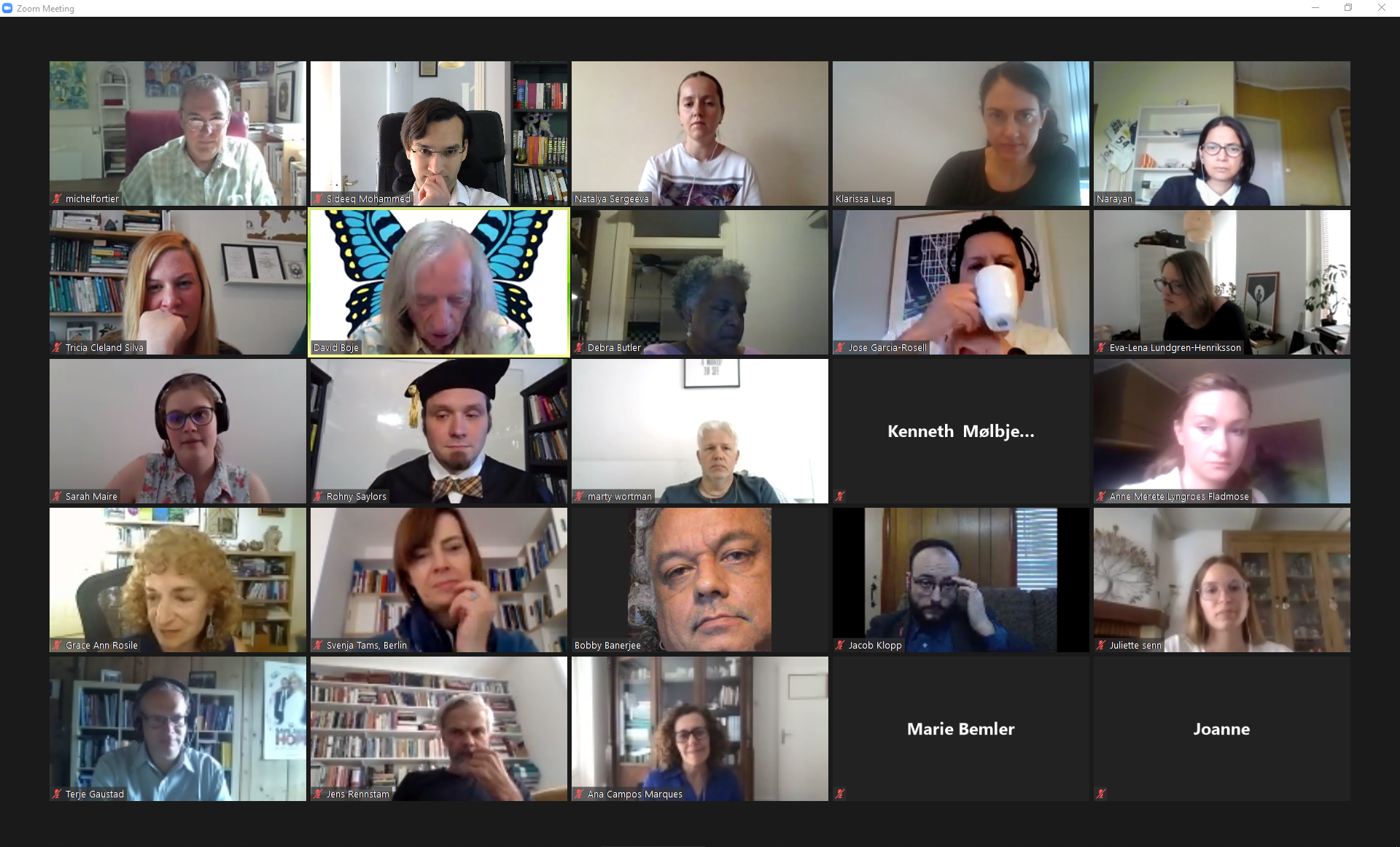
This year I took part in Sub-theme 52: Storytelling a Sustainable Future organized by David Boje, Bobby Banerjee, and Kenneth Mølbjerg Jørgensen.

EGOS screenshot

On Zoom with the members of Stream 52 at EGOS 2020

It was an enjoyable conference because I got to listen to a number of very interesting stories about local politics, indigenous ways of knowing, and new innovations and so on. Stories are always good to hear because they tell us something important about how the storyteller sees and makes sense of the world.

I presented a few sections from the book that I’m working on (provisional title: The Mall at the End of the World”).

Presentation Slide.jpeg

My cheerful opening slide. Photo credit: Seph Lawless

Without wanting to give too much away, at the core of the text is a feeling of disillusionment and disenchantment with the current stories being told in the anthropocene, specifically the naïve optimistic hopefulness that inf(l)ects everything from delusional mythologizations that tell us that we can keep digging fossil fuels out of the ground forever, and the stereotypical heroic narratives of the Great Male Entrepreneur who will innovate some new technological revolution via carbon scrubbing or argo-engineering or bioplastics or whatever in order to save us – all the way to the stories of returning to the land and celebrating local, organic, farming and recycling collectives. Each one seems to me to be inf(l)ected with a kind of naive optimistic hopefulness, a kind ‘artificial intelligence’ that overcodes thought from within, predetermining where it will go and what possibilities are available for it to encounter, until all that can be though are thoughts that hope against hope that everything will be OK. All the stories that can be storied tell us that humanity will survive in the end. That we’ll switch to renewable energies, that we’ll cease all of our myriad activities that produce mass death and biodiversity loss, that we’ll suddenly abandon capitalism and everything will be OK. This artificium optimus produces endless mutations and modifications of the exact same story ad nauseam, and we swallow it like cultural dupes in order to remain blind to suffering and anguish on multiple temporal lines (past, present, and future). We can change, it’s not too late, everything can still be ok!

I’ve become obsessed with out-dreaming this artificial intelligence and its endless and confident deluge of hope. Not as a way of reconstituting what Mark Fisher called “capitalist realism”, but as a way of seeing what other stories can emerge, ones that might prompt anger, frustration, and upset(or perhaps catatonia, depression, and melancholia) – affects that are less easy to sit peaceably with. Enter The Mall at the End of the World. A place where capitalism lives forever as a spectre of itself. The paper tries to imagine what the people of such a space would do. We know who they would be, as wealthy investors like Peter Thiel are already buying up land in remote areas with an abundance of fresh water like New Zealand or setting up condos in abandoned missile silos and beginning other strategies to prepare for global ecological collapse or other similar disasters – seeing them as a way of achieving an individualist utopia free from the tyranny of the state or as yet another way to profit off of disaster capitalism. To put it bluntly, existing class and social inequalities aren’t going away and it is likely that the ultra-wealthy will survive while the rest of us die in ecological collapse. But, long into the future, what will their descendants who survive in that space do? What will life be for this people-to-come? Will they not tell themselves stories of our wonderful and sincere attempts to save capitalism as we hoped against hope that everything would be OK with out Sustainable Development Goals and Green New Deals; our stories of patient Gaia and returning to the earth? Would their legends not be about how we all loved going to work and going shopping? About how fair and benevolent a system capitalism was (having been raised on an oral tradition of stories that extolled its virtues)? The “perspectivism” of looking forward to look back interests me at the moment.

Bobby Bangejee called the paper “despairingly inspiring” (which I take as a profound compliment) and flattered me by praising the work and encouraging others to read it. I take that as a hopeful (ha) sign that the work is worth doing and may post the full essay on this blog at some point.

I may post more updates on the book as it develops but for now, I just hope that I can attend conferences from my own home next year.

Standard
Papers and Ongoing Research

A review of [insert book title here]

Forward

In Winter 2016, I took up a rather interesting challenge. A student walked into my classroom carrying a copy of a rather large book. I took one look at it and guessed that it was an “airport bookshop” style management guru book, feeding cheap advice on what to do in organizations in order to placate anxious managers and students. He saw the look on my face and started to defend the books quality. Beyond making a face and shamefully judging a book by its cover, however, I couldn’t articulate why I was so apprehensive about this book.20180927_120308.jpg

Anyone who knows me will be able to predict how I reacted to not knowing what to say about something. I bought the book, read it, and wrote a review of it.What follows is that review, one where I try to play with giving and withholding details in order to comment on this book specifically and this type of book in general. I was also quite jaded at the end of my PhD and so I took the review as an opportunity to take potshots at academic writing. I ended up reworking this review into a paper titled ‘Understanding microfascism: Reading Deleuze and Guattari alongside management guru texts’ which hopefully will be published soon, and while digging on my hard-drive I found the following short piece and decided to post it here rather than letting it gather digital dust in obscurity elsewhere.

[insert book title here]

With the resurgence of authoritarian “strong man leadership” and the cult of personality around leaders themselves in our collective popular culture, it is perhaps no surprise that [insert book title here] is at the top of many “Bestselling Books about Leadership” at the close of 2016. [insert author’s name here] is well known for their image as a successful investor and entrepreneur, with their previous titles like [insert other book title here] trading upon this in order to sell a rhetoric of increasing efficiency and optimizing everyday life. With their newest book [insert author’s name here] broadens their scope, offering lessons from the nearly two hundred “world-class performers” that the author interviewed over the last few years. While critical scholars might argue that such a text has little of value to offer to rigorous, critical, academic analysis, being, at best, no more than a representation of the £6 billion management consultancy industry in the UK, a cheap “guru guide” [insert names of important professors here] to “managing” which tells the audience what they already know in pithy and quasi-inspirational tones and at worst, a blatant cash grab that builds off of the publicity for a highly successful podcast, which features [insert author’s name here], in order to bolster sales. However, following the precedent set by other CMS researchers like [insert reference to work of PhD supervisor here] and [insert reference to work of PhD supervisor’s conference drinking buddy here] this review aims to take the work of [insert author’s name here] seriously and understand it on its own terms, placing it into dialogue with the logic of [insert CMS buzzword here] and [insert half-understood concept from obscure philosopher] in order to suggest that rather than dismissal or readers of [insert journal name here] might find a truly “transformational” understanding of leadership in the writing of [insert author’s name here].

As such, let us begin from the proposition that there is more complexity to [insert book title here] than one would first assume. Though it seems to trade a crude kind of macho, [insert superfluous adjectives] bravado that speaks not only to the image of the leader as a great hero or messiah, but to the deep-seated anxiety and insecurity that underpins much of the popular literature on leadership and leads to the production of texts like this in the first place, [insert commentary cribbed from whoever is popular right now in critical leadership studies here]. There is, to be fair, no shortage of this and the Forward to the text, written by [insert name of popular celebrity here], speaks about how he is not a “self-made man” but rather is one who “stood on the shoulders of giants”. This is the logic by which the book operates, guiding the reader through, over the course of 674 pages, a wealth of stories about the habits of strong leaders who [insert leadership buzzwords here].

Divided into parts with labels like “Healthy”, “Wealthy” and “Wise”,  [insert book title here] seems to flaunt itself before the critical gaze, unconcerned in the face of chastisement because it is lightheaded at the thought of the sheer volume of money that it will make in sales.

Indeed, while [insert book title here] can be read as the climax of a society-wide and Business School cultivated masturbatory obsession around the strong leader (the book contains some 101 “profile chapters”, each focusing on a different “transformational leader”, one whose characteristics, qualities and successes are extolled as the [insert pithy catchphrase from book’s blurb here]) this is inadequate to the sheer magnitude of the project of  [insert book title here]. The star studded list of giants whose shoulders the reader might stand on include Olympic gymnastics coaches, Professors and PhD’s in everything from Molecular Pharmacology and Physiology to Neuroscience, doctors who were once endurance athletes, CrossFit trainers, professional wrestlers, high profile investors off of the cover of Forbes magazine, politicians, developers and founders of some of the mainstay websites of the contemporary internet, Oscar nominated film-makers, billionaires, hedge fund managers, professional snowboarders, CEO’s, master chefs, Navy SEALs, Grammy nominated musicians and popular actors; all of whom have a small space in [insert book title here] to share their wisdom and insights on life and being successful at living. However, the constant emphasis on adopting the life habits of “great men” [insert feminist critique here] and various health and wellness routines evokes the image of the transformation of a man  into some manner of drug-enhanced, low-bodyfat, business-savvy guru who speaks only in maxims about “success” and “motivation” rather than any of the above. A Gregor Samsa for the modern age. [insert witticism based on Kafka’s original German here].

However, despite what nightmarish imagery can be conjured about its content, what is perhaps noteworthy about [insert book title here] is its boldfaced simplicity. It wants to be nothing other than an instruction manual for how to be a great leader. There are no footnotes, no references to previous work done in the field, no “obligatory references”, no “positioning of the work”, no “theory” bandied about and yet, even if one might critique the rigour of the “200 interviews” that form the books basis, [insert book title here] is a qualitative study underpinned by a philosophical project of holistic wellness, mastery and development of the kind more common to ancient Greece than contemporary academia. All of this, one might contend, is in the writing, or, more apropos, in the ineffable ways in the writing constructs its reader –  an eager young millennial struggling for a sense of purpose or direction, likely to be enchanted by stories of “great men” who were successful through a series of habits or qualities that you too can cultivate. Such a reader might peruse this book and be expected to learn everything from where to meet high profile people, how to exercise more effectively, what books to read, habits to adopt to deal with ennui.  [insert book title here] is thus, in its coverage of topics as diverse as investment strategy in relation to [insert new business trend here] to why MBA programs are a 2-year vacation that look good on one’s CV, from work-out tips from people who’ve climbed Mount Everest to many other instances of what philosopher Daniel Dennett termed “deepity” (“The basics are the basics, and you can’t beat the basics” or “Life is a continual process of arrival into who we are”), a startling caricature of the life of its target audience, insofar as it seems to suggest a group so fatigued by the trials, tribulations and anxieties of modern life that they need advice with [insert list that will shock a CMS reader, like the mattress buying checklist or the constant array of “healthy living” tips, here]. One could almost be duped into believing that one were reading a “modernization” of classic philosophical aphorisms, like those of Nietzsche or Seneca for [insert book title here] has as much life affirming and positive insight in its “deepity” to help one cope with modern life as any of the dusty volumes that organizational scholars dredge from the library in order to make themselves “sound smarter than everyone else” [insert reference to anyone within CMS who has moaned about “academic writing” here]. Indeed, [insert author’s name here] shares this concern and [insert reference to story about author’s rejection of MBA programs based upon his dislike for academics who use too many big words and PowerPoint slides here] seems to suggest that one might find a more thorough and grounded education outside of the academic university. Though recent scholarship within CMS [insert a number of references to publications by members of the jorunal’s editorial board in order to mask a prayer to Dvalin, the Norse rune-god, asking both that this review be published and that the entire edifice of “academic writing” which supports a sentence like this one could burn ingloriously to the ground, here] has done much to address concerns around writing and pedagogy, what we might see in [insert book title here] is an unparalleled knowledge of audience. Such a tailored approach enables it to speak directly and prescriptively about how they may “transform”.

Like so many of these train station bookshop “leadership guides” [insert book title here] will like fade fast, into the discount bin; its status as a transformative bible for a 21-year old, final year Bsc Management student from a small British town with dreams of becoming a successful entrepreneur dwindling into the aether of memory as the book that he spent two weeks swearing to live his life by gathers dust on a shelf or is used to elevate a computer monitor. However, one wonders whether the critical scholars who number amongst [insert journal name here] audience might find the text as transient, or whether they might find something of value in the way that [insert author’s name here] writes, in the way that he draws in and captures the same audience that we would want to in order to ensure the future of our discipline. These are no doubt our students and it is worth speaking to them.

In the least, the readers of [insert journal name here] might find a reference point for critique in [insert book title here]. All too often CMS caricatures “the mainstream”, to the degree where this reviewer wonders if the readers of [insert journal name here] can remember the last time that they read a book that was on a list of “Best Sellers in Business”…

Standard
Papers and Ongoing Research

EGOS Papers: Past and Present

It’s conference abstract season again and while I’ve already submitted something on microfascism and management gurus to the Deleuze Studies Conference in Brazil, I find myself struggling with a submission for EGOS. The short paper form of EGOS has always irked me. While I understand how useful it can be to get meaningful feedback on a piece of work, I’ve always found it a miserable struggle to cut down a long paper to below 3000 words. It has never been clear to me whether the same norms of academic writing apply (i.e., “strategic” or “political” referencing to demonstrate command of a body of literature; meticulously differentiated and carefully couched contributions etc.) or whether I’m supposed to be communicating just the gist of the paper without the “bells and whistles”.

This is, of course, not the first time that I’ve submitted something to EGOS. While working on my PhD in 2015, I took the time to write up a short submission on the theme of  “Lines” and their relationship to organizational ethnography for a stream on the “power of organizational ethnography“. In reflecting upon this work, I could have done much more  to develop the notion of “linear thinking” that I struggled to articulate in the paper’s short space. Much of the thinking of this short paper would go on to form a chapter in my thesis that no one but me (not even my supervisors or external examiner) seemed to like.

The paper ended up being rejected with the following comments:

Unfortunately the ideas in this paper might need some further development. It does not become clear from the short paper how Deleuze and the ‘power of lines’ contribute to our thinking about the role of the ethnographer and the reflexive challenges that are faced in the field. This is not to say that there might be a good paper here but we had to make some hard choices on accepting papers.

Reflecting this paper, I think that this was a very charitable set of comments by stream conveners Juliette Koning and Jana Costas, but ones that I think were also reflective of the space from which I was writing at the time. The struggle was one that still troubles my writing, namely the figure of the reader. What can you assume that they know, understand, are already aware of etc. Obviously this is something that Patricia Dunker has made me reflect on further, but it also represents a pedagogical problem, namely how one is to teach/explain something. I’m posting the 2015 short paper below in full (warts and all) so that I might continue to reflect on this.


The Power of Lines: Deleuze and The Shopping Centre
Short Paper for the 32nd EGOS Colloquium: July 7–9, 2016. Naples, Italy.
With the recent publication of the second of two monographs by Tim Ingold (2007, 2015) on the nature and character of lines, the question of the line has once again risen to the forefront of contemporary anthropological thinking. Within anthropology and among practicing ethnographers the line has also become a source of interest and concern in the last decade- whether evidenced in Glowczewski’s (2005) observation of the crisscrossing storylines among hyperlinks which ethically tell the stories of the Warlpiri, or Gershon’s (2008) concern for lines of power among the multiple layers of complexity in the classroom, or Tierney’s (2008) exploration of the demarcation of the border between ethnography and fiction in Hauro’s “Demon Bird’- thinking on the line seems to be everywhere. As Ingold (2010) himself notes, this attention to lines follows in the tradition of artists like Paul Klee, who in taking lines for walks around the canvass, becomes a key example for the philosopher Gilles Deleuze in his writing on lines. Within Organizational Studies some have already begun to draw inspiration from this trend (see Holt and Mueller, 2010) but for those of us who wish to explore similar lines of thought through ethnographic work, there are still many avenues that might be pursued. This short essay, itself a product of our fieldwork at the shopping centre over the course of the last few years, will consider only one of these, namely reading through Deleuze’s work, the lines which constitute the shopping centre in time and through the subject, examining the ways that these manifest, develop, proliferate through and intersect with the shopping centre. We contend that despite Ingold’s prodigious efforts, the power of lines remains unrealized, for what lines offer is a way to problematize the role of the ethnographer and rethink the reflexive challenges that are faced in the field.

Deleuze says “whether we are individuals or groups, we are made up of lines” (Deleuze and Parnet, 2007. p.124) echoing a sentiment expressed in A Thousand Plateaus as “we are made of lines. We are not only referring to lines of writing. Lines of writing conjugate with other lines, life lines, lines of luck or misfortune, lines productive of the variation of the line of writing itself, lines that are between the lines of writing.”(Deleuze and Guattari, 2005. p.194) The line here replaces the point as the focus of analysis or, put another way, the connections between ideas, thoughts, moments or regimes of coding becomes, in Deleuze’s analysis, more important than the identification and categorization of the things themselves. Thinking in these terms, we might see the shopping centre as constituted entirely by lines. Parallel lines mark the escalator, flowing uphill into the shopping centre and downhill into the network of roads which connect its spaces to nearby towns and cities. Lines created by tiles form seemingly infinite grid, breaking only to betray areas of wear and tear, repair and heavy traffic; signs of heavy scuff marks, scrapes, prams dragging, cleaning carts grating. These lines extending from the floor, travel up the walls and intersect with ostentatious patterning which in turn weaves its way around signs adorned with various other lines of text. Diagonal white lines on a black dress adorn a mannequin in the window display of a trendy store because that particular pattern- endorsed by fashion gurus, mass-produced and worn by characters on television programs- is back in style this summer. Lines buzz in the mind from books read on the bus while travelling to the shopping centre, intermingled with the lines of multi-lingual (a trained ear might detect variants of Hindi, French and Japanese) conversations with which the bus route resonated. Lines from television, film and radio filter their way into conversation as opinions and ideas are repeated untraceably. Messes of lines pile high and offer value to the discerning Italian restaurant-goer who visits the food court. Policed and surveilled lines surround the shopping centre, creating a bordered and sovereign territory within which there are specific laws and codes of conduct; rules that often do not apply in the world outside. Lines themselves are, at times, the enemy, an indicator that further resources must be allocated in order to deal with the customers who have formed the line, lest a glut form or there be something which negatively affects the shopper’s perception of the space. However, lines themselves can be desired, like the sleek lines of a car sold in a temporary pop-up-store which are both often the subject of conversation. It seems that lines have the power to function as everything from an aesthetic choice to a vector, demonstrating variously despotic power, as it marshals men and women to attend to it, and a passive permeation, as they floats around the collective consciousness.

Our captivation with the lines of the shopping centre is entangled with Ingold’s own interest in, for example, the lines made by slugs (Ingold, 2012) or those implicated in the history of writing and inscription (Ingold, 2007). This fascination with lines is also found throughout Deleuze’s work. For instance, in Difference and Repetition, Deleuze (2001) often mentions lines in relation to time. His intention for much of this work, is to give a genetic account for not just thought and the conditions of thinking but thought of the subject. Paraphrasing Voss (2013), one of Deleuze propositions is simply that “thought” forms the “I” rather than the “I” “thought”. While a long-form discussion of Deleuze’s understanding of “the subject” (the “I” in this context) is beyond the scope of this paper, it is sufficient to say that Deleuze owes a great debt to Kant in this regard and that, for Deleuze, Kant’s work presents a subject profoundly fractured by the “line of time”. To use James William’s translation of Difference and Repetition “It is as if the ‘I’ is traversed by a fault line: it is fractured by the pure and empty form of time.” (Williams, 2011. p.82). This fracturing of the subject by what is referred to as the third synthesis of time is explained in many ways across the secondary literature, from discussions of inheritance in Hamlet, to the Nietzschean eternal return (see, for example: Voss, 2013) in each case emphasising the way that the subject is divided between the unity of the “I think” (the assumption of the naturality of which is a key concern for the project of Difference and Repetition) and the empirical experiences of the self. We shall return to this point, for what concerns us here is less this series of lines of thought and time which revolve around the exegesis of the Deleuze/Kant relationship and more what Joe Hughes says with regards to the chapter of Difference and Repetition wherein Deleuze develops this theory of time:

“This chapter in particular manages to bring together thinkers as diverse as Hume, Leibniz, Kant, Hegel, Bergson James, Freud, Husserl, Heidegger, Levinas, Merleau-Ponty, Lacan and Ricoeur – and there are probably more […] Of course it would be impossible to untangle all of these lines, not to mention counter-productive” (Hughes, 2009. p.87-88).

Indeed, Deleuze writes with a rich plethora of references and draws from a wide variety of sources, some of them acknowledged while others remain uncited. Another way to think about this is to say that the work which we call Deleuze’s is an intersection of various untraceable lines, all of ambiguous origin which will have always produced the text, given the soico-cultural, economic, historical and intellectual climate of Europe at the time of inscription. This authorial ambiguity is a source of great pride for Deleuze and his co-authors, as can be seen in the famed introductory paragraphs of A Thousand Plateaus where the question of “who wrote what” parts of the text, which is itself to be viewed as a tangle of different living lines of thought, is treated with disdain; as though it could not have been written other than written by a many at once.

The question of “Who writes thus?” is germane to ethnographic thinking and has, as such, already been considered in different ways. Though the Writing Culture project, and its current iterations in the trends of cosmological perspectivism (de la Cadena, 2015; Viveiros de Castro, 2012) or attention to the thoughts and dreams of a forest (see Kohn, 2013) or the topology of a road and other manifestations of the discourse of material ontology more broadly (see Harvey, 2012 or Harvey et al., 2013) or to the various intersections with the postmodern (Spiro, 1996; Spencer, 2001), has accomplished much in the way of achieving similar reflexive and self-aware writing, it has never gone as far as one might in reading Deleuze’s antagonism towards the subject. The auto- ethnographic turn to examine the self as it conducts ethnography (Davies, 1999; Foley, 2002) is here also insufficient, for it is attentive primarily to that relation between the assumed object of study, “outside” and that which is revealed through reflexive practice “inside”. It is perhaps yet to be considered that the lines of thinking and time intersect the subject in ways, rendering nonsensical the distinction between inside and outside or indeed the notion of the subject as origin. To adapt Wilfred Bion (1989) thoughts might live in the shopping centre, produced by no one individual but simply awaiting a thinker. Even in a cursory reading, the challenge of Deleuze’s reading of the subject as a residuum (Deleuze and Guattari, 2000), as nothing more than a by-product of the habitual synthesis of time (Deleuze, 1991) or as fractured by time (Deleuze, 2005), is to push our understanding of the interrelation of ethnographer and field further. This is perhaps what it means to answer the call to “take Deleuze into the field” (Bonta, 2005); thinking through philosophy while doing fieldwork rather than viewing “theory” as an ex post facto addendum to the completed ethnographic project. It is to ask “What does it mean to think without the ‘I’?” acknowledging that under the scrutiny of such a reflexive gaze, the subject disappears entirely, unable to function as a font of knowledge, wisdom or interpretation, what space and time occupies the subject becomes a reflector of the field and all of its madnesses. To put it differently, the study of the field becomes one about attending to lines, some of which may seem far off or remote.

Within Organization Studies, such ideas will no doubt seem paradoxical, for we have taken to, either as or in lieu of reflexivity, glorifying the identity of the researcher as subject (see, for example, Alvesson’s (2010) “Seven-S” model of “self-identity in organization studies”). While such a comment may seem facetious, given the developments to the concept of “reflexivity” that have followed from authors like Chia (1996) or Linstead (1994) it worth reflecting upon the fact that it is still a popular opinion within Organization Studies that ethnography has the potential to unveil the “realities of how things work” in an organization as researchers seek to “get into the heads” of those who live and work there (Watson, 2011. p.1); as though reality were a thing “out there” which the brave ethnographer could uncover being by implication, able to understand it; able to interpret the fundamentally chaotic nature of the universe by distilling said chaos through the “I”, to organize it and make it manageable (and no organization is more immediate to our thinking than the “I”). Where the “I” becomes part of the process, as is the case for those influenced by the discourses around actor-network-theory (see Hardy et al., 2001), it is as a part of a laudable interest in process and the construction of research subjects, however, we are still, debatably, unable to follow the lines.

Let us illustrate this with an example. While sitting in the shopping centre on a bench and waiting for an interlocutor to arrive for an “interview” one might read in a book by Deleuze and Guattari (2005) about different types of lines. They speak of the line of molar or rigid segmentarity (a line of ossified binary systems), the line of molecular or supple segmentation (a line of deterritorialization) and the line of flight (a line of rupture that disrupts the other two lines). After thinking about these three types of line for a while, contemplating how the rigid line, can be thought in terms of sites of discipline (Deleuze, 1992) such as the school, the family, the shopping centre while the supple line might be considered in terms of the small modifications, connections or resistances that one might make against such discipline by appropriating for example, the spaces of the shopping centre for exercise or dancing as are done by various small communities. Contemplating the third type of line however, leaves one perplexed for, in Deleuze and Guattari’s terms, a single line of flight might overthrow a regime, change a state of affairs and upset the order of the world for along that line is that which slips by uncoded and uncontrolled. How it could this be understood and meaningfully developed in the context of the shopping centre? Dwelling on this one might write down in a field journal only this note “There is nothing more subversive than a line”, to be puzzled over at a later date.

When one’s interlocutor arrives, the two of you slip into easy, familiar and casual conversation as this is not your first meeting. Even if the conversation was recorded, it would have been impossible to trace where or when the discussion turned to lines. Perhaps it happened while wandering past the Apple store and seeing a long line of shoppers queued up for the latest Apple gadget. Perhaps it was seeing a sign advertising a new line of lingerie. Perhaps it happened when you inadvertently revealed that you were reading about lines. Regardless of how it happened, the conversation has shifted and the discussion is now of the various lines that one might say in the shopping centre. “Thank you, come again!”, “You alright there, mate?”, “Have a nice day!” considering how these are scripted and inscribed into the employee through customer service training. As a mystery shopper, the interlocutor’s job is to evaluate how well the employee delivers these and other lines and report on how well they perform their roles. As the conversation evolves one learns much about the lines which both parties say and follow.

Can it be said that this conversation was “authored”? To do so, one would have to neglect the insight of offered by the likes of Foucault and Barthes about the death of the author. To adapt Barthes, conversation, as text does not have secret meanings instilled by an author but rather, is “a multi-dimensional space in which a variety of writings, none of them original, blend and clash” (Barthes, 1977. p.146). Despite our reflexivity, however, we would not ask who wrote these lines (The interlocutor, the ethnographer, both of them together, or perhaps the shopping centre itself- Could its lines dream themselves into the discussion, the space colluding to produce a discussion of lines) because to do so would threaten the validity of the “data gathering” that is taking place. The lines of thought seem too many and too entangled. Is Hughes (2009) thus right and is the complex inter-tanglement of the different relations of author(ity) counterproductive to attempt to parse- the text of a spoken conversation being as analytically rich as any work of philosophy- because any causal links or points of origin and genesis are the product of either the imagination or a set of relations so interlinked and inextricably intertwined that their complexity and nuance are ineffable? Did the shopping centre cause this attention to lines (rather than say, points) or were lines caused elsewhere and then imposed onto the shopping centre by a pretentious, navel-gazing academic who wanted to speak about Deleuze and lines? To ask this is to reveal ourselves to be looking for the author again, for an ethnographer as an autonomous- thinking subject- at the core of it all.

For another example, we might return to Ingold’s (2010) discussion of the interconnectedness of a tree, that is, an inability to draw lines around its boundaries and determine where the tree begins and ends, citing the problems posed by algae, squirrels and other things which don’t seem to fit traditionally in the definition of “tree”. Though Ingold himself does not make this point, when read through Deleuze, the examples of the tree or other instances of what he calls the “meshwork” (Ingold, 2015), one can think the human subject under exactly the same terms; as impossible to border with fixed lines.

Thus the question which we return to again, is that of the subject. We have puzzled over it and its assumed identity for millennia but perhaps have yet to develop an answer to the question of “How might one live?” (May, 2005) or, more relevantly, how one might research without returning to a subject. Therein lies the power of lines: a way out of the trap of the subject and the redux to the I think. By making the lines the centre of our analysis we might ask not “What is?” but the question which Deleuze and Guattari (2005. p.214) ask: “Whatever could have happened for things to have come to this?” for this is the question of ethnographic lines; not the rigid lines of a discipline nor the supple lines of individual experiments within ethnographic practice but lines of flight, radical ruptures with the organization of the “I”. Thinking thus is to begin trying to reject researching as an “I” who is thinking about those who are thought but, as Deleuze himself writes in a volume titled Who Comes after the Subject?, to think in terms of “pre-individual singularities and non-personal individuations” (Cadava et al., 1991. p.95). To put this another way, rather than being serf to the “grammatical fiction” of the I, one might- whether through experiments in writing via the “fourth person singular” or through cultivating an attention to lines- attempt to think differently.

Here we find that there is truly nothing more subversive than a line, for though we are all of us changed by our fields, we hold ourselves, nevertheless bound by the rigid li(n)es of the subject. However, inasmuch as the rigid lines of the subject constrain and subvert the creativity of our thoughts, making us always ask “Who said that?” or “What happened?” as we look for an author or origin, an attention to lines can also be what subverts this image and, in rupture, allows us to see the field differently and thus understand our mode of relating to it in ways other than those of separateness, author(ity) and identity. This is the power of lines; to follow a philosophical line of thought and see the linear thinking of the subject finally decline.

Bibliography
Alvesson, M., 2010. Self-doubters, strugglers, storytellers, surfers and others: Images of self-identities in organization studies. Human Relations, Volume 63, pp. 193-217.
Barthes, R., 1977. Image-Music-Text. London: Fontana Press.
Bion, W., 1989. Experiences in Groups and Other Papers. London: Routledge.
Bonta, M., 2009. Taking Deleuze into the Field: Machinic Ethnography for the Social Sciences. Deleuze Studies, 3(1), pp. 135-142.
Cadava, E., Connor, P. & Nancy, J., 1991. Who Comes After the Subject?. London: Routledge.
Chia, R., 1996. The Problem of Reflexivity in Organizational Research: Towards a Postmodern Science of Organization. Organization, 3(1), pp. 31-59.
Davies, C. A., 1999. Reflexive Ethnography: A guide to researching selves and others. London: Routledge.
de la Cadena, M., 2015. Earth Beings: Ecologies of Practice Across Andean Worlds. London: Duke University Press.
Deleuze, G., 1991. Empiricism and Subjectivity: An Essay on Hume’s Theory of Human Nature. New YorK: Columbia University Press.
Deleuze, G., 1992. Postscript on the Societies of Control. October, 59(3), pp. 3-7.
Deleuze, G., 2001. Difference and Repetition. London: Continuum.
Deleuze, G. & Guattari, F., 2000. Anti-Oedipus: Capitalism and Schizophrenia. Minneapolis: The University of Minnesota.
Deleuze, G. & Guattari, F., 2005. A Thousand Plateuas: Capitalism and Schizophrenia. London: The University of Minnesota Press.
Deleuze, G. & Parnet, C., 2007. Dialogues. New York: Columbia University Press.
Foley, D., 2002. Critical ethnography: The reflexive turn. International Journal of Qualitative Studies in Education, 15(4), pp. 469-490.
Gershon, W., 2008. Intent and Expression: Complexity, Ethnography and Lines of Power in Classrooms. Journal of the Canadian Association for Curriculum Studies, 6(1), pp. 45-71.
Glowczewski, B., 2005. Lines and Criss-crossings: Hyperlinks in Australian Indigenous Narratives. Media International Australia incorporating Culture and Policy, Volume 116, pp. 24-35.
Hardy, C., Phillips, N. & Clegg, S., 2001. Reflexivity in Organization and the Management of Theory: A Study of the production of the research ‘subject’.. Human Relations, 54(5), pp. 531-560.
Harvey, P., 2012. The Topological Quality of Infrastructural Relation: An Ethnographic Approach. Theory, Culture & Society, 29(4/5), pp. 76-92.
Harvey, P. et al., 2013. Objects and Materials. London: Routledge.
Holt, R. & Mueller, F., 2011. Wittgenstein, Heidegger and Drawing Lines in Organization Studies. Organization Studies, 21(1), pp. 67-84.
Hughes, J., 2009. Deleuze’s Difference and Repetition: A Reader’s Guide. London: Continuum.
Ingold, T., 2007. Lines: A Brief History. Oxon: Routledge.
Ingold, T., 2010. Bringing Things to Life: Creative Entanglements in a World of Materials, Manchester: Realities Working Papers.
Ingold, T., 2012. Looking for Lines in Nature. EarthLines, Issue 3, pp. 48-51.
Ingold, T., 2015. The Life of Lines. London: Routledge.
Kohn, E., 2013. How Forests Think: Towards an Anthropology Beyond the Human. London: University of California Press.
Linstead, S., 1994. Objectivity, Reflexivity and Fiction: Humanity, Inhumanity and the science of the social. Human Relations, 47(11), pp. 1321-1345.
May, T., 2005. Gilles Deleuze: An Introduction. Cambridge: Cambridge University Press.
Spencer, J., 2001. Ethnography After Postmodernism. In: P. Atkinson, et al. eds. Handbook of Ethnography . London: SAGE Publications Ltd, pp. 443-453.
Spiro, M., 1996. Postmodernist Anthropology, Subjectivity, and Science: A Modernist Critique. Comparative Studies in Society and History, 38(4), pp. 759-780.
Tierney, R., 2007. Ethnography, borders and violence: reading between the lines in Sato Haruo’s Demon Bird. Japan Forum, 19(1), pp. 89-110.
Viveiros de Castro, E., 1998. Cosmological Deixis and Amerindian Perspectivism. The Journal of the Royal Anthropological Institute, 4(3), pp. 469-488 .
Viveiros de Castro, E., 2012. Cosmological perspectivism in Amazonia and elsewhere. Manchester: HAU Network of Ethnographic Theory.
Voss, D., 2013. Conditions of Thought: Deleuze and Transcendental Ideas. Edinburgh University Press: Edinburgh .
Voss, D., 2013. Deleuze’s Third Synthesis of Time. Deleuze Studies, 7(2), pp. 194-216.
Watson, T., 2011. Ethnography, Reality, and Truth: The Vital Need for Studies of ‘How Things Work’ in Organizations and Management. Journal of Management Studies, 48(1), pp. 202-217.
Williams, J., 2003. Gilles Deleuze’s Difference and Repetition: A Critical Introduction and Guide. Edinburgh: Edinburgh University Press.
Williams, J., 2011. Gilles Deleuze’s Philosophy of Time: A Critical Introduction and Guide. Edinburgh: Edinburgh University Press.

Standard
Conceptual Explorations, Papers and Ongoing Research

Research Ethics: An Old Essay

I’ve been asked to give a lecture on Research Ethics in a couple of weeks time and, as such, have been reviewing some of my old material on the matter. I came across the following essay and enjoyed reading it enough that I decided to post it here. I am aware that it is not without shortcomings (limited reading being prime among them) and that is largely reflective of the particular moment within my doctoral work which produced it, but I thought that its playfulness, its creativity and the references that it highlights were worth a second consideration.


Cultivating a Deleuzian Ethics of Ethnography: A Polemic

At no other point could we have suggested a Deleuzian ethics. Even now it seems impossible; teetering on the edge of absurdity. To suggest, therefore, a Deleuzian ethics within the context of an ethnography of the shopping centre is to make a move, both in terms of theory and practice, which plunges all of the multiple discourses at play in this field into utter disarray. This is to reach a limit and start writing nonsense or, more accurately, to begin to cultivate a mode of engagement and inscription that is preoccupied with the sensible and the immanent through both its nature and content. It is to revisit the question of ethics entirely, melding and scrutinizing theory and practice, in an attempt to understand how the discourse of ethics in ethnography has reached this particular point, an exploration that falls just shy of genealogy. In sum, this polemic will begin to trace the initial moves (and only these) of the horticulturist who seeks to develop an ethnography- one that is necessarily not homogeneous with such a descriptor- in conjunction with a reading of the works of Gilles Deleuze. Through taking risks and making disjunctures at points, through examining current anthropological literature which relates to the focused frame of “engagement and ethics”, we shall attempt the cultivation of a Deleuzian ethics of ethnography.

Adam…

Adam was the first ethnographer. He is placed into the Garden with no assumptions or presuppositions and he begins to name his research subjects, the others, the anonymos; indoctrinating them into his language while learning theirs and studying the ways in which these others relate to one another. He names them, even though he knows that they may have their own names; that they may have already named themselves and each other. He does so without morality because he has not yet eaten of the tree of knowledge of good and evil. However, he still has an understanding of how to engage with and relate to the others in the garden. One might say that this understanding comes from the fact that he labours under the tyranny and in fear of an omnipresent and absolute Other, which is why he does not partake of the fruit of the tree. For Deleuze, this is indeed the case, but mistakenly so. Adam does not eat because he believes that god prohibits it. He is mistaken because he cannot understand that god has merely revealed the natural consequence of eating of the fruit of the tree: an adverse reaction between bodies; poisoning. Though he does not know it, Adam acts based on his sense of the interrelations of bodies; his comprehension of conjunctions and disjunctions. He is, for the moment, beyond good and evil. His ethics are immanent.

An exercise in ‘box-ticking’…

Immanent ethics are, however, unfortunately far removed from current discussions of ethics in anthropology. What can and should be termed the ‘administrative approach’ to ethics is what presently forms common parlance; the everyday reality of ethics as far as social scientific research is concerned. The complexity of the myriad problems concerning how one is to relate, regard and engage with others in the world has, of late, been reduced to an exercise in box-ticking in order to facilitate committee approval. “Does the research involve any of the following? Please tick where applicable.” “Provide a summary of the design and methodology of the project, including the methods of data collection and the methods of data analysis.” This is what Michael Agar (1980) would describe as ‘the bureaucratization of ethics’; a result of escalating fears regarding the treatment of ‘human subjects’ within a research context. While it might appear that ethical approval procedures have evolved from the time when Agar wrote his text, or indeed, from when authors like Wax (1977) critiqued similar approaches to ethics that governed research in the social sciences, closer examination of the works of more current authors, like van den Hoonaarud (2001, 2003), reveals the articulation of similar discontent with current systems. In sum, what these writers argue is that, though a degree of bureaucratic oversight might prove necessary, these approaches reduce ethics to a series of steps necessary, in the first place, for the maintenance of a minimal standard that will shield both the researcher and their institution from the perils of legal inquest and, secondly, to patronizingly guarantee the informed consent, confidentiality and the security of any ‘human subjects’ under study.

It is possible to understand these bureaucratic measures as emerging based on a broadly natural-scientific model of research; one where methods are more rigidly defined and adhered to, where the interactions between researcher and ‘subject’ are much more controlled and where power relations are better established (even entrenched). Indeed, most accounts of the historical emergence of “research ethics” (see, for example Hesse-Biber and Leavy, 2011) begin with the Nuremberg Code and a recounting of the medical experimentation that preceded it. As such, it is not difficult to see these procedures as an external code of practice which has been imposed upon the social sciences despite the fact that the specificity of such codes does not lend itself to the ‘inexactness’ of qualitative research methods in general and the emergent nature of ethnographic fieldwork in particular.  Were it not for infamous social scientific research like Zimbardo’s (1973) ‘Stanford Prison Experiment’ or Humphrey’s (1970) Tearoom Trade, it would be possible to argue that the social sciences have no need for such ethics of committees and procedures. We do not here place blame, but merely point out that, regardless of  whether the methods employed in these ‘experiments’ were necessary or not, they undoubtedly catalysed the emergence of the prescriptive and restrictive ethical procedures which now govern (read: mediate) engagements with ‘human subjects’, supposedly for the protection of vulnerable subjects and researchers alike. As such, while more systemic and social origins can be isolated- van den Hoonaarud (2000), for example, posits the emergence of a kind of ‘moral panic’, a by-product of modernity which exaggerates perceptions of harm and results in disproportionate regulation- this administrative approach to ethics is clearly one that the social sciences, and we as social scientific researchers, are complicit in constructing.

Still, the scope of the administration of ethics cannot but be shocking and yet, writing based on his time spent on a Canadian Research Ethics Board, Haggerty (2004) not only demonstrates that this phenomenon is global and endemic to the entirety of social science but that it is one which is growing. He chronicles a phenomenon that he dubs “ethics creep”, the growth and evolution of bureaucratic procedures and committee oversight for conducting social scientific research, and goes on to argue that this phenomenon is largely detrimental to the overall ethical conduct of the social scientific field, encouraging rule fetishization and the neglect of ‘true’ ethical engagement with others in the field (a point that we shall consider further below). Indeed, though its openness should render it as an exceptional case, the spread of administrative ethics permeates all the way to the field of anthropology, manifesting, for example, on the pages of the ethical guidelines published by professional associations like the Association of Social Anthropologists (ASA). The ASA’s ethical guidelines bear the distinct marks of having been revised to take into consideration certain ethical quandaries and problems with ethical practice that have troubled ethnographers in years past. Yet, like all other such ethical mandates, it functions along the axes of the problem of informed consent, the nature of ‘harm’ and the guarantee of anonymity; each of which we shall consider in further detail because, as can be learned from Murray et al (2012), it is positioning along these three axes that becomes crucial for obtaining ethical approval when conducting social scientific research. By implication, one must not only understand them in order to act ethically but in order to ‘get the box ticked’ and be allowed to carry out one’s ethnographic particular project.

Problematic Axes

On the surface, the premise of informed consent seems fair, necessary and unproblematic. That the subject under research should know and understand the nature of the research endeavour and be asked to acquiesce their participation in it before it begins, seems to be not only a reasonable and ethical mode of conduct but it also seems an effective way to placate any fears of the exploitation of marginal or otherwise vulnerable social groups. Several researchers have, however, called into question the whether informed consent is possible in ethnographic projects, whether the researched can ever truly give an informed and un-coerced ‘yes’.

In her exploration of this particular problematic, for example, O’Connell Davidson (2008) comments on the seeming vacuity or ambiguity of the consent that ethnographers are mandated to secure at the beginning of the fieldwork. Through a retrospective of her relationship with her informant, Desiree, she questions whether saying ‘yes’, acquiescing to the requests of the ethnographer, can really be considered as consent, given that neither the ‘human subject’ under study, nor the researcher knows how their relationship will evolve. To wit, since neither party is aware of how the subject’s life will be portrayed and dissected in the text that results from the fieldwork or, indeed, what aspects of the interaction will be featured in such a text; how can the subject ever meaningfully say ‘yes’. Here the spectre of the natural scientific/medical origins of the practice of securing consent looms large, as these problems are exacerbated if we consider consent as processual, a continually negotiated position (which it is for most ethnographic projects), rather than a singular and one-time ‘yes’, signed on a dotted line. That is, if we consider ethics as something more than an administrative exercise, the entire idea of informed consent becomes fallacious. What is being called into question here is both the ethnographer’s ability to ‘inform’ the ‘human subject’ under research, to tell them what the research is before the fact, as well as the subject’s ability to understand such a description; problems which cannot be so easily dismissed.

Further practical considerations are raised by Haggerty (2004) and others, such as the ability of the ethnographer in the field to secure consent from casual encounters in public spaces. Indeed, if our ethnography is to involve working at the Lost and Found desk in the shopping centre, this particular problem of securing informed consent becomes most troubling. The casual shopper who comes up to the desk to ask for directions, the beleaguered mother-of-three who comes in search of a mislaid diaper-bag, the janitor who stops to say ‘Hello’ during his 3pm rounds of the ground floor- none of these may be presented with a waiver, a statement of ethical intent or interrupted in their conversation by a lengthy explanation of purpose and nature of our particular ethnographic project. To do so is at best, impractical, and at worst, detrimental to the ethnography and its goals. Such encounters are, however, vital; not only for the ethnographer to assimilate himself into the community but for the development of an understanding of the space, in every aspect of the word. Should we shy away from such encounters in fear of some ‘harm’ that we might inadvertently cause or unpragmatically adhere to the doctrine of informed consent?

Equally problematic and fraught with controversy is the question of anonymity and confidentiality; terms which are by no means synonymous but both of which indicate a certain imperative to protect the identities of the ‘human subjects’ under research. Even though it is more likely that the practice of guaranteeing anonymity and confidentiality emerged in order to secure the cooperation of certain reticent research subjects, one can see how such a practice might be necessary to safeguard vulnerable individuals and groups; protecting them from any potential repercussions from their appearance in the ethnographic narrative. It seems clear that this should easily manifest in the usage of pseudonyms, the obfuscation of distinguishing characteristics of people and places and the non-disclosure of information which is deemed to be sensitive. What has been called into question in recent anthropological literature, however, is whether or not these practices offer any meaningful form of protection.

As Arlene Stein (2010) notes in a recounting of her ethnography of ‘Timbertown’, the town’s residents were easily able to discern the identities of the individuals featured in her text The Stranger Next Door, despite her attempts to give them anonymity. Her descriptions and depictions, being necessarily detailed for the construction of an ethnographically-informed narrative, were easily decipherable because of the small size of the community under survey. Among the conclusions of her retrospective, she asserts that it was perhaps the very promise of anonymity- a promise which would not have been made by an investigative journalist pursuing the same line of inquiry- that caused so much ire in the wake of her book’s publication. That is to say, having been promised anonymity, her informants felt that they had been outed, their trust violated by the researcher’s faltering attempt to mask their identities. Stein, therefore, concurs with Nancy Scheper-Hughes who, in writing about a similar situation in which her disguised field-site was unveiled, asserts that the “time-honoured practice of bestowing anonymity on ‘our’ communities and informants fools few and protects no one—save perhaps the anthropologist’s own skin.” (2000, p. 128).

Indeed, we are likely to face a similar problem to Stein and Scheper-Hughes in the shopping centre, which we must assume is populated by a relatively small community of staff. No matter what pseudonym we use or how we disguise our description of the site, the staff of the shopping centre will know that they are the ones being written about and will very likely be able to decode even the most veiled depictions of individual subjects. Do we deny their right to anonymity and hope that they will still speak to us or do we offer only the most transient sham of anonymity in order to satisfy administrators and ethics committees? Or, do we obscure all of an individual’s distinguishing features (including their race, gender, socio-cultural affiliations and position in the organization), ‘protecting’ them at the cost of producing a weak and unpersuasive ethnographic narrative that ignores the importance of positionality? It is regrettably the case that the latter two options are selected far more frequently than the first. It is for this and other reasons that van den Hoonaarud (2003) suggests that, while it may be more easily deployed in quantitative methodologies, true anonymity is an impossibility as far as ethnographic research is concerned. We are inclined to agree, given the potential difficulties to which we have alluded; even if this would seem to render the ‘human subjects’ in our ethnography vulnerable to ‘harm’.

Indeed, the third and final axis, ‘prevention of harm’, the one which the other two exist to serve, is disputable for precisely the reasons which we have been outlining. To return to the ASA’s ethical guidelines, the anthropologist is charged to anticipate and minimize ‘harm’, to mitigate any foreseeable negative consequences to the ethnographic project. This might take the form of reassuring the directors of the shopping centre that no confidential, sensitive or potentially harmful information regarding the organization and its practices would be disclosed; having recourse to a councillor if the project involves the reliving of painful memories in response to an ethnographer’s probing questions (Murray et al, 2012) or, more simply, anonymizing the names of participants who aren’t openly gay to keep from outing them (Stein, 2010). The problem which is highlighted by the examples that we have entertained thus far is that it is the unforeseeable, the unpredictable, that tends to be the most damaging, that causes the most harm. Equally, however, it is this unpredictability that makes ethnography a useful and indispensable methodology. How does one, therefore, proceed without harming the ‘human subjects’?

In his paper on the moral dilemmas of fieldwork, the Ten Lies of Ethnography, Fine (1993) describes the shared delusions that ethnographers present to the world (and to each other), key among them being the lie or myth of “the honest ethnographer”- one who always secures consent, anonymizes his informants and always knows exactly what he is looking for in the field. While we concur, we would also argue that what Fine is unable to postulate is a more endemic cause, a capitulation that encourages the fieldworker to tolerate the now obviously vast disjuncture between the administrative approach to ethics and those that must necessarily exist between the researcher and the ‘subject’. What we suggest is that the problems that emerge with regard to ethics and fieldwork- particularly those which we have catalogued thus far- stem from the transeunt or transcendental approach to ethics that pervades in social science and indeed, in wider society. It is the tree of knowledge (paradoxically comprised of axes) which we have been administered, and by which we are administered (always complicit in its construction), that seems to be the root of these problems. It is when he or she feels that they must labour in the shade and under the gaze of this omnipresent other- the ethical guidelines and contradictions internalized- that the ethnographer feels alienated, uncertain, and indeed, impotent, and so questions (as we are doing) the ethical framework that has been put upon him. To understand the alternatives that are available to researchers, and indeed, to ‘human subjects’ in the course of their everyday lives, we must engage in a closer interrogation of Deleuze’s ethical project.

Encounters…

Encounters between Deleuze and ethnographers are limited and fleeting when they do occur. Perhaps this is because, as Biehl and Locke (2010) so aptly demonstrate with their misappropriation of many of Deleuze’s concepts (most notably ‘desire’ which they mistake for sexual desire via Freud), the onto-epistemological assumptions that simultaneously govern and underpin anthropology, and indeed ethics in anthropology,  are ostensibly incompatible with any philosophical approach that might be termed ‘Deleuzian’. There would appear to be no reconciling the vestiges of the scientific method and progressivism that form a core of anthropological discourse (see Adams 1998); vestiges that result in Biehl and Locke’s attempt to cultivate a ‘Deleuzian anthropology of Becoming’ amounting to little more than an ex post facto imposition of Deleuzian terminology onto a completed ethnographic project. Their engagement with concepts like ‘becoming’ or Deleuze’s understanding of writing cannot disguise their continuous employment of phenomenological metaphors or hide their psychoanalytically informed preoccupations with pathologies and cures; so much so that they act unethically (for a schizoanalyst), botching the becoming-cat of their informant, Catarina.

This seeming irreconcilability does not derail our present endeavour since we maintain that there are ways, becomings, via which a Deleuzian may engage with and in ethnographic practice. This polemic, however, is not and cannot be directed at such a systemic problem. For now it will have to be sufficient for us to draw attention to this conflict and posit, with an attentive ear towards ethics, that the difficulties in developing a Deleuzian approach to ethnographic or anthropological methods stem from the fact that there is no Deleuzian tree of knowledge from which the Adam-ethnographer can pluck the fruit of ethics. Such ethics must emerge inside, in-between and through engagements; growing rhizomatically. Perhaps the most productive attempts at developing a Deleuzian ethics within the context of an ethnographic fieldwork project comes from authors who understand this.

In FoodScapes, a text which addresses itself to developing a ‘Deleuzian ethics of consumption’ through a multi-site ethnography, Rick Dolphijn (2004) demonstrates such an understanding. Much like Smith (2007), Dolphijn picks up on the distinction which Deleuze draws between ‘ethics’ and ‘morality’ in his text on Spinoza– a distinction which is reprehensibly absent from the administrative approach to ethics. Via Spinoza’s Ethics as well as Nietzsche’s Genealogy of Morals, Deleuze understands ‘morality’ as referring to systems of transcendental values or prior judgements, philosophies of ‘good’ and ‘evil’ that pre-exist the event or assume a position of exteriority to the engagements of the encounter. It is such ‘moral philosophies’ that we have alluded to as being the source of discontent within anthropological theory, since it is these, in their totalizing and rigidifying modes, which come to delimit individual action and restrict the varying range of engagements between bodies that may occur during ethnographic fieldwork. Morality is here a mechanism of constraint, control and organization; one which we must understand, through Nietzsche, as the product of specific power relations and practices. To paraphrase Twilight of the Idols, the researcher must set himself beyond this, recognizing such illusions to be beneath him. Indeed, for Deleuze, great moral thinkers like Bentham, Mill and perhaps even Kant were inherently unethical as, in their construction of totalizing and prescriptive moral frameworks, they regulate and restrict the possibility for ethical engagement. Only etiolated ethics can result from such approaches. As such, it would seem apropos to retroactively redub the term ‘administrative ethics’, changing it to ‘administrative morality’- a given morality that the ethnographer bears as a rite de passage, a necessary evil for a greater good, a crutch, an anaesthetic that dulls the thorny feel of the engagement.

The term ‘ethics’, on the other hand, is one which is employed in reference to “a typology of immanent modes of existence” (Deleuze, 1988. p. 23), to a system of understanding (one that borders on a set of rules) that encompasses the constitution of bodies and the way that these are composed and decomposed within the event. For Adam, the fruit of the tree would poison him, decomposing his body; the fruit, by virtue of its very composition, being antagonistic to his nature. He understands this to be a negative form of engagement, ‘bad’ one might say, and shies away from it until he is convinced that the fruit is, in fact, nourishing- a positive engagement between bodies. He acts neither upon the realization that ‘poison’- as we know via the history of medicine and language encapsulated by the etymological roots of the word pharmakon– is contextual and is only a meaningful term within a given assemblage nor upon a transcendental imperative (in fact, the story tells us that he is innocent of these) but on an immanent ethology. It is this that Dolphijn focuses on in FoodScapes, “the compositions of relations or capacities between different things” (Deleuze, 1988. p. 126), the relations, processes, reactions and functions of food that emerge from the different field sites in his study.

The truly ethical question, therefore, is not “What must I do?” or how best can I perpetuate and persist in my subordination to this illusionary transcendence, this imposed moral code of conduct? Rather it is “What can I do?”- what possibilities are available to me as a researcher and to the other subjects within a given assemblage? What becomes in these? Ethics are here facilitative rather than prohibitive. In fact, while one is still surf to morality, still preoccupied by issues of consent and anonymity, of ‘good’ and ‘evil’, we neglect the ethical questions of engagements. Ethics is itself prohibited since transcendence disbars ethical action.

Departing the Arboretum

The question which still haunts us, is whether Adam acted morally in the Garden? Did he consider the potential sources of harm and attempt to mitigate these? When he names the animals, is he actually anonymizing them to protect them from some hitherto unmentioned harm or is he robbing them of their names, giving them new identities and keeping their story out of history? It seems to us that the lesson to be learned from Adam is that ethnography can be amoral. It is rarely unethical, but it can (and perhaps should) take place in the absence of a rigidly defined moral structure.

Upon reconsidering the questions raised in the preceding sections, it is clear to us that many of these must remain unanswered at the present juncture since, in our own ethnographic project, we have not yet encountered the others, any other actual bodies, and do not yet know whether anonymity, consent or harm will be involved in our ethical mode of relating to them. This is not merely a situational or relativistic proposition which says that we will subscribe to the administered morality where it is suitable, but rather, it is one that says that we should cease to be preoccupied with such a code; it is restrictive and universally inapplicable; focusing instead upon the ways and means by which we engage with the others in the field, an ethics more indicative of practice.

Indeed, retrospecting further, the Deleuzian ethics which we have been considering can produce new offshoots/readings of some of the ethical quandaries in anthropology. Humphrey’s Tearoom Trade, for example, was immoral by the standards with we have defined but it was certainly not unethical. In the case of the becomings of Biehl and Locke, their research was unethical not immoral. Ethical conduct would have been learning to speak to Catarina in her own language; leaving her to her becomings; helping her understand her coding, her lines, the territories through which she has passed and is passing as well as the forces at work upon her desires and how these arose- not delivering her into further repression by trying to find the ‘true nature’ of her “rheumatism”. Such ethical conduct would not have merely been between Biehl and Catarina but between Biehl, Locke and Deleuze; an ethical mode of engaging with a body of literature, one that we hope to employ in our own research.

It would seem, therefore, that there is still much more growing to be done.

Bibliography

Adams, W. Y., 1998. The Philosophical Roots of Anthropology. Stanford, CA.: CSLI Publishings.

Agar, M. H., 1980. The Professional Stranger: An Informal Introduction to Ethnography. London: Academic Press Ltd. .

Biehl, J. & Locke, P., 2010. Deleuze and the Anthropology of Becoming. Current Anthropology, 51(3), pp. 317-351.

Bogue, R., 2007. Deleuze’s Way: Essays in Transverse Ethics and Aesthetics. Hampshire: Ashgate Publishing Limited.

Association of Social Anthropologists of the UK and Commonwealth, 1999. Ethical Guidelines for Good Research Practice. [Online] Available at: http://www.theasa.org/ethics/guidelines.shtml
[Accessed 29 December 2012].

Davidson, J. O., 2008. If no means no, does yes mean yes? Consenting to research intimacies. History of the Human Sciences, 21(4), pp. 49-67.

Deleuze, G., 1988. Spinoza: Practical Philosophy. San Francisco: City Lights Books.

Deleuze, G., 1997. Essays Critical and Clinical. Minnesota: The University of Minnesota Press.

Deleuze, G., 2001. Pure Immanence: Essays on A Life. New York: Zone Books.

Deleuze, G. & Felix, G., 2010. A Thousand Plateaus: Capatilism and Schozophrenia. London: Continuum.

Dolphijn, R., 2004. Foodscapes: Towards a Deleuzian Ethics of Consumption. Delft: Eburon.

Fine, G. A., 1993. Ten Lies of Ethnography: Moral Dilemmas of Field Research. Journal of Contemporary Ethnography, 22(3), pp. 267-294.

Haggerty, K. D., 2004. Ethics Creep: Governing Social Science Research in the Name of Ethics. Qualitatitive Sociology, 27(4), pp. 391-414.

Hammersley, M. & Atkinson, P., 2007. Ethnography: Principles in Practice. London: Routledge.

Hesse-Bieber, S. N. & Leavy, P., 2005. The Ethics of Social Research. In: The Practice of Qualitatitive Research. London: Sage Publications, pp. 83-116.

Humphreys, l., 1970. Tearoom Trade: A study of homosexual encounters in Public Places. London: Duckworth.

Jun, N. & Smith, D. W., 2011. Deleuze and Ethics. Edinburgh: Edinburgh University Press.

Murray, L., Pushor, D. & Renihan, P., 2012. Reflections on the Ethics-Approval Process. Qualitative Inquiry, 18(1), pp. 43-54.

Nietzsche, F., 1990. Twilight of the idols and The Anti-Christ. Harmondsworth : Penguin .

Nietzsche, F., 1996. On the Genealogy of Morals. Oxford: Oxford University Press.

Raymond, M., 2010. Being Ethnographic: A Guide to the Theory and Practice of Ethnography. London: Sage Publications.

Scheper-Hughes, N., 2000. Ire in Ireland. Ethnography, 1(1), pp. 117-140.

Smith, D. W., 2007. Deleuze and the Question of Desire: Toward an Immanent Theory of Ethics. Parrhesia, 2(1), pp. 66-78.

Stein, A., 2010. Sex, Truths, and Audiotape: Anonymity and the Ethics of Exposure in Public Ethnography. Journal of Contemporary Ethnography, 39(5), pp. 554-568.

van den Hoonaard, W. C., 2001. Is Research-Ethics Review a Moral Panic?. Canadian Review of Sociology, 38(1), pp. 19-36.

van den Hoonaard, W. C., 2003. Is Anonymity an Artifact in Ethnographic Research?. Journal of Academic Ethics, 1(1), pp. 141-151.

Wax, M. L., 1977. On Fieldworkers and those Exposed to Fieldwork. Human Organization, 36(1), pp. 400-407.

Zimbardo, P. G., 1973. On the ethics of intervention in human psychological research: With special reference to the Stanford Prison Experiment. Cognition, 2(1), pp. 243-256.


Thanks must go to Dr. Stef Jansen whose course on Issues in Ethnographic Research catalysed and nurtured this essay.

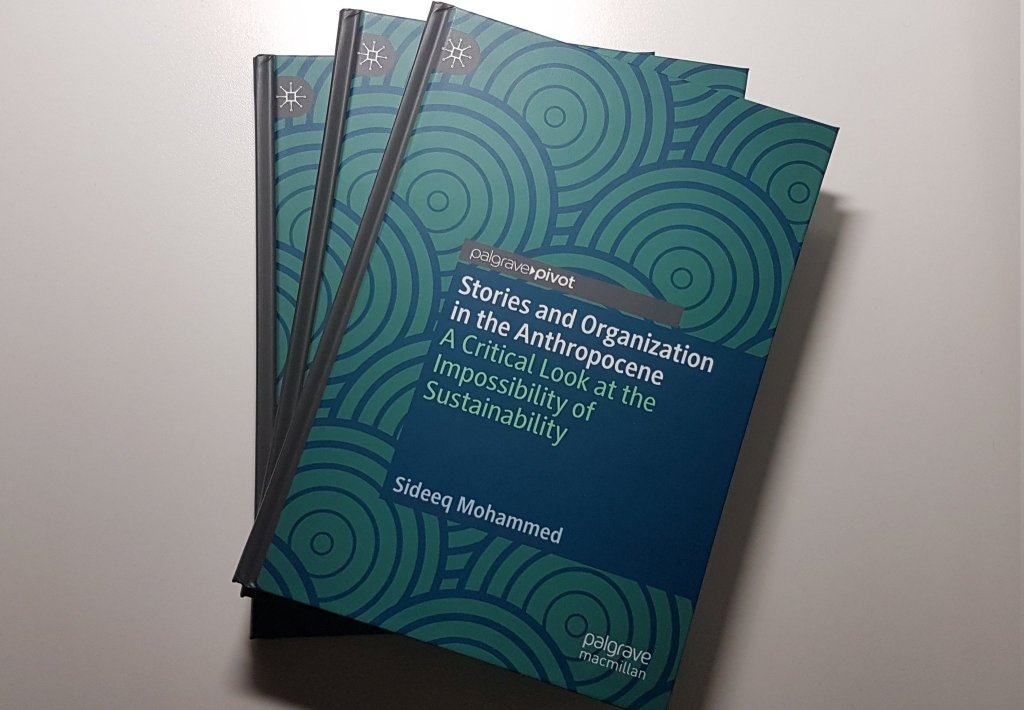
Standard
Papers and Ongoing Research

Conference Presentation: Organizing “the ontological turn” or what Organizational Ethnography can learn from Viveiros de Castro

I presented my work on Viveiros de Castro at the 12th Ethnography Symposium this week. There was a pretty good turn out and I heard some very interesting papers, some in my panel, and others in Ed and Leo’s stream on extreme work and ethnography. The stand-out paper was perhaps a colleague’s “undercover ethnography” in a Spanish brothel.

Part way through my own presentation I had the strangest experience, a weird crystallizing moment where I realized that no one on the room quite followed what I was saying. Perhaps this is not correct; perhaps it is more accurate to say that the concerns that I was trying to vocalize and speak to with the paper were those that either were not shared by the audience or, because if their theoretical backgrounds,  that it had never occurred to them to be concerned about what I was proposing. This is not to speak ill of my colleagues, rather it is to say that I need to find a better way of explaining and contextualizing the problems of the ontological turn so that their importance can be better appreciated. This requires less in the vein of “strategic referencing” and more of a concern for developing better examples, through fieldwork, of the problems with which I am concerned. What follows is that paper in full, warts and all which I leave here so that I might keep reflecting upon how to improve it.


Organizing “the ontological turn”

Preamble

Organization studies is fairly conservative in its experimentation with the method of ethnography, at least when compared to anthropology, where ethnography seems on the surface to be constantly explored and reinvented. We can pick up a recent copy of The Journal of Organizational Ethnography or The Journal of Business Anthropology or indeed more mainstream journals and find very good ethnographic work, reporting on the nuance of the contemporary corporation but in the same ways and with the same preoccupations as were had by trailblazers like Van Maanen or Watson. That is to say, preoccupied with the same concerns of uncovering the everyday realities of practices etc. and not yet attentive to questions of representation, deconstructions of the ethnographer as subject, questions of the posthuman etc. This is where the “ontological turn”, a movement within anthropology to reconsider some of the assumptions upon which ethnography is based, becomes important for me. The paper that I want to give today speaks to this as it is born out of an interest in the “ontological turn” and a fondness for the work of Brazilian anthropologist, Eduardo Viveiros de Castro in particular. Specifically, it hinges on the question of “What makes good ethnography?” I used to think that good ethnography was defined by good storytelling (Bourgois) but for reasons that I’ll outline here I now think that what defines good ethnography is the creation of “concepts”, tools for thinking that though inseparable from the milieu of the field can constitute a “way of looking” which emerges from it. In this paper I want to look at how Viveiros de Castro develops concepts and hopefully we might emerge from this talk with a better understanding of how to look at our ethnographic work in organizations and think about concepts.

As such, today I am concerned to address a fairly simple question: “What can the ontological turn help me to think about in my ethnographic work?”. The argument that I’m going to unpack is that the ontological turn offers organizational scholars a way to rethink (or unthink) how we engage with concepts. Writing about the ontological turn Holbraad and Pedersen (2017) cite the play of concepts (in addition to a heightened reflexivity and a willingness towards experimentation) as one of the things that the ontological turn does differently from what came before.

In order to develop this I want to think about the nature of concepts through a consideration of the concept of nature. In order to do this, I will consider the ways in which “nature” is depicted in the shopping centre (my now and former field site), and then develop out of a reading of Viveiros de Castro’s concept of “multinaturalism” a pedagogy of the concept of nature (and thus a concept of the concept) as it works therein. Finally, I want to conclude by developing a set of sensibilities that an ethnographer in the field-site  of a contemporary organization might use to be attentive to what I shall call the “ontogenesis of a concept”.


“Nature of business”

The concept of “nature” is one that is implicated in a number of debates, so many and so large that it would be foolish to try to speak to them all. As such, I want to give an example that I think illustrate simply a point that I want to make about concepts in general and the concept of nature in particular. I could give examples from newspaper archives or from recently published “management guru” literature but instead I’m going to give one that involves an ethnography at a British shopping centre.

So let’s say that you’ve been studying a shopping centre for about a year and notice an increasing number of store fronts covered over with large but well-designed canvass screens in order to hide the fact that they are now empty. Stores coming and going is not an unusual occurrence but it seems to you that over the last month there have been more than usual, remaining empty for longer than usual. When you ask an interlocutor, a former school-teacher in her sixties who lives literally “around the corner” from the shopping centre, what she thinks of this, she says something to the effect of, “That’s just the nature of how things are,”

I want to suggest that this is a watershed moment in the ethnographic work and from here there are two predominant paths that the analysis can take, one that I have to caricature because of time constraints and another that I want to consider more carefully. The former involves an analysis of disposable capitalism. Here the ethnographer basks in the glory of noticing something that they are not supposed to notice and begins to study rent inflation in the shopping centre or the ways in which the shopping centre constructs itself as a portrait of Middle-England while simultaneously trying to paint a more aspirational identity. A study begins to emerge of working class/lower-middle class v big business politics; the kind that critical-scholars might delight in and knowingly nod at and and connects to work in a Marxist tradition of organization studies that offers critique of class capitalism and the inequalities that it entails.

The second involves obsession. An increased sensitivity to what this statement, “That’s just the nature of how things are,” might entail, how it is used, to what ends etc. In so doing, one might find that the word “nature” will start cropping up everywhere (Baader Meinhof phenomenon), from in conversation about interlocutors’ trips into nature, to stores advertising products proudly telling consumers to Go Natural!, from strewn copies of newspapers on the floor of the bus with articles talking about business leaders and their visions of sustainable business that “cares for nature” or is “at one with nature” to the “Management and Leadership” section of the shopping centre’s bookstore in the form of titles like The Nature of Business. One may even find in the year end reports of the corporation that owns the shopping centre, a justification for the seemingly foolish fact that the company has sold off all of their holdings of property in the London area that reads as follows: “Since 2009, a key driver for growth in value within the UK real estate market has been exposure to central London properties […] however, given the cyclical nature of the property sector, we would not expect this trend to endure over the long-term cycle.”

While critical attention when it comes to the subject of “nature” is focused on the new vogue of “sustainability” and “sustainable development”, “business ecology”, the “circular economy”, and the ever-present“corporate social responsibility” there is some previous scrutiny applied to this conceptualization of nature. In a 2003 paper, for example, Banerjee traces the ways in which nature can be recast as a passive actor in a discourse of scientific and economic progress which ignores specific (often colonial) power disparities. He says “The reinvention of nature by biotechnology, apart from assuming no material ecological impact, provides legitimacy for the dominant order and ruling Elites” (Banerjee, 2003, p.167). Garland et al (2013) also analyze the ways in which hyperreal images of “nature” form a part of advertising for “green” vehicles like the Toyota Prius. For them the purposefully idyllic image of “nature” (blue skies, perfect grass, pristinely trimmed trees etc..) evokes a sense of nature as tamed in “an improved, rehabilitated future reality” (p.691) disciplined and controlled by the corporation in a show of its implicit power (see Adorno and Horkheimer). What is absent from these analyses is, however, is the multiple ways in which “nature” might seem to work in the shopping centre; its irascible, unpredictable and ultimately indifferent character that produces all of these empty shops.


The Ontological Turn and Eduardo Viveiros de Castro

So what does this question of the “nature of business” have to do with the ontological turn and Eduardo Viveiros de Castro? Perhaps the core of Viveiros de Castro’s project is the concept of “Amerindian perspectivism” and the consequent notion of “multinaturalism” both of which are best explained in and through the following quote, from his 1998 paper Cosmological Deixis and Amerindian Perspectivism, which attempts to explain the ways in which the various people of Amazonia (particularly the Araweté who are Viveiros de Castro’s main reference in terms of the peoples who belong to the Tupi–Guarani language group) experience their reality:

“humans see humans as humans, animals as animals and spirits (if they see them) as spirits; however animals (predators) and spirits see humans as animals (as prey) to the same extent that animals (as prey) see humans as spirits or as animals (predators). By the same token, animals and spirits see themselves as humans: they perceive themselves as (or become) anthropomorphic beings when they are in their own houses or villages and they experience their own habits and characteristics in the form of culture” ( Viveiros de Castro, 1998, p.470)

What Viveiros de Castro is sketching here is a complex system of species or being-specific points of view that materially shift the nature of “reality” based on relations to others. It is not that there is one reality, one true nature, wherein humans, animals and spirits all correspond to their “proper” Rather, within a perspectival metaphysics one assumes that the human, the animal and the spirit each have an anthropomorphic perception of self and world that constitutes a unique ontology. Viveiros de Castro (2015, p.71) offers the following description of the experience of life in Amazonia from different points of view:

“what we take for blood, jaguars see as beer; the souls of the dead find a rotten cadaver where we do fermented manioc; what humans perceive as a mud puddle becomes a grand ceremonial house when viewed by tapirs.”

It is not that the jaguar’s perception of, say, the human as a gourd of beer is a hallucinatory aberration or primal misperception, rather each perspective constitutes its own reality. What perspectivism stresses is that the world is inhabited by many different types of subject all of which understand “reality” from different and distinct points of view. It is therefore, incorrect to speak of “the world” rather than “a world” because perspectivism does not assume a thing-in-itself (i.e. that there “really” is blood on the floor which the jaguar “mistakes” for manioc beer), rather, it operates on the assumption of absolute relativism; that there are simultaneously multiple interfacing realities in existence, each of which constitutes an equally “true” or veridical perspective on the world and lies in the Tupi-Guarani creation myths where, at some point in our collective history only people existed and it is they who would evolve into the animals and spirits that populate the earth now. What this implies is that there is not one but many “natures” the perception of which is contingent upon one’s “point of view”.

Such a mythological system confronts the anthropologist with a problem which has historically been difficult to articulate: does one account for these differing points of view by calling them “beliefs” and treating them as a unique culture which possesses a “different” understanding to what Western science and metaphysics “know to be true” about the natural world and the evolution of species or does one try to understand, through dedicated conceptual engagement, a world wherein “nature” means something different, where the so called “natural order” of things is suspended and where “human” means something other than we understand it to be, such that Araweté mythology can be true? It is the choice of the latter that characterizes the ontological turn and though the “strawman” of the former can often be problematic (see Graeber, 2015), there is a definite shift in how we think about the concepts that we encounter in the field. In one sense the ontological turn thus asks if we can “de-natural-ize” our thinking

These are big questions that link to debates around Nature/Culture that encompass the work of other anthropologists like Wagner, Strathern, Descola and Levi Strauss as well as eminent scholars like Latour and Stengers; too much for us to cover today. So I want to leave them hanging and briefly explore the what I want to call the ontogenesis or emergence or most appositely the becoming of this way of thinking, this concept of “nature” in Viveiros de Castro’s fieldwork with the Arawete, as recounted in his 1992 book From the Enemy’s Point of View. In his fieldwork, he notes that “The difference between men and animals is not clear” and  that he could not “find a simple manner of characterizing the place of ‘Nature’ in Arawete cosmology”  for they seem to  think of the “natural” and “cultural” distinction differently to the way that is germane to anthropological thought and by extension that of advanced Western civilization.  In a subsequent article, he elaborates with an example:

“Amerindian words which are usually translated as ‘human being’ and which figure in those supposedly ethno-centric self-designations do not denote humanity as a natural species. They refer rather to the social condition of personhood” (Viveiros de Castro, 1998, p.476)

What is at stake here is that, via perspectival thinking, “humanity” ceases to be a “natural category” and rather, becomes a social condition, something “culturally” constructed. In the same paper, Viveiros de Castro develops this critique of the nature/culture distinction by building upon the work of Philippe Descola (1996) to consider of what can be described as a “Western naturalist ontology”, the assumption that “nature” functions as an inert and impervious reality, “out there” while “culture” functions as the human perceptions of or interventions in it. That is to say, rather than there being multiple cultures and a single nature, Viveiros de Castro suggests that we try to imagine the existence of multiple natures and a single culture; a multinaturalism as opposed to multiculturalism. A singular human experience common to beings (human, non-human, spirit etc.) which corresponded to different ontological realities based upon material considerations (particularly of body or encasement). As Viveiros de Castro (2015, p.72) suggests

“Cultural relativism, which is a multiculturalism, presumes a diversity of partial, subjective representations bearing on an external nature, unitary and whole, that itself is indifferent to representation. Amerindians propose the inverse: on the one hand, a purely pronominal representative unit-the human is what and whomever occupies the position of the cosmological subject; every existent can be thought of as thinking (it exists, therefore it thinks) , as “activated” or “agencied” by a point of view- and, on the other, a real or objective radical diversity. Perspectivism is a multinaturalism, since a perspective is not a representation.”

This concept of “multinaturalism” powerfully reshaped how we think about nature and human/animal relations and its ontogenetic moment lies in noting something as innocuous the Arawete not really having a term for “nature” and allows Viveiros de Castro to develop a complex conceptual structure to explain this.


Implications for ethnographers

So how do we adopt this kind of thinking in our ethnographic work in organizations? For many academics (see Holbraad, 2007) the play and invention of concepts is core to the means by which an ethnographer might regard the field differently in light of the ontological turn. There are two things that we can learn here from Viveiros de Castro, firstly, from his concept of “multinaturalism” we can begin to unthink the mono-naturalism that is invoked in the earlier experiences of the shopping centre and the way things “naturally” seem there and call into question the images of nature that the modern corporation uses in order to invoke a sense of quality, beauty, serenity, authenticity etc.. Secondly, and more importantly, we can follow the method that Viveiros de Castro uses to think, that is, through concepts developed by taking seriously the things that interlocutors say to us. This is contra the often popular wisdom that the last person that you can trust to tell you what’s going on is your interlocutors and complicates many of the concerns that we have when “studying up” but it involves the ethnographer in a process of thinking through the implications of a reality wherein “that’s just the nature of how things are” is a true and veritable statement, not underpinned by any implicit biases or internalized logics of boom/bust capital that need to be critically denaturalized but one reflective of a “truth” of the space and by consequence, a nature wherein these truths make sense, wherein the ethnographer does not know what “nature” means in this context. A concept born in conversation in the field. This links intimately to what Viveiros de Castro calls a method of “equivocation” which we do not have time to fully address here but suffice it to say that it begins from the assumption that the “native” and the “ethnographer” speak about a concept (whether this is the gift, or nature, or power, or money) they do so from non-equivalent conceptual regimes that inevitably lead to misunderstandings. What is truly at stake here is the ethnographer’s status as a rational, thinking subject because they are forced to ask “what is it about how I define nature that makes the idea of its cyclicality make sense or the idea of its multiplicity rendered via perspectivism not make sense?”. I have alluded to the fact that there are resonances here to what we have classically called denaturalization but it is far more intensive and prompts flights into abstract contemplation. Perhaps one might consider that there is a fundamental transience to the “natural reality”  of corporate personhood within contemporary capital; that their cycles of birth, life, death, and rebirth should take place ever so brief a period as a few months and that their eulogies should exist in erasure- a well decorated board to hide that nothing is there anymore. Understanding this we might reconsider what it means for a corporation to act as a “person” and furthermore what it means for it to “die” and by consequence what “person” and “death” mean as concepts for the human; the shopping centre here becomes the radical other whose “nature” contrasts our own (even if it share our culture) by which we garner a more profound understanding of ourselves.


Concluding Thoughts

In summation then, what might we learn from Eduardo Viveiros de Castro and the ontological turn? Organizational scholars are already unpacking what this turn means (O’Doherty, 2017) but there is still, we argue more work to be done when it comes to the importance of concepts. In a 1966 article that seems to foreshadow much of what he would write about over the subsequent decades, Gilles Deleuze (2004, p.92), describes the challenge of our times as to:

“set up a new image of thought: a thinking that no longer opposes itself as from the outside to the unthinkable or the unthought, but which would lodge the unthinkable, the unthought within itself as thought, and which would be in an essential relationship to it”

For Viveiros de Castro, a keen reader of Gilles Deleuze, I would suggest that this ring true and informs his project of comparative metaphysics. What Deleuze is enshrining here is the imperative to think differently, creatively and in a circumspect way about the ideas and concepts that we encounter in our fields. I remain unsure of whether I can define “good ethnography” on these terms but it might be the case but an ethnography attentive to the concepts of the field may be a good start.

Standard