Notes from the Conference Circuit, Papers and Ongoing Research

Notes from the conference circuit: EGOS 2020

I love sleeping in my own bed, eating food cooked in my own kitchen, and sitting in my own comfortable chair with my blanket wrapped around my legs. As such, it should come as a surprise to absolutely no one that I enjoyed the fact that conferences for the 2020 academic conference season were cancelled due to COVID-19. EGOS (the European Group for Organization Studies) is, however, large enough and long-standing enough that it could afford to go online, so I relished in the opportunity to attend the conference from the comfort of my own home.

Different people approach EGOS differently. Some find a group of colleagues interested in a particular area and stick with them, maybe forming or joining a Standing Working Group on a particular issue. Ever the nomad, I like to roam around; jumping into the discussions and agendas of strangers and, for serious want of better terminology, raining on their parades with my mix of pessimism and overly critical, furrowed-brow commentary.

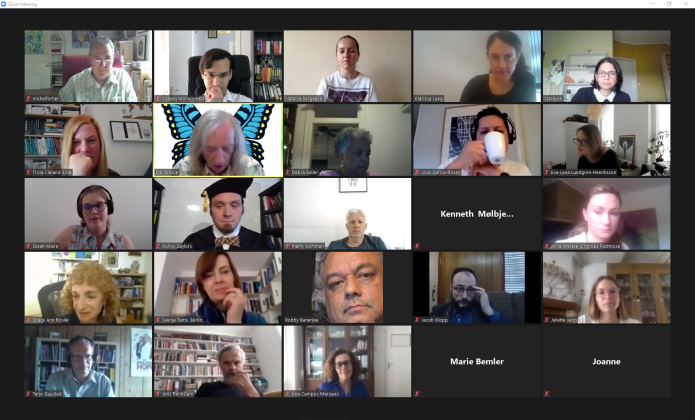
This year I took part in Sub-theme 52: Storytelling a Sustainable Future organized by David Boje, Bobby Banerjee, and Kenneth Mølbjerg Jørgensen.

EGOS screenshot

On Zoom with the members of Stream 52 at EGOS 2020

It was an enjoyable conference because I got to listen to a number of very interesting stories about local politics, indigenous ways of knowing, and new innovations and so on. Stories are always good to hear because they tell us something important about how the storyteller sees and makes sense of the world.

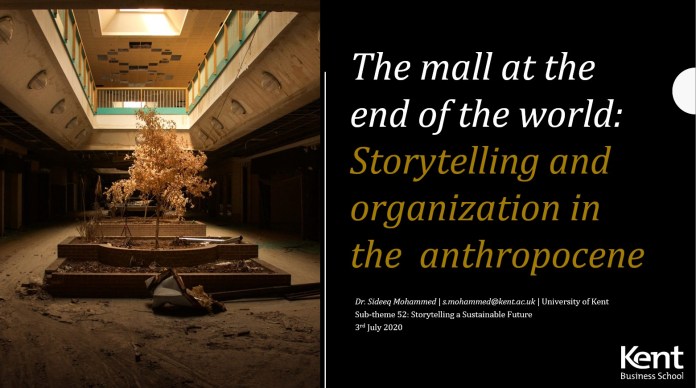
I presented a few sections from the book that I’m working on (provisional title: The Mall at the End of the World”).

Presentation Slide.jpeg

My cheerful opening slide. Photo credit: Seph Lawless

Without wanting to give too much away, at the core of the text is a feeling of disillusionment and disenchantment with the current stories being told in the anthropocene, specifically the naïve optimistic hopefulness that inf(l)ects everything from delusional mythologizations that tell us that we can keep digging fossil fuels out of the ground forever, and the stereotypical heroic narratives of the Great Male Entrepreneur who will innovate some new technological revolution via carbon scrubbing or argo-engineering or bioplastics or whatever in order to save us – all the way to the stories of returning to the land and celebrating local, organic, farming and recycling collectives. Each one seems to me to be inf(l)ected with a kind of naive optimistic hopefulness, a kind ‘artificial intelligence’ that overcodes thought from within, predetermining where it will go and what possibilities are available for it to encounter, until all that can be though are thoughts that hope against hope that everything will be OK. All the stories that can be storied tell us that humanity will survive in the end. That we’ll switch to renewable energies, that we’ll cease all of our myriad activities that produce mass death and biodiversity loss, that we’ll suddenly abandon capitalism and everything will be OK. This artificium optimus produces endless mutations and modifications of the exact same story ad nauseam, and we swallow it like cultural dupes in order to remain blind to suffering and anguish on multiple temporal lines (past, present, and future). We can change, it’s not too late, everything can still be ok!

I’ve become obsessed with out-dreaming this artificial intelligence and its endless and confident deluge of hope. Not as a way of reconstituting what Mark Fisher called “capitalist realism”, but as a way of seeing what other stories can emerge, ones that might prompt anger, frustration, and upset(or perhaps catatonia, depression, and melancholia) – affects that are less easy to sit peaceably with. Enter The Mall at the End of the World. A place where capitalism lives forever as a spectre of itself. The paper tries to imagine what the people of such a space would do. We know who they would be, as wealthy investors like Peter Thiel are already buying up land in remote areas with an abundance of fresh water like New Zealand or setting up condos in abandoned missile silos and beginning other strategies to prepare for global ecological collapse or other similar disasters – seeing them as a way of achieving an individualist utopia free from the tyranny of the state or as yet another way to profit off of disaster capitalism. To put it bluntly, existing class and social inequalities aren’t going away and it is likely that the ultra-wealthy will survive while the rest of us die in ecological collapse. But, long into the future, what will their descendants who survive in that space do? What will life be for this people-to-come? Will they not tell themselves stories of our wonderful and sincere attempts to save capitalism as we hoped against hope that everything would be OK with out Sustainable Development Goals and Green New Deals; our stories of patient Gaia and returning to the earth? Would their legends not be about how we all loved going to work and going shopping? About how fair and benevolent a system capitalism was (having been raised on an oral tradition of stories that extolled its virtues)? The “perspectivism” of looking forward to look back interests me at the moment.

Bobby Bangejee called the paper “despairingly inspiring” (which I take as a profound compliment) and flattered me by praising the work and encouraging others to read it. I take that as a hopeful (ha) sign that the work is worth doing and may post the full essay on this blog at some point.

I may post more updates on the book as it develops but for now, I just hope that I can attend conferences from my own home next year.

Standard
Notes from the Conference Circuit, Reflections

Notes from the Conference Circuit 2019: Capitalistic perspectivism

One of my favourite ideas comes from the work of Brazillian anthropologist Eduardo Viveiros de Castro: Cosmological Perspectivism. Based on his ethnographic work, Viveiros de Castro recounts the creation mythologies of Amerindian peoples which suggest that there was a time when the earth contained only people, and that through various adventures, misadventures and encounters, these people were transformed into the flora and fauna that we know today. The quote that I love which explains this comes from a 1998 paper, Cosmological Deixis and Amerindian Perspectivism, but appears in different forms throughout his body of work:

“being people in their own sphere, non-humans see things as ‘people’ do. But the things that they see are different: what to us is blood, is maize beer to the jaguar; what to the souls of the dead is a rotting corpse, to us is soaking manioc; what we see as a muddy waterhole, the tapirs see as a great ceremonial house” (p.477-478)

The core idea that is being communicated here, the one that fascinates me the more that I think about it, is an absolute metaphysical relativism that challenges us to reflect that other human and non-human beings do not see the world as we do, that ‘experience’ is itself heterogenous, tout court, and the world understood thus becomes not a place of unstable signifiers but of unstable referents, one that has only difference at every level. That another being  may look at the very same thing that ‘I’ see, and see something radically different is best understood, as Latour describes it, a bomb thrown into a Western metaphysics with the potential to upend the ways in which we think about the social milieu in general and ethnographic encounters in particular.

20190708_073026.jpg

Penny and I enjoying Royal Holloway’s beautiful campus at the Deleuze Studies Conference

I’ve written about this before on this blog and I bring it up again, because while at this years conferences I became interested in a particular and perhaps related question, namely, “How does capitalism see the world?” My paper at EGOS was at least partially about the ways in which capitalist axiomatization is complicit in the production of a perverted desire for annihilation and one audience member was, to use his term, “embarrassed” by the way in which I tend to speak of speak of “capital” as a having a coherent existence, desires, logics and so on. If I reflect on this tendency to speak sloganistically (e.g. “Capital places no extra-monetary value on human life,”) I might tease out a tendency in Deleuze and Guattari – following Marx – to do the same (indeed, other Deleuze scholars do the same thing) but more pointedly, while I might acknowledge that capital has different flows, fluxes, counterflows, resistances, schisms, and bifurcations, I genuinely ask any reader to think of the last time that they did something that was not in the service of a firm’s agenda of profit maximization. When was the last time that you acted against the best interests of capital? The absolute heterogeneity of our experiences starts to look quite perversely the same when we think about it as all being in the service of capitalist revenue maximization. Indeed, the difficulty that we all experience in answering such a question should give us pause to reflect that every potential act of rebellion, creative thought, radical offshoot and so on, creates a new market that is (with the appropriate time lag) eventually capitalized upon, everything is eventually subordinated to profitability. If this is the case, how can we ever speak of individual subjects or agentic action, given that supposedly free agents will never exercise any radical freedom, only ever serving the interests of capital to greater or lesser extents.

20190629_072009

Studiously making notes. Penny judges my handwriting far too harshly.

As such, I have what I think is a perspectival thought. What is it like to be capital? Capital does not perceive the same reality that humans do. Capital looks at an ecological crisis that involves a warming planet, acidified oceans, drought, wildfires, more powerful hurricanes, and rising oceans and sees opportunity to maximize profits by responding to a new demand for sustainable businesses or products. What to us is a public health crisis of drug use and addiction, capital sees an opportunity to make profits by at once expanding the pharmaceutical industry in order to sell the drugs and also own the prisons and rehabilitation centres where people are sent for punishment/treatment. Where we see an expression of acceptance and love by those who have not been accepted, those whose love was once outlawed by the state, capital sees an opportunity to maximize profits by cornering the LGBTQ+ market through participation in Pride. 

What is it like to be capital? It is to be the Great Optimist, always hopefully watching out for a new opportunity. It is to see the world only in terms of possibilities for multiplication, for connection, for proliferation, to grow infinitely. Capital exists with a purely virtual ontology, a numerico-techno-potentiality, it can become any thing and has a passport to go anywhere. As the condition of axiomatization, facilitating unequal exchange, capital is itself never axiomatized. It is a flow endlessly, circum- and extraplanetary. Whereas a traditional Western metaphysic might tell us that humans see humans as humans, animals see animals as animals, and capital sees capital as capital, Capitalistic Perspectivism suggests to us that capital sees humans, animals, and capital as opportunity – as resources that can be used in order to generate more capital. Capital sees the world only in terms of possibilities for multiplication, for connection, for proliferation. Capital is in this sense the great equalizer. Its perspectivalism means that it does not see humans in the sociopolitical contexts that other humans do. Rather, it sees them as resources that it uses to further its own growth and proliferation. Capital does not care if humans are whie, black, or brown. If they are abled or disabled. If they are LGBTQ+ or straight. If they are human or non-human Indeed, capital does not even ask if they are alive or dead as both are equally resources for capital’s growth and expansion. Capital’s only question is “How can I continue to grow?” or “What assembly’s of resources will allow me to grow the most?”The ethics of capital is thus Spinozist, asking what combinations will healthily increase my body, what will decrease or harm it and since capital overs over all things, these ethics are purely immanent.

Understood in this way, the operations of the contemporary social fabric make more sense. Capital only ever sees one thing, potential for growth. That is it. Capital cares about nothing other than its own survival and in expanded size there is less of a possibility of diminution and disappearance. It is this naked and comically exaggerated self-interest that I think Hietanen et al (2019) are talking about when they talk about the capitalized subject or the “one who has completely embodied capitalism’s monstrous desire of indefinite accumulation (‘I am productivity itself!’). […] all possible subjectivation is replaced by the desire of capital itself.” While the term itself is becoming increasingly passé, this is what it means to be a good “entrepreneurial, neoliberal subject”, to be one with capital. To want what it wants. To see only from its perspective. And who among us does not?


Standard
Notes from the Conference Circuit

Notes from the Conference Circuit: Desire and Breakfast

In L’Abécédaire de Gilles Deleuze, Claire Parnet presses Deleuze to explain his and Guattari’s concept of desire; challenging him to explain it in clearer terms. He says “you don’t desire someone or something, you always desire an aggregate. It’s not complicated.” This formulation of desiring-production has always stuck with me and I often think about it in the course of everyday life. Desire is not about lacking or wanting an object or a person, desire desires an assemblage. I had cause to reflect on this when I was in Edinburgh for EGOS and got sick of eating breakfast at the hotel. Having had to travel more than I’d have liked to over the past few weeks, I was quite literally fed up with eating Premier Inn buffet breakfasts and wanted something better.

20190707_083417.jpg

Pictures with Penny near the outside of the Quick and Plenty Cafe.

I chose the Quick and Plenty cafe, precisely because it looked like a tiny hole in the wall on Google Maps. It was the best breakfast that I’ve had in a long time. I couldn’t have made it better myself (which anyone who knows my fondness for things done my way would know is high praise). Friends will know that I like simple food done competently, which is precisely what this was. I reflect that I enjoyed the meal, because I didn’t just desire an “authentic” Scottish breakfast (or some hyperreal simulacra in construction of authenticity) and I didn’t just want to get out of the hotel. It was the assemblage that was important. The desire was for sitting somewhere with dingy yellow lighting, on a cushion that had become so worn from use that it had to be covered over by a blanket which itself looked to be as old as I am. The desire was to order a Scottish breakfast off of a speckled, laminated menu while staring at the tangle of power cables and wires that was supporting their payment/online order/music system. The desire was to come in out of the light Scottish drizzle and feel awash with the warmth of a running stove. The desire was for watching the chef cook my breakfast in cheap looking pans on a small kitchen hob while bantering with his assistant in a thick Scottish accent, occasionally taking a phone call in which he would yell at someone (perhaps a mother, wife, or a girlfriend) that he was too busy to talk and needed to be left alone. The desire was for listening to the great care that he had for the food and to speak to him in exceptional detail about the long-standing local bakery that the rolls came from or the history of the company from which he sourced the haggis. The desire was for the glass-eyed sterility of the polished customer service interaction in my hotel to be completely upended by a space dominated by a kind of professional-unprofessional, an intermingling of diligent, conscientious care and that special kind of not giving a shit that is an artefact of Scottish dourness. This disconnect from a multinational semiocapitalist machine and reconnect to a smaller capitalist machine, one not yet alienated from itself, is a key part of this assemblage and its remobilization of consumer/tourist discourses. The desire was for reflecting on all of this while drinking instant coffee and thinking about how desire was being machined in that moment. I did not know how much I needed the food until it arrived, served in a rambunctious and unpretentious space. But this “I” invites further consideration.


20190703_212315.jpg

Definitely not day drinking at The Bow Bar.

As Deleuze and Guattari say in Anti-Oedipus:

“Desire does not lack anything; it does not lack its object. It is, rather, the subject that is missing in desire, or desire that lacks a fixed subject; there is no fixed subject unless there is repression. Desire and its object are one and the same thing: the machine, as a machine of a machine. Desire is a machine, and the object of desire is another machine connected to it. Hence the product is something removed or deducted from the process of producing: between the act of producing and the product, something becomes detached, thus giving the vagabond, nomad subject a residuum.” (p.26)

What is important to say is not only that this desire did not pre-exist the assemblage, I did not preexist the assemblage, the subject was machined along with everything else as a by-product or residuum of the machinations of desire. Subjectivity is here not that from which desire emerges, but a residuum, a by-product made in the small pub assemblage or the used-bookshop assemblage.

20190706_172644

Edinburgh had several used bookshops that we visited because they had books and I am a simple man.

In most readings, Deleuze and Guattari’s understanding of desire is thought in a way focuses on the affirmative and the joyous connections that desire brings about. Recent work (like Culp’s Dark Deleuze) has, however, begun to popularize an alternative reading to which I am partial, the darker understandings of desire, not productive and prudent, but destructive and apocalyptic; desire tearing itself apart. Desire for annihilation, for destruction, for even death. Perhaps that’s why desire was producing a person with high cholesterol and mild liver damage…

Breakfast at Quick and Plenty was the start to the best morning that I’ve had (outside of my house) in a long time. I want to go back to Edinburgh as soon as I can, and I know where I’m having breakfast when I do.

Standard
Notes from the Conference Circuit

Notes from the Conference Circuit: Is well ethical, innit bro?

Perhaps one of  the hardest things in the world to accept is that other people might consider the same information as we do and arrive at different conclusions. Most of us are so sure of the efficacy of our thought processes that it may not ever occur to us that they may be flawed or problematic. This is a less lucid and self-aware reflection than it seems to be, because I am here simply trying to think about how it is possible for anyone to still believe that “ethical capitalism” is possible. I have taken to openly saying to students and colleagues that “anyone who seriously believes in the possibility of a contemporary corporation acting with genuine ethical concern is either dangerously delusional or an irretrievable idiot; I don’t know which is worse.” This never fails to be a divisive comment – not only because it is very heavy-handed but also because it plays fast and loose with the term “ethics”, so I wanted to offer a clarification. Without a digression into contemporary moral philosophy (which I am not well-read enough to sustain), an “ethical capitalism” – as most would understand it – would be a form of capitalism that seeks not only the increase of private wealth but also places value on human and social well-being. This is an impossibility. Here’s Peter Bisanz writing for the World Economic Forum, which I quote at length because it is important:

“Call it what you like: conscious capitalism, responsible capitalism, ethical capitalism – the better way to practice capitalism is to move the needle towards creating long-term socio-economic and environmental value: a business model with a higher purpose, where businesses build deep, trust-based relationships with their customers, employees, suppliers, investors and society. The bottom line benefits too from this kind of ethical, values-driven capitalism. Businesses adopting this model attract more customers, reduce operating costs through energy efficiency and lower waste, boost employee loyalty and enjoy engaged workforces that share the corporate vision, aspirations and goals.”

The paradox here should be obvious but isn’t is this is a popular refrain within many academic circles – “being ethical is profitable”. The logic of wanting a business model with “a higher purpose” and wanting a business to continue to maximize the benefits to their bottom line is never considered as mutually contradictory or fundamentally in conflict. The axioms of contemporary capitalism – perpetual growth, assimilation of paradox, market sovereignty and so on – make it impossible to even conceptualize a reality wherein a business may have to make a loss to serve a higher purpose (as an aside, this is why I’ve been so fascinated by the reaction to Jeremy Hunt’s comments about a no-deal Brexit, precisely because they break this taboo and blaspheme against the market). In this sense capitalism has an “ethic”: accumulation. Capital seeks only to grow, through whatever combinations and conjunctions it can make.

20190703_153602.jpg

On the train to Edinburgh

I read about my new favourite examples of this on the train to EGOS in Edinburgh. Here’s Bloomberg’s Peter Robinson reporting on the Boeing 737 debacle:

“The Max software — plagued by issues that could keep the planes grounded months longer after U.S. regulators this week revealed a new flaw — was developed at a time Boeing was laying off experienced engineers and pressing suppliers to cut costs.”

What recent reporting has brought to light is that increasingly, the iconic American plane-maker and its subcontractors have relied on temporary workers making as little as $9 an hour to develop and test software, often from countries lacking a deep background in aerospace development. While the entire story of the 737’s development, reads like an attempt to prove that only economic interests, as they pertain to wealth accumulation, are represented in decision making, it is this outsourcing – the kind of story that seems too moronic not to be true – that highlights what happens when the profit motive clashes with any other concern (in this case valuing human life). Profitability wins, every time. This case doesn’t really tell us anything about the blood-soaked calculus of economic rationality that the Ford Pinto case didn’t tell us in the 1970’s; laying off your experienced software engineers, and outsourcing their work to a cheaper organization in the global South and possibly directly contributing to the deaths of hundreds of people, was very likely the most profitable option, even considering the $100m payout that is supposed to go to the families of the 346 people killed by the 737 crashes. Yet one can go to Boeing’s websites and read about their social responsibility policies and how much they invest in “communities”. And if I asked my undergraduate management students, “Is Boeing an ethical company?” it is from this very page that they would quote in order to tell me that it is.

Yet, since the 1990’s, public intellectuals like Noam Chomsky have been commenting on the ways that companies like Boeing are gaming the system and using military investment to further their interests. We have long known that companies like these represent a perfection of the capitalist logic of perfidious accumulation, using any means necessary to grow and agglomerate wealth, while an entire social and political apparatus convinces us that this is merely the disembodied will of “the market”. Here “management” as a practice is itself unveiled as entangled – the decision taken on a microlevel to cut costs through layoffs and outsourcing is inextricable from the regarding of “the market” as sovereign and the profit motive as the only true and legitimate impetus to action – producing the predictable effect of people dying. This is to say nothing of the fact that we know how damaging flying is to the environment, meaning that Boeing’s profitability as a company fundamentally relies on us continuing to disregard the dangers of anthropogenic climate change.

I imagine that defenders of capitalism would say that its current predicament is the price that Boeing pays for not acting “towards creating long-term socio-economic and environmental value”. Yet we have to ask which of the axioms of capitalism Boeing is in breach of here? Is the shift in employment relations towards precarity and temporary working as evidenced by the much praised gig-economy not symptomatic of precisely the decision to seek out cheaper labour internationally? When we collectively know that we need to recycle to keep plastic out of our oceans but multiple journalistic exposes tell us that often plastic now goes unrecycled (destined for landfills or incinerators) because there’s no demand for recycling “due to poor market conditions” is this not the same logic of economic valuation privileged over everything else?
20190707_175949.jpg

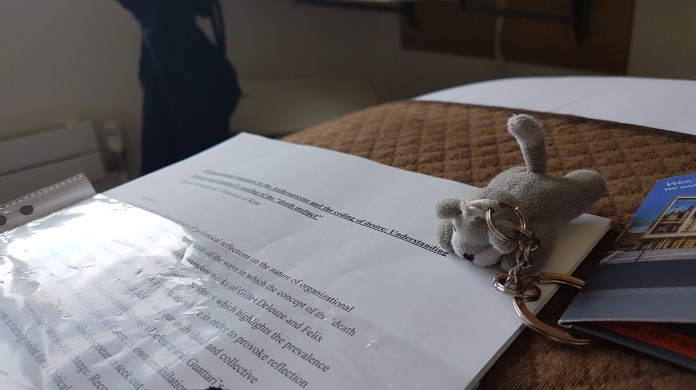
Getting reading to present a paper or desire, death, capitalism and the Anthropocene

I thought about this while attending a stream on Critical Organizational Anthropocene Studies. As I heard about the very ethical and environmental things that different organizations were doing, I thought about the character Waj, from Chris Morris’s incredible film Four Lions. Waj is characterized as a well-meaning but simple man whose defining character trait is perhaps that he consistently defers decision making (and thus ethical responsibility) to his presumably more ethical and intelligent friends. The deferral of ethical judgement to an other, allowing for a reality in which one could do or condone the doing of potentially horrible things is encapsulated in what I might stylize as a refrain of the question: “Is well ethical, innit bro?”. Perhaps it evidences that I have watched the film too many times but I can hear actor Kayvan Novak saying it in Waj’s accent and could hear it at times during colleagues’ presentations at EGOS.

Indeed, though I was participating in a stream on “Critical Organizational Anthropocene Studies” not many of the presentations treated seriously the question of what a “critical” study of organizational responses to the Anthropocene might be. Many of the presentations had a hopeful tenor, or one that we might recognize as a kind of business-as-usual for capitalism – turning any form of critique or revolutionary action into something in the service of its own end – and could thus be read as complicit in mobilizing environmentalism as a vehicle by which to “save” and preserve the mores of capitalism itself. Here’s a company in the circular economy that’s recycling concrete or turning fish scales into bioplastics, or here’s one that is taking seriously the “slow food” movement and building up a community concerned with sustainable, local, everyday practices, or here’s a co-operative volunteering to sort and recycle other people’s waste, or here are some people in the global-South involved in a recycling cooperative. Is well ethical, innit bro? I at times found myself envying the optimism of my colleagues – as well as admiring their passion for their work – but I find myself to be too cynical to be hopeful that these kinds of engagements as they seek to preserve the essential logics of capitalism by merely wrapping them in a “green” casing. Indeed, in the cruellest reading these organizations and their ethical/sustainable/circular economy moves merely function to  allow capitalism to continue. But one can’t observe this, it’s too bleak, too uncomfortable a thought because of how roughly it grates against our fondness for the world that capitalism has built for us and how much it jars with the accepted mores of neoliberal subjectivity. “By trying to help you and champion those who you see as trying to bring about a better way, you may be making things worse; the main thing that you’re doing is making yourself feel better. There is nothing else that you can do.” I have to keep thinking about this, not just because it’s important but because it speaks to one of the defining features of contemporary capitalism, the assimilation of critique or its absolute reliance upon those who hate it.

20190706_153250.jpg

Enjoying the view from near Arthur’s Seat

What troubles me is that these kinds of arguments have been around for a while. Based on a decade long case study Wright and Nyberg’s (2016) An Inconvenient Truth: How Organizations Translate Climate Change into Business as Usual basically points out all of the same critiques that I might. That organizations’ short-term focus, focus and preoccupation with growth and revenue maximization make them ill-equipped to lead the fight against climate change. Most often we see organizations viewing the Anthropocene as an opportunity, seeking to profiteer off of it by providing the next new “sustainable” innovation. This was clearly put across by Andrew Hoffman in the context of a sub-plenary discussion on the Anthropocene when he said simply: “this is a great opportunity.” It was not immediately clear whether he meant that it was a great opportunity to further one’s academic career by publishing on the newest fad or whether he meant that it was a great opportunity for businesses to capitalize on a fast growing and profitable new sector but he later clarified by saying (overtly seeking to contradict Naomi Klein), and I quote:


The market is the most powerful force on the planet. If business does not solve it [the problems of the Anthropocene], it will not be solved.

The only way that we’ll see change in how organizations respond to the Anthropocene, according to a leading commentator, is via the logics of the market in a kind of eco-modernist optimism (presumably a demand for there not to be an ecological crisis will eventually be matched by a supply of “not an ecological crisis” once the time-lag is over). The role of an organizational scholar is therefore supposedly to show businesses how much money they stand to make if they start taking the Anthropocene seriously. It’s hard not to hear a simple abdication of responsibility to the other of “the market”. Is well ethical, innit bro?
Standard
Notes from the Conference Circuit

Notes from the Conference Circuit: An Introduction

Over the last few weeks I’ve been attending academic conferences. While never the easiest thing to do and not entirely unproblematic, conferences are a core part of being an academic as they allow you to catch up with colleagues (who are really the only other people who understand what the hell it is that you do) and get a handle on what research is going on in the field – a sneak peak of what will end up being published in the next few years. It’s also a great way to “network” and get a reputation for doing a particular kind of work, which if your colleagues value, they’ll consistently come to you for.

20190627_161822

Watching presentations at ICMS 2019 in Milton Keynes

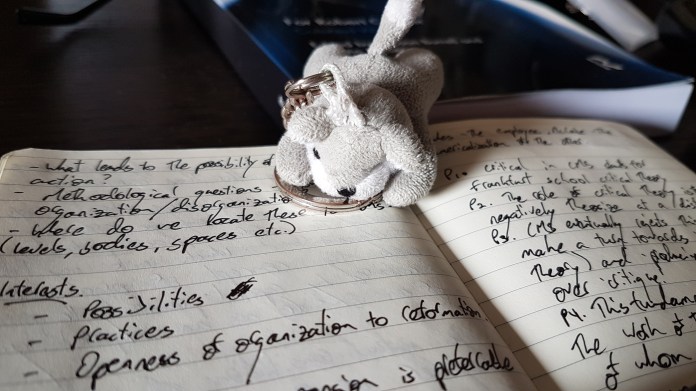
I had a lot to think about at this year’s conferences and so I’m going to put my notes from them into a series of articles/essays here which I’m titling Notes from the Conference Circuit. I fully intend to populate these notes with my usual array of pictures of a Penumbra the travelling wolf because, as this research log has likely already established, I’m most likely an idiot (and I perhaps mean this only slightly in the Socratic sense).

The notion of “circuits” appeals to me as the word connotes going around, undertaking a circular journey, and finding your way home the long way ’round, all of which reflects something fundamental to the logic of conferences. Revolutionary. We go somewhere “exotic” and then spend most of our time in a hotel or university building that looks almost indistinguishable from the one that we just left, we spend time with the same group of friends that we regularly correspond with, and present our work to a hungover audience who can’t follow what we’re trying to say because we’re saying it too fast, and sketching in strokes that are too broad to stand up to scrutiny. However, conferences remain the best places to pick up the random off-shoot, the snippet or fragment of an idea that turns into something substantial a few years down the line. Most likely it will be something that you already knew or were thinking about, but you needed to hear it phrased differently, of come from a different source. You had to go around a long way to come back to where you were.

Standard