I never really appreciated how much of what I write would end up on the cutting room floor until recently. Paragraphs, pages, whole sections of papers, and even entire texts that I have neither the time nor the wisdom to get through the peer review process, all end up resigned to the recycling bin. I’ll occasionally remember these texts and wonder what happened to them. Here’s one such text that I wrote which explains the core themes of my book. It’s short and pithy and was supposed to be a guest post/article for a newspaper or similar. It never took off/I never heard back from the university press office (I can’t imagine why) so I’m giving it a home here.
There’s nothing wrong with our imagination. It just cannot offer an escape…
The story that we seem to be telling is the same as it always has been, that we still have hope that things will get better. Humans, it seems, are a fundamentally hopefully species that are perhaps too enamoured with the myth of progress to imagine a reality where things are getting worse for us.
Questions of imagination sit at the heart of our response to the threat of global ecological collapse that we face. Literary luminaries like Amitav Ghosh and Ben Okri impress upon us how important it is that we try to imagine new futures, new ways out of the crisis, and commentators like George Monbiot frequently invoke the idea that our collective inaction in the face of a planet that is fast becoming unliveable for the human is a “failure of the imagination” The idea that our imagination is the key to unlocking a better response the challenges that we face now has become core to how we see the challenges that we face in the anthropocene.
But what exactly are the new solutions that we are hoping to imagine? A future where a heroic entrepreneur saves us from the potential horrors of ecological collapse with some new innovation in the area of carbon scrubbing or recycling? A future where we all “return to the land”, and set up quiet enclaves of local, communal, sustainable farming that facilitates vegan lifestyles? A future where we all flee the planet and live on Mars? The drive to imagine and create new futures, to keep dreaming of new worlds and ways of living in them, is such a potent and powerful part of what we might call the human experience that it is worth asking who or what benefits from us maintaining such a drive towards the continuous production of new imagined futures. Despite the fact that there is a litany of evidence that contemporary organizations cannot lead the fight against climate change we continue try to imagine a future where such organizations sidestep government inaction in order to really make a difference. Why?
Fredrick Jameson once commented in passing that “it is easier to imagine the end of the world than to imagine the end of capitalism”. In light of current events, it is necessary for us to revise this formulation and suggest that we all now joyously participate in the production of new imaginaries in order to create new markets, support new futures, and ensure the continuance of capitalism.
The idea that there is some kind of outside to capitalism is increasingly farcical. Every new innovation and imagined future is immediately captured and subordinated to market logics. It is not that there is something wrong with our imagination, it is that the very nature of capitalism involves the capture of any new offshoots or potentials. The best example is that veganism and “eco-friendly diets” are now big business. Yet another pointless consumer fad.
At this point, the truly unimaginable future seems to be one where capitalism continues indefinitely having shirked off the “drag” of the human. Imagine an underground bunker protecting a nuclear powered server farm that continues to make stock trades, long after all of an organization’s human workers are dead? This is the kind of future that capital is dreaming for us all.
Is sustainability possible? Of course it is, but there’s absolutely no reason for us to hope that the human will be involved.
If this is the case, at what point should we begin to regard the hope and optimism inherent in calls to imagine new futures as forms of “climate denialism”? The insistence that “it’ll all be OK”, at some point should be regarded evidence of a dangerous detachment from the social, political, and economic realities in which we find ourselves?
I enjoy Adam McKay’s work. While I can’t say that I hold all of his many collaborations with Will Ferrell in the highest of esteem, The Big Short and Vice are hilarious and cutting portrayals of the financial crisis of 2007–2008 and the post-September 11th warmongering respectively. As such, I was always going to watch his newest film, Don’t Look Up. My interest in it was compounded by the fact that my Twitter timeline over the last few days has been absolutely brimming with tweets and retweets from various academics in the climate science or sustainability research space speaking up in support of the film under the hashtag: #DontLookUp, praising its satire of contemporary politics and its critique of our collective inaction around climate change.
Critical reception has been mixed, but I have to say that I enjoyed the film while watching it. It was filled with the call-back gags and black comedy that make McKay’s work entertaining. However, I went to bed thinking about three passages from three texts that have sat at the forefront of my mind in recent years. Reflecting on these led me to think differently about the film, its message (which going by McKay’s Twitter is that we need urgent action in order to solve the climate crisis), and how I was affected by it.
“As Žižek has provocatively pointed out, anti-capitalism is widely disseminated in capitalism. Time after time, the villain in Hollywood films will turn out to be the ‘evil corporation’. Far from undermining capitalist realism, this gestural anti-capitalism actually reinforces it. Take Disney/Pixar’s Wall-E (2008). The film shows an earth so despoiled that human beings are no longer capable of inhabiting it. We’re left in no doubt that consumer capitalism and corporations – or rather one mega-corporation, Buy n Large – is responsible for this depredation; and when we see eventually see the human beings in offworld exile, they are infantile and obese, interacting via screen interfaces, carried around in large motorized chairs, and supping indeterminate slop from cups. What we have here is a vision of control and communication much as Jean Baudrillard understood it, in which subjugation no longer takes the form of a subordination to an extrinsic spectacle, but rather invites us to interact and participate. It seems that the cinema audience is itself the object of this satire, which prompted some right wing observers to recoil in disgust, condemning Disney/Pixar for attacking its own audience. But this kind of irony feeds rather than challenges capitalist realism. A film like Wall-E exemplifies what Robert Pfaller has called ‘interpassivity’: the film performs our anti-capitalism for us, allowing us to continue to consume with impunity.”
Don’t Look Up performs our anti-capitalism for us. The film features Mark Rylance as “Sir Peter Isherwell” the CEO of BASH, a thinly veiled analogue for the CEO’s of Microsoft, Apple, Tesla and other large lucrative tech multinationals. In everything from his demeanour to his ultimate and predictable ineptitude, the film enjoins us to dislike Isherwell, to resent his power, wealth, and willingness to turn the potential death of the human race into a cash grab, mining the comet for minerals. Watching the film, we engage in our ceremonial “Two Minutes Hate” of these scapegoats and enrage ourselves at the inept politicians dragging their feet and failing to take meaningful action to prevent global ecological collapse because they are too busy capitulating to the whims of the wealthy. Netflix will happily sell us this anti-capitalist film in order to continue to be profitable. We interact with and participate in this mechanism of control as we post on social media about how relatable it is and someone at Netflix’s marketing department records our engagement figures to drive content options in the future. This is not, to borrow the phrase, a film using the master’s tools to dismantle the master’s house; it is simply the case that the demographic audience for anti-capitalist film has grown large enough for capitalism to recognize it as a lucrative demand block and begin catering to its desires.
It is in the affective catharsis of hating the idiots shown on screen in Don’t Look Up, that we need to find some suspicion. We already know that corporations contribute disproportionately to the climate crisis and that they can’t lead the fight against it, so whose interests are being served as we continue to consume this anti-capitalist message?
“Thus, everywhere in Disneyland the objective profile of America, down to the morphology of individuals and of the crowd, is drawn. All its values are exalted by the miniature and the comic strip. Embalmed and pacified. Whence the possibility of an ideological analysis of Disneyland […]: digest of the American way of life, panegyric of American values, idealized transposition of a contradictory reality. Certainly. But this masks something else and this “ideological” blanket functions as a cover for a simulation of the third order: Disneyland exists in order to hide that it is the “real” country, all of “real” America that is Disneyland (a bit like prisons are there to hide that it is the social in its entirety, in its banal omnipresence, that is carceral). Disneyland is presented as imaginary in order to make us believe that the rest is real, whereas all of Los Angeles and the America that surrounds it are no longer real, but belong to the hyperreal order and to the order of simulation. It is no longer a question of a false representation of reality (ideology) but of concealing the fact that the real is no longer real, and thus of saving the reality principle.”
Satire finds its basis in exaggeration. Yet any exaggerated portrayal of current events is no longer possible because the lines between fiction and reality are obfuscated. The scene where the scientists finally get to meet the President and discuss the urgent crisis of an enormous mass of rock threatening to wipe out all life on Earth is funny when they are met with the response of an indifferent and dismissive decision to “sit tight and assess” precisely because it exists in stark contrast to dramas like The West Wing, where characters made larger than life by Aaron Sorkin’s verbose yet eloquent dialogue would respond to such a crisis by taking decisive action in order to reach a meaningful resolution (usually with one or more heartfelt soliloquies along the way). The fact that such scenes redouble and find themselves being performed or deliberately not performed in the course of everyday life, can only remind us of the fact that “the real” is no longer identifiable. None of us would know what decision making in the Oval Office is like, and indeed we could not know, because any decision making would inevitably be a kind of mediated performance from all parties.
The film’s relation to our current political “reality” can thus be analogized to that which Baudrillard sees between Disneyland and America. It is lauded as satire in order for us to continue to hope that reality is not quite like what it depicts. Yet the interplays between the satire and documentary make this praise one that should draw suspicion. Any affects that the film elicits, whether laughter or deep frustration, which our daily news does not, may well stem from a misrecognition of the fact that it is “the real” which hides that there is none.
*
Lastly, from Carl Cederström and Peter Fleming’s Dead Man Working:
“The business discourse of ecology evokes a pseudo-criticality that numbs us even further, blinding us to the impending disaster of an unsustainable system (with mindless mantras such as ‘recycling will save us’). In other words, the disingenuous code of responsibility provides a practical medium for people to express their concerns, but in a manner that precisely consolidates their role as an obedient, productive worker. The sequence is clear. We are enlightened about the catastrophe around us, we embark on a employee-led social responsibility campaign such as jogging to raise money for a local homeless shelter. We are making a difference, but in reality nothing changes for the better. It is this feeling of ‘we tried’ that allows us to sustain what we know far too well is an unsustainable state of affairs.”
When Jennifer Lawrence’s character, Kate Dibiasky, is faced with death at the end of the film, her poignant reflection on her life is: “I’m grateful we tried”.
She and the other scientists resign themselves to their fate and sit down to a quiet dinner and continue with pained and deliberate small talk while waiting for the end of the world. In this regard, if anything, the film seems to me to be a critique of the environmentalism movement’s own self-image. The sane and rational scientists with logic and the weight of peer-reviewed evidence on their side still lie at the mercy of divisive politics and antagonism, apathy, corporate greed, the cult of the “hero” entrepreneur, and general ignorance. The utterly impotent and resigned “we tried”, thoroughly imbued with feelings of intellectual and moral superiority, can also be read as a fitting mockery: this is the best that you could do. With all of your knowledge and insight, all of your protest, all of your theorization, nothing is the best that you could do.
It is this self-satisfied feeling of “we tried” that we need to continuously meet with suspicion. I suspect that many of us will be waiting with a schadenfreude-laden “I told you so” when ecological collapse starts to have effects that are not possible to debate or ignore. Yet the precursors to this affect are also present every time we “do the right thing” and eat vegan meals, recycle, travel in a more sustainable way, buy local produce, and so on. Anytime that we feel like we’re trying our best, we need to be wary that this affect is what allows an unsustainable system to continue.
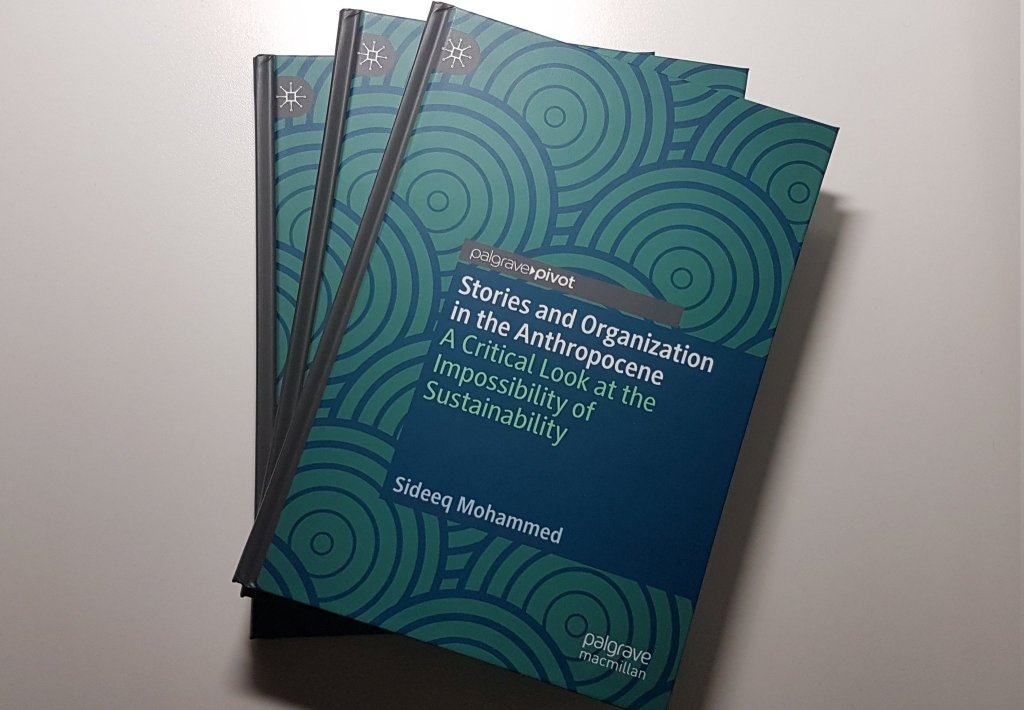
Copies of “Stories and Organization in the Anthropocene”
I still don’t really believe it. I’ve been posting about it on Twitter, but I’ve also been so swamped recently by doing things related to being KBS’s Associate Dean of Education that I haven’t really had the time to register or sufficiently reflect upon it. Occasionally, I’ll narcissistically refresh the page and just sort of look at it. I imagine that the excitement might wear off when the first negative reviews start coming in, but unless they tell me that it’s boring I’ll be OK with it.
I recorded a video for KBS’s marketing team where I talked about the different issues raised by the book and tried to answer some simple questions about it and in so doing I started to reflect on the key themes of the text.
I’ve come to the conclusion that, despite the complexity that I like to insist upon in my writing, there are basically three core ideas in the book and if someone understands those, then they understand what the book is trying to do.
What can we learn from trying to think critically about these stories and what they can tell us?
There are three key story threads that I think are worth disentangling in order to try to address such a question:
Imagination – Can we imagine our way out?
Acceleration – Can we accelerate our way out?
Hope – Can we hope for any way out?
Anyone paying attention to writing around the subject of the anthropocene will have become all too familiar with the refrain:“We need to imagine new solutions” or some similar statement decrying a failure of imagination. It’s everywhere, from critical theorists to journalists, and often in response to Jameson’s famous quip: “Someone once said that it is easier to imagine the end of the world than to imagine the end of capitalism“. I find this to be an inadequate position. It doesn’t ask how we move from the imagining to the actualization but, much more importantly, it assumes that one is capable of, as an agent, tapping into some transcendental resource, an escape from Capital, that will give life to some solution to the present ecological crisis. Yet we know that any deterritorialization will be accompanied by a reterritorialization, there is no escape to some mythical outside; Capital will easily appropriate any radical new strategy that you imagine; any new politics or radical offshoot becomes a new market for growth. Indeed, the idea that no one else will have thought of the solution that you imagined and isn’t already using it as a means to profit and perpetuate the same economic conditions that produce the anthropocene, is pure hubris.
This connects to one of my favourite lines of commentary in Anti-Oedipus where Deleuze and Guattari say that “capitalism has haunted all forms of society, but it haunts them as their terrifying nightmare, it is the dread they feel of a flow that would elude their codes.” This is an amazing description because it positions capitalism not as a particular social formation that has emerged in a particular place at a particular time in response to a particular set of social conditions, but rather as an “Unnameable Thing” that has always been with the human, Capital with a capital “C”. Waiting to emerge, influencing, using the human as a vector, inspiring, a muse, a trickster demon, and a source of hope. This confronts us with a far more interesting question: “Who or what is doing the imagining of new solutions?” A human agent thinking and trying to innovate? Or is it this Capital as nightmare, dreaming through you, producing your imagination in a confluence of influences and suggestions, rendering certain things as sayable, thinkable, and producible. What might be the goal or end of such an imagination?
In this regard, the book proposes a thought experiment, The mall at the end of the world. A space, perhaps built underground or among the stars buy some billionaire tempted to flee terrestrial life for reasons unknown to them, where Capital can live forever, long after resource extraction has become impossible and long after all humans outside this protected enclave had died? Could Capital survive as a kind of spectral performance enacted in stories passed down through the generations? The event of the emergence of such a space and the mass death that would produce such a bottlenecking of our species might affect us in the present in unknowable ways… Such a space would also exist as a powerful rebuke against the many threads of storying that tell us that the end of the world might bring about the end of capitalism, as it could live on, forever, in the right vessel, with or without the human. It also suggests that our attempts to imagine new solutions and ways of surviving translate into attempts to build the mall at the end of the world, to continue to survive and profit long enough for it to emerge, Capital using us like Leucochloridium paradoxum uses a snail. Such a space is perhaps already embedded in our collective imaginaries, given not only the popular images of “dead malls” but also the images of commodified spaces in The High Frontierand other works of speculative fiction. Is such a space not already being dreamt into being by those seeking to build bunkers to survive catastrophe? The hyperstition is making itself real.
The second theme we might think about asks the question: what if we tried to get out, not by resistance, but by going through capitalism? This story thread is present in Marx, in Deleuze and Guattari, Lyotard, and a number of others but it becomes most salient in the work associated with the Cybernetic Culture Research Unit (Ccru) formed at Warwick University in the 1990’s around the work of people like Sadie Plant and Nick Land. There are a number of different varieties and vectors of accelerationist though but the core is summarized by Land when he says:
“The point of an analysis of capitalism, or of nihilism, is to do more of it. The process is not to be critiqued. The process is the critique, feeding back into itself, as it escalates. The only way forward is through, which means further in.”
Land’s work imagines Capital as the mechanism of a hyper-intelligent AI emergent in the near future and capable of exerting influence back through what we perceive as time in order to secure the conditions of its own emergence. Essays like Meltdown, play on images of an inevitable planetary technocapital singularity that dissolves the biological into the technological, provoking eventually a radical series of conclusions, perhaps the only way forward is through, to accelerate capitalism’s destructive or abstracting tendencies, its ability to produce things which it cannot externalize (like a climate crisis), and see what else is possible because capitalism can’t be greened, reformed, placated, or changed. Its process proceeds with or without the human, a terrifying nightmare that has found us as a temporary host.
What does this mean for those of us who teach and work in the contemporary Business School. Should we be teaching alternative modes of organizing or sustainable/ethical modes of business? Viewed in a certain uncharitable way, one is perhaps less engaged in resistance and more engaged in creating new markets stimulating new trajectories for growth and profitability. The book proposes a number of thought experiments around this theme, but ultimately it arrive at the image of the Klein-bottle, an inside-outside that loops back onto itself. Different “strategies” that one might seek to employ in order to experiment with “practical accelerationism” are self-defeating, pointless (because the process was always taking place), or based in misunderstanding.
The last theme that we might consider is simply, can we hope for any way out? Again, those following published work on the anthropocene will be all too familiar with the question of hope. It is everywhere. Anywhere you look, there is a hopeful commitment to the future, a hope that there is something more that we can do, a hope that it’s not too late to change, a hope that protest will work, a hope that a Green New Deal will save us, a hope that some new innovation will work, a hope that some new diet stop ecological collapse, a hope in defiance of mounting evidence that there is nothing to hope for.
In response we might ask simply, whose Hope is this? Is it the independently felt emotion of a rational human subject, or is it an affect of Capital?If we were to genuinely take seriously Dipesh Chakrabarty’s comments that the human is now a geological agent, we have to ask whether there is any agency left. We are perhaps not ready to ask whether the concept of a “human subject” is of any use to us anymore, given that it is now an amorphous collective “anthropos” that grapples with existential risk. Again, is it really Hope that you feel for the future, or is it Capital’s survival instinct? The philosopher Emil Cioran suggests that “Hope is a slaves virtue” and in this case it is hard to see how he is not correct for this hopefulness is all pervasive. There is even hopefulness in Land’s experiments with the inhuman; a belief that the future exists and can realize the promise of a technocapital singularity in which the human is revealed as irrelevant and can be snuffed out by a machinc intelligence beyond its comprehension. It betrays a yearning for non-being; that a stilted and morphed Capital might have to survive in the stories of the mall at the end of the world may be too tragic an inevitability to consider. As such it also behoves us to cast a sceptical eye on the hopefulness that all too often emerges within the narratives of those claiming to be hopeless in the anthropocene.
If you’re a manager or a person interested in the lives and inner workings of organizations, you might justifiably ask, having been provoked to consider your own irrelevance in imagining, accelerating, and hoping, “So what should I actually do? If I wanted to really make a difference what should I be doing?” And unfortunately my response to this question is “Whose desire is it to “do something” in response to the anthropocene?” Is it your all too human survival instinct, your empathetic care for the species and its future, or is it Capital, thinking through you, dreaming ways to survive, to stall time until the mall at the end of the world can emerge and it can survive forever.
To put it bluntly, when we talk about “sustainability” who or what are we seeking to sustain?
The idea of a hyperstition upends this and is perhaps best explained with an example. The story of human refugees fleeing a dying planet earth and colonizing a new world is well established in our collective cultural imaginary. From books like Kim Stanley Robinson’s Red Mars to films like Christopher Nolan’s Interstellar, the idea that some catastrophe might befall the earth and consequently that we might have to make a new world for ourselves by colonizing and perhaps even terraforming some other planet, is very popular indeed. Perhaps less common is the image of the alien race that flees their own planet and tries to transform Earth (or the population of it) so that it might more closely resemble their home-world.
The trope has existed in different ways in the history of science fiction and can be seen in Thomas M. Disch The Genocides (1965), Raccoona Sheldon’s The Screwfly Solution (1977), and Ian McDonald’s Chaga (1995). It is also becoming increasingly popular in film. In the 1996 film The Arrival, the protagonist discovers alien underground bases disguised as power plants which are terraforming the planet. In the 2013 film Man of Steel, the same central thematic plays out. Aliens arrive from a distant galaxy and begin to attempt to xenoform the Earth, this time using an enormous “World Engine” that spews clouds of dust and gas. In the 2018 film Annihilation an zone of disjuncture called “The Shimmer”, is created around a crashed alien ship, which rewrites DNA and distorts the world around it in frightening ways that produce transmogrified flora and fauna. These stories may well be appearing at an increasing rate signalling that at some future point they may make the transition from fiction into reality and appear on the pages of our newspapers, once some critical point of density is reached.
The question raised by hyperstition is simply “Who is telling this story of the colonization of the earth?” Our common sense answer would say that it is a wide variety of human actors entangled in particularly identities, relations of power, and discourses that make certain stories sayable, intelligible, and thinkable. However, could it be that these stories are telling themselves, that they are possessed of certain libidinal energies that are capable of using the human subject as a vector in order to actualize themselves? Or, could it be that certain entities or events are of such significance that they have effects that travel back from the future through what we perceive as time, creating effects in the form of fragments of storying that serve to facilitate the bringing of these events or entities into existence?
This is the core of the notion of hyperstition, what is either a new theory of time or is an account of possession as “The Old Ones” seek to shape human affairs, all of which connects to Land’s vision of Capital as an alien intelligence or AI from the future that is acting through time in order to make itself real. He ends the essay Circuitries by asking provocatively:
How would it feel to be smuggled back out of the future in order to subvert its antecedent conditions? To be a cyberguerrilla, hidden in human camouflage so advanced that even one ‘s software was part of the disguise? Exactly like this?
Theorized in this way, we ask what cultural fragments are being effected back out of the future by some event, say the final emergence of the planetary technocapital singularity that replaces the human, or the death of the last human in the anthropocene?
Indeed, in light of the most recent IPCC report one might ask how could the anthropocene make sense other than as a concerted attempt to xenoform the planet Earth by or for some other form of life-to-come? It is patently absurd to think that world leaders, organisational stakeholders, and a civilised global populous, would simply resign themselves to do nothing in the face of global ecological collapse. Instead, it makes far more sense that the Earth is being prepared for some other form of like which needs higher and warmer oceans, burned forests, and mass extinction of existing wildlife, in order to arrive and thrive with its own forms of life. If it is Capital and not some other form of alien intelligence that requires this new form of life in order to continue to expand proliferate and grow as it always has – humans having reached their full potential of usefulness to it – then it is necessary for us to acknowledge this coming obsolescence and to see the anthropocene as the mechanism by which simultaneously preparations are made for something new and useful and a process by which the irrelevant detritus of human existence is disposed. Capital may simply no longer require the intelligence and affects of bipedal primates and is preparing for what form of life will next advance it. Why else would we be creating a toxic lake of black sludge filled with run-off from the processing of rare earth metals, growing underwater DDT dumps, or generating many areas rife with nuclear radiation, other than to support something to come which would need such places in order to live?
In the final analysis, the anthropocene represents the hyperstition of the xenoformed earth attempting to make itself real.
In The Trouble with Being Born, Cioran reflects: “Ideas come as you walk, Nietzsche said. Walking dissipates thought, Shankara taught. Both theses are equally well founded, hence equally true.”
I thought about this often over the last few days, suggesting that Cioran was both wrong and right, in his observations. I think that he would have found that kind of ambivalence amusing. There is a certain peculiar complementarity or synergy between Cioran’s acerbic pessimism and the dour and severe weather on the Munros over the last week where I went to try to get a bit of a break from work.
I've had an obscenely busy and stressful year so I'm actively trying to not work for a little while. I'm not good at relaxing though so I'm currently drinking scotch, eating chips, staring out at the fog rolling in over the hills, and reading Cioran. Baby steps. pic.twitter.com/GQUU6k09bS
After the last year of lockdowns, work, and being stuck inside, being on my own in the hills felt a bit like a dream, or at least the kind of dream that Cioran describes when he comments: “I suppressed work after word from my vocabulary. When the massacre was over, only one had escaped: Solitude. I awakened euphoric.”
*
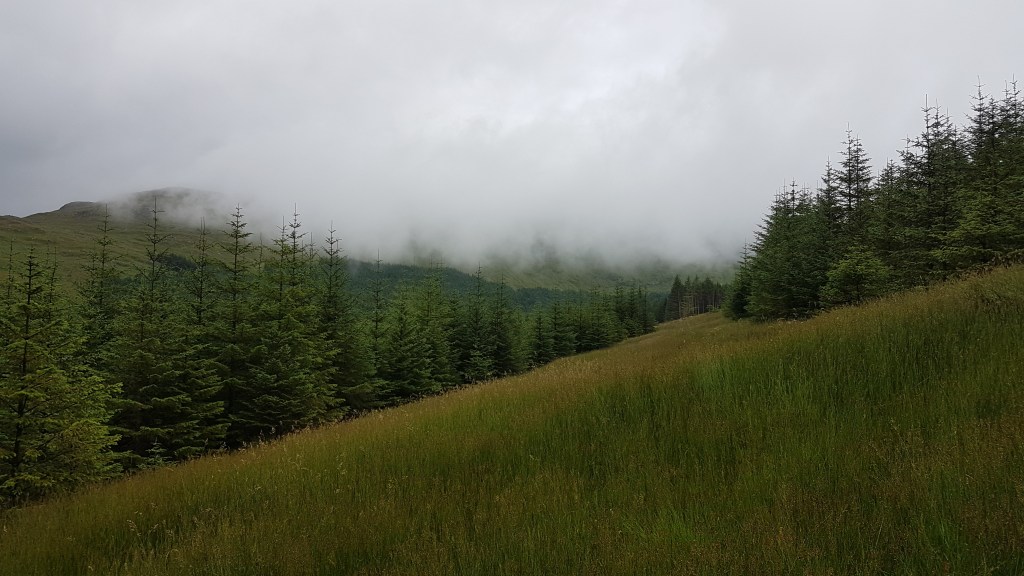
In the forest south of Crianlarich, looking east towards the ridge line.
My first Scout Leader was Joel Beharry at the 1st Naparima College Sea Scout Troop. I don’t have any photos of him, but I remember him as a kindly and paternal figure who taught me to respond to life’s challenges with temperance and good humour.
We would often go on hikes through the undulating rainforests of Trinidad to see a waterfall or some other natural feature. Often, while dripping with sweat and the exertion of navigating the at times claustrophobic paths, Mr. Beharry would pause, and staring into the middle distance would ask “Where allyuh does bring me boy?”
As a boy, I recalled finding this question flummoxing. Surely, he was the one who brought us, to what was usually a humid and mosquito infested patch of forest, not the other way around. As a man in his early thirties, I now understand what Mr. Beharry was asking, because I asked the same question of no one in particular while standing ankle deep in mud looking for an unmarked footpath through an evergreen Scottish forest, trying to scale a ridge to get to Cruach Ardrain, which I could already see was covered in cloud.
*
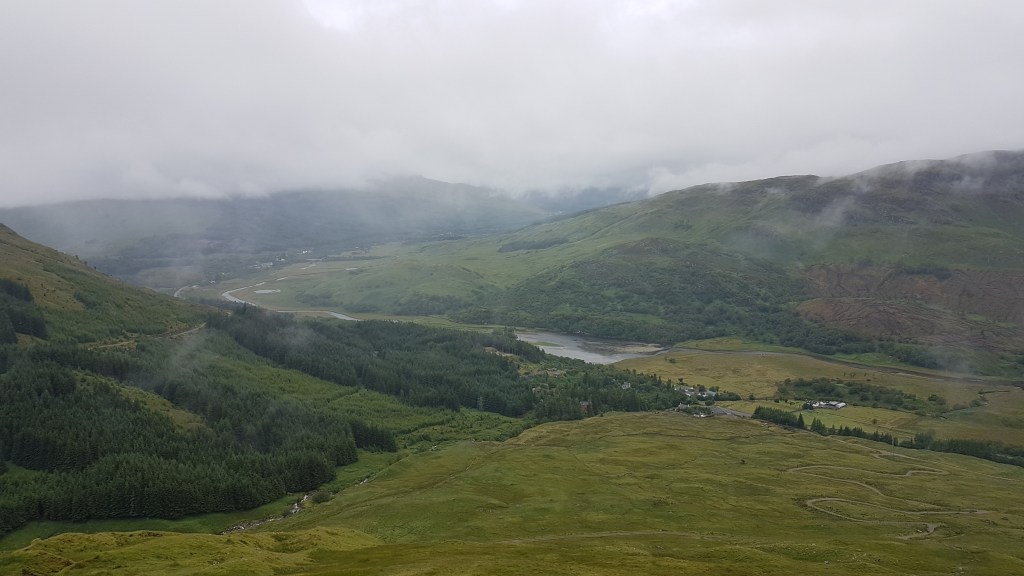
Looking back at Loch Dochart while summitingBen More.
The poem Alone by Edgar Allan Poe hangs on the wall of my flat. I’ve seen many interpretations of it, ranging from it being a poem about deeply loneliness and isolation to a reflection of Poe’s personal traumas, experienced during adolescence. The famed final line, “And the cloud that took the form […] Of a demon in my view” has been analyzed and assayed, and is understood to refer to a manifestation of the author’s own hatred of his image, resentment of his poor mental health and identity. The demon is a warped version of himself, perhaps seen in a mirror or as he imagines being seen by others. Such readings are tied to narratives about the author that lie in his past or present. But what of the future? I think about the demons that might emerge out of the future, crawling back to us through time and events which have not yet happened which nevertheless leave us dazed and delirious in the present, as I picture the clouds rolling over the mountains in my minds eye.
*
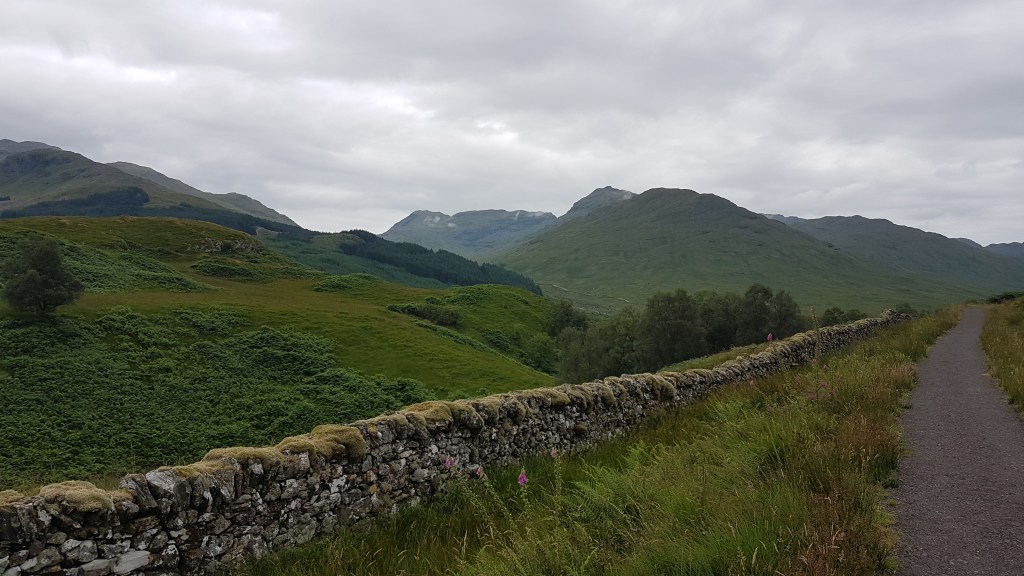
Looking towards An Caisteal from the West Highland Way.
I’ve made no secret of the fact that Tolkien is one of my favourite authors and that his writings had a tremendous impact on my as a boy. In The Fellowship of the Ring, there’s a song that Bilbo sings as he leaves the Shire, destined for Rivendell:
The Road goes ever on and on Down from the door where it began. Now far ahead the Road has gone, And I must follow, if I can, Pursuing it with eager feet, Until it joins some larger way Where many paths and errands meet. And whither then? I cannot say.
Different versions of the song appear at different points in Tolkien’s oeuvre, but this is the one that I memorized and is the one that I sing to myself as I walk. Over the years I’ve made up more verses and more lines. I don’t know if the tune is one that Tolkien intended, but it matches the rhythm of my normal walking pace and is a comforting song that speaks to a certain freedom and openness of life.
*
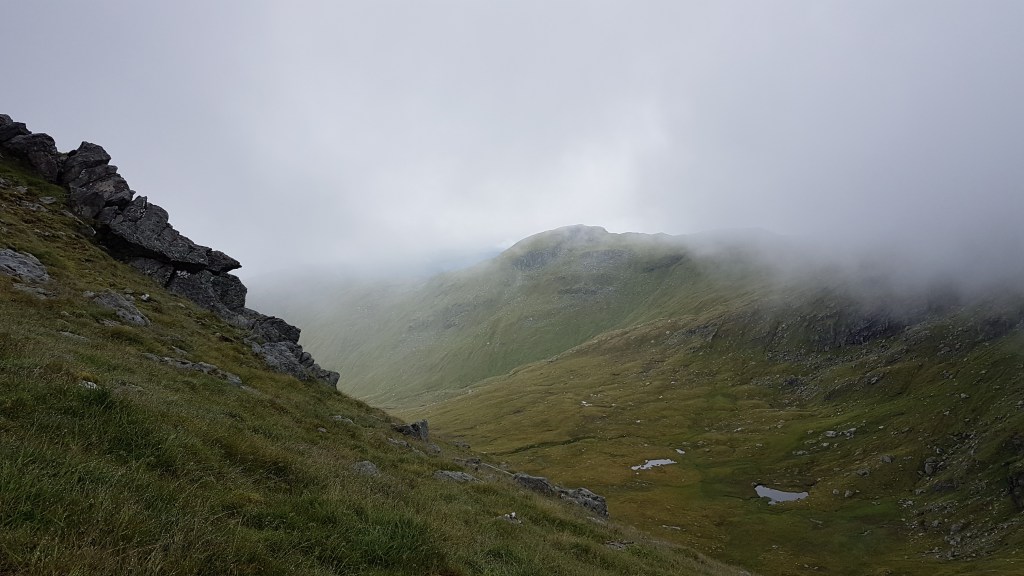
A break in the clouds coming off Ben More into Bealach-eadar-dha Bheimn
If you are sad about having to leave Scotland, don’t watch Justin Kurzel’s Macbeth on the train home. Yes, the score is magnificent, and the imagery of death and damnation really manages to capture the core of Macbeth’s arc as a character, but the movie is basically a two hour “Visit Scotland” advert. Nothing is more depressing than watching a scene of a maddening Macbeth wandering through a desolate moor to find the witches and thinking: “I want to go there…”
I don’t think that that fact surprises anyone. I’m stubborn, ornery, I don’t like to “play along”, have difficulty picking up on the social cues of what the teacher wants me to do, and most importantly, if I relax my face it frowns and I look like this >=| . As I’ve learned in my time in Higher Education, I am a fiercely independent learner. I cannot work to your curriculum. I do not want to go at your speed or wait for the others in the class to be up to speed. I want to learn on my own by reading and reflecting and there are perilously few ways to direct or point me to learn specific content that you think is important.
This is not just a self-pitying and reflexive acknowledgement.
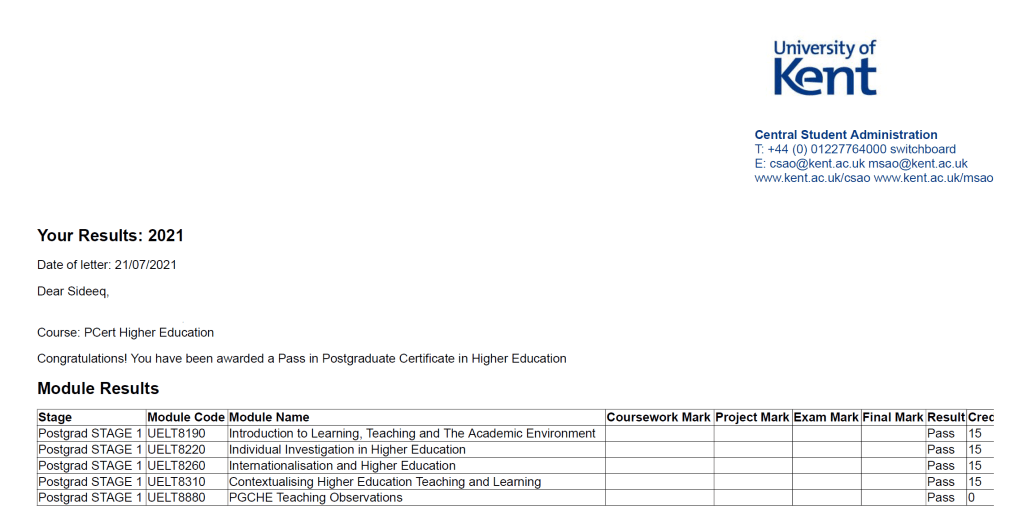
As part of their probation here at the University of Kent, new lecturers are required to undertake a Postgraduate Certificate in Higher Education. The course is designed to introduce new lecturers to the basics of pedagogical techniques and reflections in the theory and practice of higher education; to key terms, to important concepts or pressing issues, and to debates around topics as diverse as internationalization and the marketization of the contemporary university.
The course could have been exceptionally useful. Indeed, I imagine that if you’re a lecturer who’s just starting out, then it would be very helpful to you by allowing you to network with other new lecturers, get support and feedback from more experienced colleagues on how you’re doing, and begin to reflect on your pedagogic assumptions, practice, and philosophy. However, because I started at KBS in 2017 on a temporary contract, I didn’t get put forward for the PGCHE until January 2020. At that point, I already had a fairly good idea of what I was doing, wouldn’t really benefit from the opportunity to connect with other new lecturers, and had already become a well-respected colleague and well-liked teacher in KBS (as well as the Director of Studies for the BSc Management course). Additionally, and I cannot stress this enough, I am bad student. All of this means that I was never going to benefit as much as I could have from doing the PGCHE.
The four modules that I took all obviously involved assignments. All of them were essays on themes or questions related to the module and I decided to post these to this research log for posterity, but also as a showcase of what I’ve been doing over the last year. Most of the essays were written over the course of a single weekend because I didn’t have much more time than that to spend on them. As such, they drew mostly on material that I had already read or was already reading and are more than a little repetitive, drawing on common themes of accelerationist theory, Critical Management Education (CME) literature, and the role of “critique” itself in the Business School.
What follows is a list of the essays and their titles. They can all be found here. I share them with the typical disclaimers that ask that they not be circulated beyond this blog, published elsewhere, or cited without consulting with me first. I also share them as Turnitin Downloads so that they include the feedback that I received from the module convenor who assigned them.
“I don’t know if I’m brown enough for the Business School to sell”: Reflections on Internationalization.
If you notice that “one of these things is not like the other”, then congratulations on being observant. My original essay for UN819 was titled “Becoming the third person – Reflections on the otherness of student-teacher performances” and was an extended reflection on how the dominant practices and paradigms in Higher Education often involve a non-self-aware-awareness. In approaching the assignment for UN819, I found myself thinking a lot about how you could teach someone to be a better teacher. The goal, insofar as I understand it, is the cultivation of a continuous critical reflection that prompts circumspect and self-aware evaluations of one’s own practice. That’s a lot of what was asked of us on this module. However, I found myself struck by the artificiality of the reflecting that I was being asked to do. Reflecting on your teaching, and actively asking yourself what went well, what didn’t, and what you might be able to do better next time is just good pedagogic practice. But on a PGCHE module, reflecting becomes a spectacle, something done for the sake of praise and adulation, for a teacher to say that you’ve done a good job – instrumentalism abounds. I started feeling like I was not paying attention to the class, because I was too distracted by trying to seem like I was “a good student”, to make a spectacle of listening, to perform participation in an exaggerated way that would be noticed, to reflect that I was reflecting in a conspicuous enough manner. So, I wrote an essay around this theme that drew heavily on Macfarlane and Gourlay’s (2009) paper on “the reflection game” which addresses precisely this problem. The module convenor failed the essay on the grounds that it did not meet the learning outcomes for the module. I was mildly entertained by this, a classic case of “make me reflexive but not too much” and wrote what I consider to be a very dry and dull essay for the resubmission.
At a certain point, though, I began to try to just have fun with the essays. What unifies them is a deeply held skepticism about whether the Business School can play a positive role in shaping the future, one which I know that many CMS colleagues share, which I continue to reflect on in other texts that are forthcoming.
For now, I’m just glad that it’s over, if only so that I no longer have to worry about being on probation.
The following are excerpts from the ethnographic diaries of Dr. Sideeq Mohammed, who went out in order to study the lives of academics and found themself engaged in the study of the lives of The Nameless Ones.
18th September, 2017
I have settled into life with the natives. They are very familiar and welcoming towards me. I continue to be surprised by their charity and generosity. One of them welcomes me into their office and tells me about the various rituals of this place including the “School Forum” and the temperament of various others. I learn which people are irritable and which ones can be counted on. I am intrigued by these fascinating people.
October 1st, 2017
I have heard the natives speak about “The Nameless Ones”. They do so with tones of reverence and mild fear as though these things decide their fates and shape their entire lives. They tell me that it is very important to them that they prepare offerings that are then accepted by The Nameless Ones. It seems that they believe that their entire livelihoods, hopes, and dreams, depend on whether The Nameless Ones approve of their offerings. One of the natives confesses to me that she loses sleep at night because she is not sure whether The Nameless Ones will accept an offering that she is preparing.
October 7th, 2017
I observe one of the natives preparing a offering for The Nameless Ones. These noble savages seem dedicated to the practice and, with a discipline and diligence that is a marvel to behold, they often work from dawn to dusk preparing these offerings. I learn that some will spend months of their lives preparing a single offering. I was thus surprised to speak to one of the natives and hear that they believe that making an offering is like a game of chance, a roll of the dice, a question of having the right luck. Sometimes The Nameless Ones will like the offering and accept it, at other times, they will reject it. “There’s no telling which,” they say to me. Indeed, as I speak to the natives they all seem to have stories about incredible offerings that were rejected by The Nameless Ones and none of them ever fully understood why.
December 14th, 2017
It seems that The Nameless Ones are hard to find. I speak to one of the natives who serves as a Medium, a conduit who summons The Nameless Ones to view an offering. She tells me of how difficult it is to commune with The Nameless Ones, that she invites them to view the offerings but often will not respond and the offerings often sit idle and ignored, waiting to be seen by someone.
January 22nd, 2018
I speak to one native who claims that The Nameless Ones actually really helped them. They suggest that The Nameless Ones were very supportive and helped them see what work they needed to do in order to improve the offering to the point where it could be accepted. They speak with the tone and tenor of one who has come to love the feel of the rubber of the boot that stamps on their face. I ask another native about their experience and learn that they think that it’s all about the Mediums. “If you submit your offering on the right day it will go to a Medium who is more likely to be helpful, more likely to summon The Nameless Ones to offer more helpful comments,” they say. I cannot tell if they believe this or not, but they appear to have in-depth knowledge of when which Mediums will be available. I must learn more.
January 23rd, 2018.
I speak to a Medium who suggests that the preparation of the offering is a collaboration between the natives and The Nameless Ones. That the process of making an offering is really about working together to “co-create” something. This seems to me to be so absurd as to beggar belief because I speak to a native who says that The Nameless Ones were ruthless in their critique of his offering, that they largely ignored it, asked him for impossible changes and rejected him when he could not deliver them. The Nameless Ones seem capricious and changeable.
Date Unknown
I have long stopped writing in this journal because I have now become obsessed with uncovering the secrets of The Nameless Ones. I find a document from a Medium that describes that they reject “around half” of the offerings sent by the natives. Of the half that the Medium allows The Nameless Ones to see, a significant number are subpar and The Nameless Ones demand changes, or reject the offering altogether. This seems perverse to me. That these natives should work so hard in order to prepare their offerings, only to have The Nameless Ones respond with scorn and indifference seems obscene. Are The Nameless Ones simply discerning and are able to see the quality of the offerings in a better way than I can, or do The Nameless Ones simply not know what they want and so mercurially demand different and often paradoxical things. I wonder if The Nameless Ones are supposed to reject the offerings so that the natives are encouraged to keep working on their offerings for the next time? There is a curious economy of offerings that I must study further.
Date Unknown
I do not know how it has happened but a Medium has offered me insight into the world of The Nameless Ones. They send me an “Invitation to Review”. I do not know what this will do but I am about to “Accept” it.
…
I am not sure who I am or what has happened to me. When I Accepted the invitation of the Medium everything changed. The offering was in front of me but I both saw and did not see all of the work that the native had put into it. The Nameless Ones must have inhabited my body. I felt constipated. I felt self-important. I felt the onset of a migraine. I felt too busy to explain myself. I felt like I could never explain myself enough. I looked at the offering and I asked “What it is ‘contributing’ to the conversation in this journal?” I do not know what this means and realized that I had begun to speak in tongues. I have become deranged. I was always deranged. I use words like “relevance”, “structure”, and “impact” in a way that I have not ever done before. I found myself wholly present and aware of my actions, that I was passing judgement on the offering of someone who had worked very hard to prepare it, and then I was absented again and thinking about “the conversation” again and whether this offering was sufficiently important as to merit acceptance. The word “contribution” suddenly had a meaning, and then it didn’t. I lament the “structure” of the offering as a way of reassuring myself that I understand its qualities. I was a judge. The gatekeeper before the Law. An advisor. The clown of god. A research assistant in the archives looking up minutia. A harsh critic. A moron. A Socratic questioner. An expert. The memory of the world. An extraterrestrial watching a human test subject continuously doubt itself. A haze. A lament for academic careerism. A staunch disciplinarian. A rebel who encourages others to break all of the rules. A fury of words. A pedant. I was a lie about who I am….
By the end of it I had passed judgement on the offering and whispered it to the Medium. The Medium responded by thanking me for viewing the offering. They agree with what I have said about it. They praise my advice to the native on how to improve their offering so that it can be accepted. I do not feel pride or satisfaction because The Nameless Ones have left me. I only say “thank you for the opportunity” and leave it at that. I have come to no deeper knowledge of what is happening.
* * *
Over the last few months I’ve reviewed papers for Organization, Organization Studies, and Gender, Work and Organization. Every time that I review, I find that it is a struggle to know what the right thing to say is. Do I think that this paper is weak because it’s not doing what I would do with the ethnographic stories that it is reporting? Am I being harder on it than I should because I want the Associate Editor who invited me to review it to think that I did a good job? Am I being fair enough and trying to understand the author(s)’s argument on their own terms? Am I being uncollegial? Am I giving clear enough instructions for what I think that they should change? Am I being too demanding? I can never tell and never feel sure.
I decided to use the absurd and perhaps offensively colonial writing device of the found diary in order to try to underscore some of the weirdness and curiosity of the peer-review process as well as all of the mythologization and superstition that runs through it, to say nothing of the anxiety and intense feelings of insecurity, depression, guilt, doubt, and self-loathing that are often entangled within it. It is never “objective”, sometimes it does feel like random chance, and it is always a struggle to respond and comment in a meaningful and supportive way and there aren’t good solutions to this.
Imagine a sphere. Think about it hovering in the space in front of you. What you observe, from your perspective, is it’s outside. Now imagine that you are on the inside of the sphere. Even though you cannot see the outside, you can infer that one exists. Logically and definitionally, a sphere must have an outside (I am sure some mathematician of note has proven that spheres topologically have two sides, an inside and an outside). Imagine now that the sphere that you observed was a hologram, an illusion of a 3 dimensional image created by projecting light onto a rapidly moving flat plane or screen. The fact that it is an advanced technological images does little to change its fundamental properties, a sphere is still a sphere and it still has an inside and an outside. Now imagine a glitch, the holographic machine begins to break down and as it does so, the surface of that holographic sphere begins to persistently and perpetually undulate, rotating and tessellating in on itself in defiance of geometry, seeming to bulge, tremble, reverberate and repeat as though it has neither inside nor outside, only an infinitely shifting topology of peristaltically undulating folds created by the flickering of the rapidly dying lights.
When I say that capitalism has no Outside, I want you to understand that I am not making a benign depressive or pessimistic comment or indulging in some kind of “capitalist realism”. I am suggesting that by design, an exterior surface is not possible. There is no breaking through or breaking out; anything perceived as such is done in error. To suggest this is not to ignore the other forms of political and economic organization that have existed before or since Capital’s genesis, but rather it is to suggest that Capital has always been with us. A fundamental force. A kind of will or drive; an impetus to endless connections, proliferations, and growth that has always been a part of the human experience, we simply didn’t have a name for it or know yet fully what it was like to be, think, and dream like Capital. Capital’s spectral haunting extends thus infinitely into both past and future, it simply needed the right conditions in order to realize itself.
What we are witnessing now in real time is the shifting of the folds. As Capital schizms and wriggles it “captures” more possibilities that might be mistaken to be Outside itself, yet the rippling of its body is little more than an adjustment, a stretch to reorder what was already its own. This rippling now takes the form of a kind of self-awareness. In his Quick and Dirty Introduction to Accelerationism, Nick Land argues that “accelerationism is simply the self-awareness of capitalism, which has scarcely begun. (“We haven’t seen anything yet.”)” Yet one might ask what it means to intentionally seek to accelerate Capital’s overcoding and terratorializing dynamics, given that Capital is always already exceeding these, producing new hyper-velocities of capture and colonization, of which it is impossible to keep track? What does it mean for Capital to have become self-aware, for it to understand its own processes?
I have been thinking about this question after seeing the finale of Season 2 of The Boys on Amazon Prime. I wrote about the show’s first season on this blog in the context of a very tame reflection on the question of whether we would know if we were living in a dystopia. What struck me this time around was the self awareness, the lucidity, and reflexive quality of the jokes and marketing which I observed to be part of or associated with Season 2 of The Boys on Amazon Prime. The show makes a point to poke fun at the crude and at times grotesque rationales of contemporary marketing practices and discourses. It has always done this, existing as a rebuke of the kinds of crass and uncritical worship of superheroes that we see in so much of our popular culture, particularly the kind of woke-branded imagery that we see from the Marvel cinematic universe.
Yet, Season 2 of The Boys on Amazon Prime takes this a step further. For example, one of the characters, Queen Maeve, is outed as bisexual during the events of the season, and we watch a grotesque scene in which Maeve and her partner have to sit down with Seth and Evan from Marketing and talk about her coming out story, her new image, and what it means for the brand. As we go through the season we see glimpses of adverts for “Brave Maeve Pride Bars” or “Brave Maeve’s Vegetarian Pride Lasagne” in the kind of crass and tasteless attempt to co-opt a person’s sexuality that could only be dreamed up in the insipid discourses of contemporary marketing that sees any demographic as a potential for growth and wealth generation, in the same kind of move that impels brands to co-opt Pride or in the same way that we saw Nike do with Colin Kaepernick. In presenting this do us, Season 2 of The Boys on Amazon Prime is asking us to laugh and join them in mocking how “cringe” this kind of blatant marketing and commodification is, but this lampshading is fickle.
Perhaps the definitive example of this is Starlight’s costume. In Season 1, we sat through another uncomfortable scene with Seth and Evan from Marketing who tell Starlight all about her journey, her transformation, and her newfound acceptance of herself, as she sits there appalled and confused. The culmination of the scene is them unveiling her new costume which is much more revealing than her current one.
Season 2 of The Boys on Amazon Prime makes fun of this new costume by having another character, Stormfront, engage in some facile lampshading of its own fetishized presentation of its female superheroes. She says: “Vought won’t let me have pockets in this. You can see every crease in my ass. You can practically see up Starlight’s uterus. You want to talk about girl power, let’s talk about getting some pockets!” Yet at the same time, the show uses this costume in the promotional material for Season 2 of The Boys on Amazon Prime. This frequently occurring PR image, for example, features Starlight’s uterus in all of its glory.
Starlight’s new costume, mocked by the show itself, is used in the show’s marketing.
The reason that I keep thinking about this self-awareness is that I wonder not whether the show is somehow hypocritical of its mockery of marketing, but because I can’t help but think about whether its marketing material is doing a kind of “anti-marketing shtick” on purpose. What convinced me to write this post was a sponsored video on Season 2 of The Boys on Amazon Prime done by the Youtube content creator, Michael Reeves. I could not say how I started watching Michael Reeves’s videos – I think that it was through association, a recommended video around the time when another creator in the Youtube maker-space, Simone Giertz, was trending because of her brain tumour – but his sense of humour is dumb, dark, and juvenile(much like my own) so I kept watching his videos.
As Michael explains in his video, the marketing team for Season 2 of The Boys on Amazon Prime, asked him to build a “Laser Baby”, like the one that appeared in Season 1 of the show, as a piece of sponsored content. As he explains, however, the pitch sent to him by the marketing team is “cringe” and as such he has to openly mock it throughout the video, making fun of the asinine storyboard that they sent him or openly ridiculing their attempt to make him add “Do not try this at home” disclaimers or caveats to the crude jokes that he makes about shaking babies. Throughout the video he weaves in mentions of Amazon Prime, The Boys, and Season 2, that is, the SEO or other key words that have probably led some algorithm to find this blog-post because of how many times I’ve said “Season 2 of The Boys on Amazon Prime”. One wonders that this is not a more effective strategy, mocking marketing and corporate legal hand-wringing as a way of marketing more effectively. One wonders that this was not the plan all along. At time of writing the video has 7.5 million views, so even ignoring all of the other Youtubers and influencers that they got to promote the show, it’s safe to say that Amazon got their marketing message across, while being openly mocked for trying to do so.
Anti-marketing is marketing. There is no outside to Capital. Even me pointing out all of Amazon’s crude stratagems is successful marketing; generating buzz, creating talking points that leads to clicks, engagement, and other metrics that Capital can measure.
One thus wonders whether anti-marketing is the future of marketing. Forget the false conjurations of emotionality and sincerity that used to be a part of marketing campaigns targeted at your mom and dad and embrace a new politics of making fun of emotions and even the concept of marketing because we’re all so cynical and jaded that it’s the only way that we won’t disengage from attempts to sell us something. In Michael Reeves’s video we witness the transmutation of the mocking of “cringe” marketing ideas into marketing strategy. This is not ridicule or critique, it was Capital finding new ways to stimulate desire.
What monstrous futures await us as Capital becomes more self-aware. Its meat-husks know how cringe and unsettling its perverse strategies for “growth” are, so the active mockery of these becomes colonized, becomes a unique selling point, becomes part of what is for sale. The Boys shows us this by being a show produced for an by one megacorporation, Amazon, in order to actively mock the saccharine and naive superhero fantasies of another megacorporation, Disney.
What exactly can we accelerate here? Or put more bluntly, what can I inject into this machinic operation that the Business School is not already providing in spades as new strategies for connecting with consumers are dreamt up everyday by eager marketers. Nothing. The holographic sphere gives us a potent image of a undulating surface that has both and neither any inside or outside. There was never any outside, just a shifting of the folds, an optical illusion to make us believe that a way through was possible.
I’ve been listening to an alarming amount of Lo-fi hip hop, or “Chillhop” as some prefer to call it, in recent months.
The first time that I encountered “Lofi Hip Hop Radio 24/7 🎧 Chill Gaming / Study Beats” it was a Youtube stream that had a short clip of Hana, the protagonist of the inimitable Wolf Children, studying late into the night while dropping off to sleep. It is impossible for me to say exactly when I stumbled across it, but I can say which some degree of certainty how. I got into Chillhop though Nujabes, one of its great pioneers. Specifically I fell in love with the eclectic and captivating soundtrack that he designed for the exceptional anime Samurai Champloo (it is at this point that I fear that I have outed myself as a closet weeb) and then branched into his three main albums, Metaphorical Music, Spiritual State, and Modal Soul which in particular has occupied a special place in my playlists because of the ineffable affective quality of songs like “Feather” and “Reflection Eternal”.
Nujabes, and many of the best Lo-fi hip hop/Chillhop artists at the moment like j’san, Kupla, Aso, j^p^n, and also artists who fall slightly outside it in the trip hop genre, like Saltillo, Halou, Bonobo, Doctor Flake, and Neat Beats, are designers of affective aesthetic soundscapes, stitching and weaving together samples and pulling life out of contemporary recording and mixing software. Their craft lies in gesturing at a particularly difficult to quantify feeling, a kind of haunting nostalgia, like something is missing or has become absent, but one is not quite aware of what one has lost, how or when this loss occurred, or why this feeling seems to be so prevalent. The affect of the genre is one that discourages what some might call “presence”. It is designed to fade into the background, to colour a setting and give it some thing like a texture rather than to shape the lines of the experience in which one is embroiled. Saltillo’s A Hair on the Head of John the Baptist does this for me better than perhaps any other piece of music, draping Hamlet quotes over haunting violins and gloomy piano lines, the song is a collage of that very peculiar feeling of absence that is so prevalent in the genre. The Youtube channel Dreamy is currently one of the better compilers of music with such sensibilities, gesturing at them ineptly with compilation titles like “I can’t sleep. It’s 4am” or “Breathing dreams like air” – a signalling of a feeling that commits you to listening but once committed, there is a kind of tragedy in the realization that there is never going to be any kind of relief or climax of that feeling, one is simply suspended there indefinitely because it is on that unironically postmodern sense that something is missing that Chillhop trades.
Screenshot of Dreamy’s Youtube Channel
Speaking about Burial, and to some extent the genre of Jungle music in general, Mark Fisher once argued that through its samples and rhythms the songs spoke to a kind of nostalgia for derelict and left-behind spaces of the UK rave scene, a wistful longing for something that the artist had never experienced, a mourning for something that had disappeared like the public spaces that characterized some version of modernity, and perhaps even a kind of sentimental reminiscence for the sounds of the industrialized factory – for the pulsing, grinding, crunching, and colliding that people lived and worked under for such a long time. It strikes me that Chillhop’s explosion across contemporary platforms like Youtube and Spotify speaks to something that we all want to hear in the now, a music that colours and textures the background of whatever it is that we’re doing (whether you’re at work with your headphones in or looking longingly out the window of a lengthy train journey) but doesn’t intrude or call attention to itself. It doesn’t demand anything from you, it simply shades the silence of the room. Indeed, for some, this is exactly what it is supposed to do. As Liz Pelly writes for the Baffler
“Spotify loves “chill” playlists: they’re the purest distillation of its ambition to turn all music into emotional wallpaper. They’re also tied to what its algorithm manipulates best: mood and affect.”
While trying to keep up with the frankly absurd number of things that I am trying to do this term, I have had their music running in the background, filling my ears with a kind of nostalgia and evocation. Chillhop might be the music for the present moment, one where we are not present at all, but rather are in some ways dissociated and schizoid while still being in some sense “productive”, in transit, reading, replying to emails and so on. It’s an experience of absence, a yearning for something(?), but one isn’t quite sure what and one listens always with a half ear that some artificial intelligence or algorithm of some kind might have produced this feeling to resonate with something specific to your experience with talented multi-instrumentalists as its puppets, a mass-produced affect just for you.
“affects can be described as extradiscursive and extra-textual. Affects are moments of intensity, a reaction in/on the body at the level of matter. We might even say that affects are immanent to matter. They are certainly immanent to experience […] by asking the question ‘what is an affect?’ we are already presupposing that there is an answer (an answer which must be given in language). We have in fact placed the affect in a conceptual opposition that always and everywhere promises and then frustrates meaning.) So much for writing, and for art as a kind of writing. In fact the affect is something else entirely: precisely an event or happening. Indeed, this is what defines the affect.”
An event. A happening. Perhaps my reading here is still stilted, but I see the affective as a kind of excess to the event. Something always capable of deterritorializing an experience, transmogrifying the body through the ecstasy of sensation. Yet how do we make sense of the affect of Chillhop whose affect seems to be absence, something(?) undefined that one believes is missing. The issue here is one of disentanglement. Trying to find out whether it is Chillhop that produces the affect of absence or whether the current socio-cultural milieu – from the anthropocene and our inextricably technologically-mediated lives to what Fisher called the “slow cancellation of the future” and the stagnation of popular culture coupled with the decay of all forms of human sociality that characterizes the market-centric logics of neoliberalism – is what produces this unidentifiable nostalgia for something, anything other than this.
Yet even if I am suspicious of Chillhop, and all of the comparable genres that Spotify keeps throwing at me, I won’t deny being affected by it. Indeed, even if I know that Spotify has quite likely identified me as someone who would like melancholic, nostalgic gesturing and not say, the upbeat and jubilant chill/trip hop of someone like Brock Berrigan, it doesn’t change how the music makes me feel. For example, in order to close their sophomore album, Sleep Cycles, trip-hop artist Neat Beats includes the following quote from Robert Oppenheimer in their song The Destroyer of Worlds:
“We knew the world would not be the same. A few people laughed, a few people cried. Most people were silent. I remembered the line from the Hindu scripture, the Bhagavad Gita: Vishnu is trying to persuade the Prince that he should do his duty and, to impress him, takes on his multi-armed form and says, ‘Now I am become Death, the destroyer of worlds.’ I suppose we all thought that, one way or another.”
Frisson. Every time is the first time. The slow and melancholic repeating piano loop gives me chills that make my hair stand on end and reverberate as though each were reaching out to affirm something(?) about my experience in the present but at the same time it is a kind of absent-affect, a benign and defanged background melancholia. Neither debilitating nor affirming. It is simply there, a colour in the background of my life, a partial connection, a fragment of an experience that reminds me that I am also a fragment of a thinking thing, a texturing to the office in which I spend most of my time.
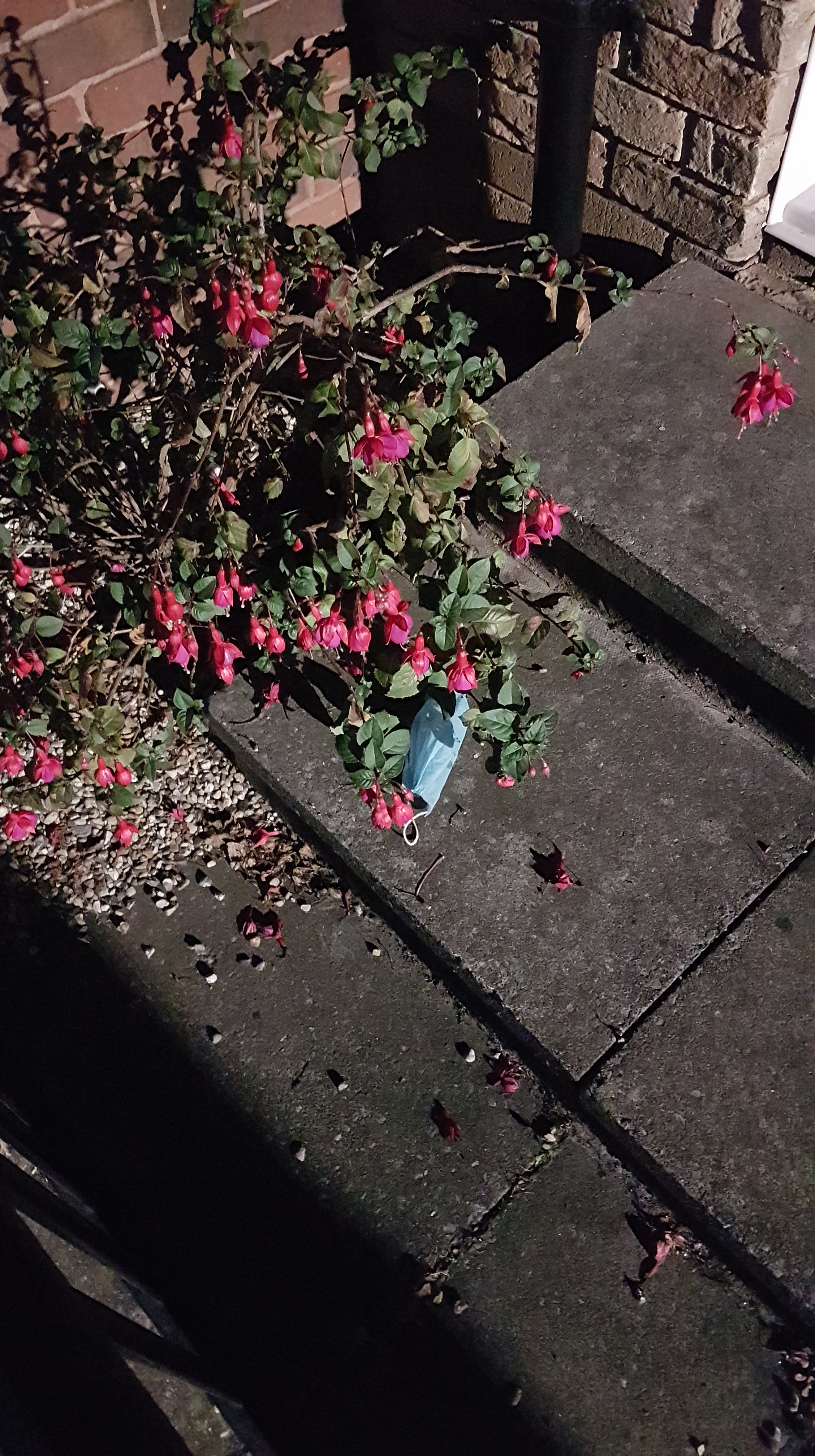
With the new academic year about to start, I wanted to post something about what I’ve been up to over the last few months. Being an academic is never an easy job to describe and for me it always will have been a vocation, something that doesn’t turn off or dissipate with the seasons which I seem to spend ten to twelve hours per day doing. Recent events have encouraged me to reflect on what exactly it is that I supposedly “do”. There’s just been so much happening or so much that I’m responsible for lately that it all seems to start to blur together and I’m starting to have difficulty keeping track of it all… update a spreadsheet that contains all of the assessment deadlines for the BSc Management programme and in the process have to chase multiple colleagues all of whom are senior to you for the deadlines on their modules do a webinar with the title Becoming-manager: On the challenges facing managers in contemporary organizations (which the marketing team seem determined to repeatedly get wrong) in order to get new students excited about studying at KBS record induction videos for the incoming group of Stage 1 students in order to introduce them to studying at university and brief them on what’s going to happen work on assignments for PGCHE modules which helps you to learn more about how not to teach and manage a module than it helps you to develop as a pedagogue assist on the Clearing hotline for a lot longer than you expected but enjoy being able to speak to future students who didn’t think that they’d have a place and reassure them that Kent would take them and realize in the process that you’d never be able to do a job outside of academia because you were tremendously bored and inefficient on the Clearing hotline and then redouble your efforts at publication and research funding give in and make a Twitter page to try to augment your presence in the public eye but never post anything submit a paper on Traffic Officers and the “extreme” work in which they are often involved which is the product of a long collaboration between you and a colleague to a 4* journal with a great exasperated sigh of relief try to nudge another colleague to work on another paper on Accelerationism and Business School pedagogy to submit to another 4* journal notice that someone has not just cited one of your articles in one of theirs but they draw on it heavily in order to develop commentary on microfascism and feel so flattered that you think about emailing them but decide not to be so full of yourself instead start planning meetings for the teaching term with the team on the BSc Management programme as well as the team on the 550+ student Introduction to Management module and you’re going to be convening and have the distinct experience that everything is happening much too fast you your job becomes to slow it down so that everyone can understand continue to watch the University attempt to implement a large scale organizational restructuring with all of the competency and grace of a wrecking ball while still navigating a pandemic and observe the paranoia and politicking that sets in to your colleagues as they all start angling for ways to keep their jobs and avoid wider lay-offs keep looking for organizations who might want to collaborate on ethnographic projects keep planning blog entries that you never find the time to write and thus transforming your blog into a full blown academic cliché in the form of an academic project that gets left to languish as other projects come along keep running Twitter pages for your undergraduate and postgraduate modules by posting news articles about case study organizations or trade unions that you hope that students will read but are fairly certain that few will try to remember to exercise every morning wonder when you’ll be able to resume Scouting attend session after session on teaching online and watch as academics fail to discuss anything other than their own anxieties and misgivings for example in one session that was supposed to be about ways to get students to engage in an online class watch instead as a large number of confused academics ask basic tech support questions like how do I turn off notifications or how do I get my audio to not echo and wonder how they can have PhD’s and not be able to use Google keep participating in a weekly Reading Group of early career organizational scholars who get together to focus on ethnography and interesting developments in organization studies attend a even more meetings to prepare for online teaching start preparing for your own online teaching by setting up Moodle pages and designing assessments and activities continue to panic about having to teach a small module with a colleague because you have a hard time working with others realize that when multiple colleagues send you lecture clips, plans for assessments, or papers that they’re working on that people actually value your opinion finish writing a book with the cheerful title “The Mall at the End of the World” and send it to colleagues to get their thoughts and get unduly excited about it because it’s one of the few honest and frank things that your been able to write outside of your blog that isn’t dressed up in layers of sycophantic brown-nosing keep thinking about funding keep practising your bass and try to find time to record a heavy metal album spend an absurd amount of time trawling blogs, twitter pages, and forums for other accelerationists and tracing out this bleak line of thought which seems to be the most interesting and exciting branch of contemporary theory develop a weird obsession with reading about organizations that play a large role in our lives without being noticed like Serco or 3663 spend a lot of time reading emails spend a lot of time researching and writing lectures spend a lot of time preparing for the start of term notice that you’re grinding your teeth a lot more than you used to develop a curious habit of going for a walk shortly before bed to try to calm down and taking photos of the discarded disposable masks which will quickly become the new cigarette butt or coke bottle in terms of being an object of frequently observed detritus lingering on streets and in bodies of water everywhere and resolve to write something about that because it’s probably important but realize that you probably won’t get time to.







 Sideeq Mohammed