My book is out!
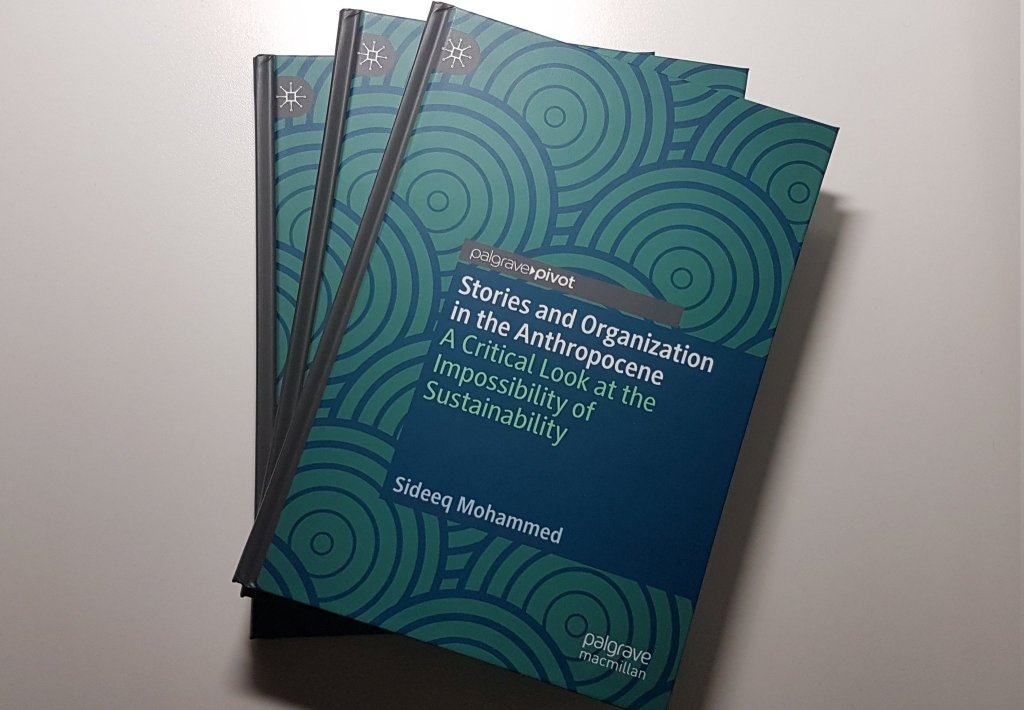
I still don’t really believe it. I’ve been posting about it on Twitter, but I’ve also been so swamped recently by doing things related to being KBS’s Associate Dean of Education that I haven’t really had the time to register or sufficiently reflect upon it. Occasionally, I’ll narcissistically refresh the page and just sort of look at it. I imagine that the excitement might wear off when the first negative reviews start coming in, but unless they tell me that it’s boring I’ll be OK with it.
I recorded a video for KBS’s marketing team where I talked about the different issues raised by the book and tried to answer some simple questions about it and in so doing I started to reflect on the key themes of the text.
I’ve come to the conclusion that, despite the complexity that I like to insist upon in my writing, there are basically three core ideas in the book and if someone understands those, then they understand what the book is trying to do.
The core premise of the text is an interest what stories we are telling in the anthropocene. The news that we read everyday seems littered with stories a looming climate catastrophe, of uncontrollable wildfires, of microplastics in human bodies, of species going extinct, of scientists “rebelling” in order to prevent their reports from being diluted or sanitized by governments and political interests, of the effects of pollution on our mental health and so ad nauseam. It seems like everyday there’s some new report or announcement from a panel of scientists telling us how bleak things are and how we need to act to change things now. Yet at the same time we seem to be enamoured of stories of new innovations that offer us hope for a different future, of people looking for zero waste or degrowth strategies or even of the wealthy trying to escape ecological collapse (through space flight or through life underground) as well as everyday doomsday preppers and those looking for some kind of escape. Green capitalist dreams of sustainable futures, alongside apocalyptic nightmares of climate wars. Climate change denialism is still popular, whether in overt or subtle forms. All inflected with an audacious and arrogant hope for human survival above all else. These different threads bleed together into an aggregate anxiety about the future.
What can we learn from trying to think critically about these stories and what they can tell us?
There are three key story threads that I think are worth disentangling in order to try to address such a question:
- Imagination – Can we imagine our way out?
- Acceleration – Can we accelerate our way out?
- Hope – Can we hope for any way out?
Anyone paying attention to writing around the subject of the anthropocene will have become all too familiar with the refrain: “We need to imagine new solutions” or some similar statement decrying a failure of imagination. It’s everywhere, from critical theorists to journalists, and often in response to Jameson’s famous quip: “Someone once said that it is easier to imagine the end of the world than to imagine the end of capitalism“. I find this to be an inadequate position. It doesn’t ask how we move from the imagining to the actualization but, much more importantly, it assumes that one is capable of, as an agent, tapping into some transcendental resource, an escape from Capital, that will give life to some solution to the present ecological crisis. Yet we know that any deterritorialization will be accompanied by a reterritorialization, there is no escape to some mythical outside; Capital will easily appropriate any radical new strategy that you imagine; any new politics or radical offshoot becomes a new market for growth. Indeed, the idea that no one else will have thought of the solution that you imagined and isn’t already using it as a means to profit and perpetuate the same economic conditions that produce the anthropocene, is pure hubris.
This connects to one of my favourite lines of commentary in Anti-Oedipus where Deleuze and Guattari say that “capitalism has haunted all forms of society, but it haunts them as their terrifying nightmare, it is the dread they feel of a flow that would elude their codes.” This is an amazing description because it positions capitalism not as a particular social formation that has emerged in a particular place at a particular time in response to a particular set of social conditions, but rather as an “Unnameable Thing” that has always been with the human, Capital with a capital “C”. Waiting to emerge, influencing, using the human as a vector, inspiring, a muse, a trickster demon, and a source of hope. This confronts us with a far more interesting question: “Who or what is doing the imagining of new solutions?” A human agent thinking and trying to innovate? Or is it this Capital as nightmare, dreaming through you, producing your imagination in a confluence of influences and suggestions, rendering certain things as sayable, thinkable, and producible. What might be the goal or end of such an imagination?
In this regard, the book proposes a thought experiment, The mall at the end of the world. A space, perhaps built underground or among the stars buy some billionaire tempted to flee terrestrial life for reasons unknown to them, where Capital can live forever, long after resource extraction has become impossible and long after all humans outside this protected enclave had died? Could Capital survive as a kind of spectral performance enacted in stories passed down through the generations? The event of the emergence of such a space and the mass death that would produce such a bottlenecking of our species might affect us in the present in unknowable ways… Such a space would also exist as a powerful rebuke against the many threads of storying that tell us that the end of the world might bring about the end of capitalism, as it could live on, forever, in the right vessel, with or without the human. It also suggests that our attempts to imagine new solutions and ways of surviving translate into attempts to build the mall at the end of the world, to continue to survive and profit long enough for it to emerge, Capital using us like Leucochloridium paradoxum uses a snail. Such a space is perhaps already embedded in our collective imaginaries, given not only the popular images of “dead malls” but also the images of commodified spaces in The High Frontier and other works of speculative fiction. Is such a space not already being dreamt into being by those seeking to build bunkers to survive catastrophe? The hyperstition is making itself real.
The second theme we might think about asks the question: what if we tried to get out, not by resistance, but by going through capitalism? This story thread is present in Marx, in Deleuze and Guattari, Lyotard, and a number of others but it becomes most salient in the work associated with the Cybernetic Culture Research Unit (Ccru) formed at Warwick University in the 1990’s around the work of people like Sadie Plant and Nick Land. There are a number of different varieties and vectors of accelerationist though but the core is summarized by Land when he says:
“The point of an analysis of capitalism, or of nihilism, is to do more of it. The process is not to be critiqued. The process is the critique, feeding back into itself, as it escalates. The only way forward is through, which means further in.”
Land’s work imagines Capital as the mechanism of a hyper-intelligent AI emergent in the near future and capable of exerting influence back through what we perceive as time in order to secure the conditions of its own emergence. Essays like Meltdown, play on images of an inevitable planetary technocapital singularity that dissolves the biological into the technological, provoking eventually a radical series of conclusions, perhaps the only way forward is through, to accelerate capitalism’s destructive or abstracting tendencies, its ability to produce things which it cannot externalize (like a climate crisis), and see what else is possible because capitalism can’t be greened, reformed, placated, or changed. Its process proceeds with or without the human, a terrifying nightmare that has found us as a temporary host.
What does this mean for those of us who teach and work in the contemporary Business School. Should we be teaching alternative modes of organizing or sustainable/ethical modes of business? Viewed in a certain uncharitable way, one is perhaps less engaged in resistance and more engaged in creating new markets stimulating new trajectories for growth and profitability. The book proposes a number of thought experiments around this theme, but ultimately it arrive at the image of the Klein-bottle, an inside-outside that loops back onto itself. Different “strategies” that one might seek to employ in order to experiment with “practical accelerationism” are self-defeating, pointless (because the process was always taking place), or based in misunderstanding.
The last theme that we might consider is simply, can we hope for any way out? Again, those following published work on the anthropocene will be all too familiar with the question of hope. It is everywhere. Anywhere you look, there is a hopeful commitment to the future, a hope that there is something more that we can do, a hope that it’s not too late to change, a hope that protest will work, a hope that a Green New Deal will save us, a hope that some new innovation will work, a hope that some new diet stop ecological collapse, a hope in defiance of mounting evidence that there is nothing to hope for.
In response we might ask simply, whose Hope is this? Is it the independently felt emotion of a rational human subject, or is it an affect of Capital? If we were to genuinely take seriously Dipesh Chakrabarty’s comments that the human is now a geological agent, we have to ask whether there is any agency left. We are perhaps not ready to ask whether the concept of a “human subject” is of any use to us anymore, given that it is now an amorphous collective “anthropos” that grapples with existential risk. Again, is it really Hope that you feel for the future, or is it Capital’s survival instinct? The philosopher Emil Cioran suggests that “Hope is a slaves virtue” and in this case it is hard to see how he is not correct for this hopefulness is all pervasive. There is even hopefulness in Land’s experiments with the inhuman; a belief that the future exists and can realize the promise of a technocapital singularity in which the human is revealed as irrelevant and can be snuffed out by a machinc intelligence beyond its comprehension. It betrays a yearning for non-being; that a stilted and morphed Capital might have to survive in the stories of the mall at the end of the world may be too tragic an inevitability to consider. As such it also behoves us to cast a sceptical eye on the hopefulness that all too often emerges within the narratives of those claiming to be hopeless in the anthropocene.
If you’re a manager or a person interested in the lives and inner workings of organizations, you might justifiably ask, having been provoked to consider your own irrelevance in imagining, accelerating, and hoping, “So what should I actually do? If I wanted to really make a difference what should I be doing?” And unfortunately my response to this question is “Whose desire is it to “do something” in response to the anthropocene?” Is it your all too human survival instinct, your empathetic care for the species and its future, or is it Capital, thinking through you, dreaming ways to survive, to stall time until the mall at the end of the world can emerge and it can survive forever.
To put it bluntly, when we talk about “sustainability” who or what are we seeking to sustain?
 Sideeq Mohammed