I am a bad student.
I don’t think that that fact surprises anyone. I’m stubborn, ornery, I don’t like to “play along”, have difficulty picking up on the social cues of what the teacher wants me to do, and most importantly, if I relax my face it frowns and I look like this >=| . As I’ve learned in my time in Higher Education, I am a fiercely independent learner. I cannot work to your curriculum. I do not want to go at your speed or wait for the others in the class to be up to speed. I want to learn on my own by reading and reflecting and there are perilously few ways to direct or point me to learn specific content that you think is important.
This is not just a self-pitying and reflexive acknowledgement.
As part of their probation here at the University of Kent, new lecturers are required to undertake a Postgraduate Certificate in Higher Education. The course is designed to introduce new lecturers to the basics of pedagogical techniques and reflections in the theory and practice of higher education; to key terms, to important concepts or pressing issues, and to debates around topics as diverse as internationalization and the marketization of the contemporary university.
The course could have been exceptionally useful. Indeed, I imagine that if you’re a lecturer who’s just starting out, then it would be very helpful to you by allowing you to network with other new lecturers, get support and feedback from more experienced colleagues on how you’re doing, and begin to reflect on your pedagogic assumptions, practice, and philosophy. However, because I started at KBS in 2017 on a temporary contract, I didn’t get put forward for the PGCHE until January 2020. At that point, I already had a fairly good idea of what I was doing, wouldn’t really benefit from the opportunity to connect with other new lecturers, and had already become a well-respected colleague and well-liked teacher in KBS (as well as the Director of Studies for the BSc Management course). Additionally, and I cannot stress this enough, I am bad student. All of this means that I was never going to benefit as much as I could have from doing the PGCHE.
The four modules that I took all obviously involved assignments. All of them were essays on themes or questions related to the module and I decided to post these to this research log for posterity, but also as a showcase of what I’ve been doing over the last year. Most of the essays were written over the course of a single weekend because I didn’t have much more time than that to spend on them. As such, they drew mostly on material that I had already read or was already reading and are more than a little repetitive, drawing on common themes of accelerationist theory, Critical Management Education (CME) literature, and the role of “critique” itself in the Business School.
What follows is a list of the essays and their titles. They can all be found here. I share them with the typical disclaimers that ask that they not be circulated beyond this blog, published elsewhere, or cited without consulting with me first. I also share them as Turnitin Downloads so that they include the feedback that I received from the module convenor who assigned them.
UN819 – Introduction to Learning, Teaching, and the Academic Environment
“Identify and critically evaluate key principles that influence learning, teaching and assessment in Higher Education”
UN831 – Contextualizing Higher Education Teaching and Learning
Assignment 1 – Helping or hindering? Reflections on the sustainability of critique in the contemporary business school
Assignment 2 – What does it mean to be critical? Auto-exorcisms of the spectre of neoliberalism
UN822 – Individual investigation in Higher Education
Towards a Revolt-ing Pedagogy: Accelerationism and the future(s) of critical management education
UN826 – Internationalization in Higher Education
“I don’t know if I’m brown enough for the Business School to sell”: Reflections on Internationalization.
If you notice that “one of these things is not like the other”, then congratulations on being observant. My original essay for UN819 was titled “Becoming the third person – Reflections on the otherness of student-teacher performances” and was an extended reflection on how the dominant practices and paradigms in Higher Education often involve a non-self-aware-awareness. In approaching the assignment for UN819, I found myself thinking a lot about how you could teach someone to be a better teacher. The goal, insofar as I understand it, is the cultivation of a continuous critical reflection that prompts circumspect and self-aware evaluations of one’s own practice. That’s a lot of what was asked of us on this module. However, I found myself struck by the artificiality of the reflecting that I was being asked to do. Reflecting on your teaching, and actively asking yourself what went well, what didn’t, and what you might be able to do better next time is just good pedagogic practice. But on a PGCHE module, reflecting becomes a spectacle, something done for the sake of praise and adulation, for a teacher to say that you’ve done a good job – instrumentalism abounds. I started feeling like I was not paying attention to the class, because I was too distracted by trying to seem like I was “a good student”, to make a spectacle of listening, to perform participation in an exaggerated way that would be noticed, to reflect that I was reflecting in a conspicuous enough manner. So, I wrote an essay around this theme that drew heavily on Macfarlane and Gourlay’s (2009) paper on “the reflection game” which addresses precisely this problem. The module convenor failed the essay on the grounds that it did not meet the learning outcomes for the module. I was mildly entertained by this, a classic case of “make me reflexive but not too much” and wrote what I consider to be a very dry and dull essay for the resubmission.
At a certain point, though, I began to try to just have fun with the essays. What unifies them is a deeply held skepticism about whether the Business School can play a positive role in shaping the future, one which I know that many CMS colleagues share, which I continue to reflect on in other texts that are forthcoming.
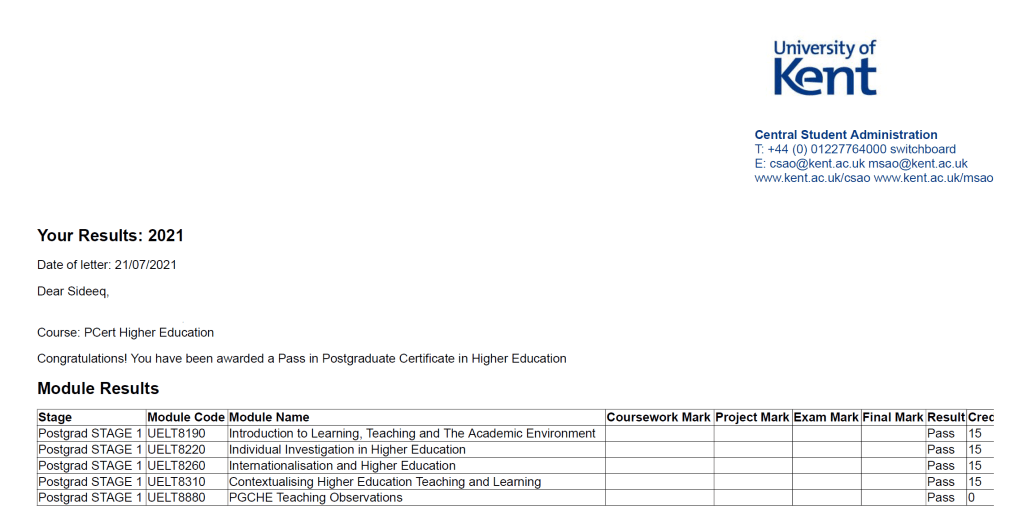
For now, I’m just glad that it’s over, if only so that I no longer have to worry about being on probation.
 Sideeq Mohammed