I love sleeping in my own bed, eating food cooked in my own kitchen, and sitting in my own comfortable chair with my blanket wrapped around my legs. As such, it should come as a surprise to absolutely no one that I enjoyed the fact that conferences for the 2020 academic conference season were cancelled due to COVID-19. EGOS (the European Group for Organization Studies) is, however, large enough and long-standing enough that it could afford to go online, so I relished in the opportunity to attend the conference from the comfort of my own home.
Different people approach EGOS differently. Some find a group of colleagues interested in a particular area and stick with them, maybe forming or joining a Standing Working Group on a particular issue. Ever the nomad, I like to roam around; jumping into the discussions and agendas of strangers and, for serious want of better terminology, raining on their parades with my mix of pessimism and overly critical, furrowed-brow commentary.
This year I took part in Sub-theme 52: Storytelling a Sustainable Future organized by David Boje, Bobby Banerjee, and Kenneth Mølbjerg Jørgensen.
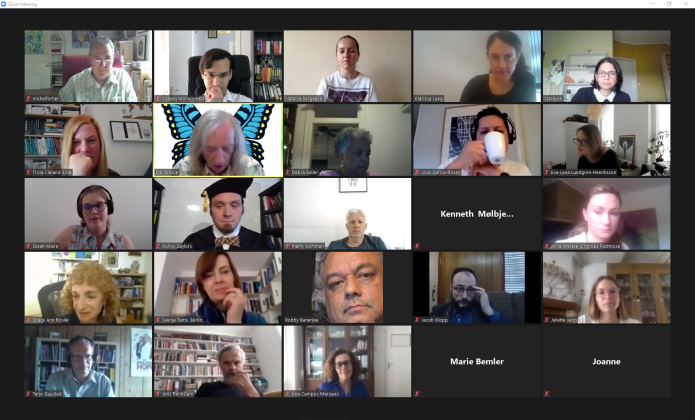
On Zoom with the members of Stream 52 at EGOS 2020
It was an enjoyable conference because I got to listen to a number of very interesting stories about local politics, indigenous ways of knowing, and new innovations and so on. Stories are always good to hear because they tell us something important about how the storyteller sees and makes sense of the world.
I presented a few sections from the book that I’m working on (provisional title: The Mall at the End of the World”).
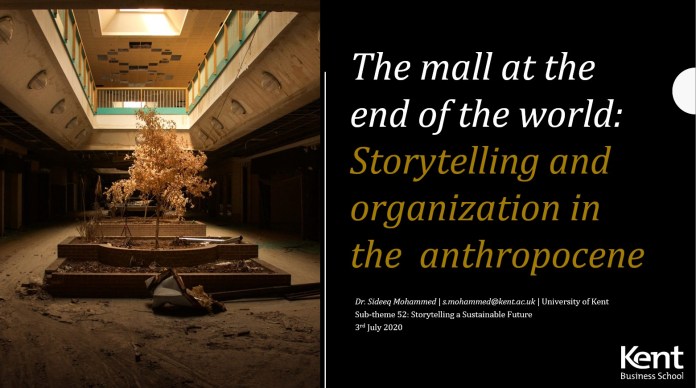
My cheerful opening slide. Photo credit: Seph Lawless
Without wanting to give too much away, at the core of the text is a feeling of disillusionment and disenchantment with the current stories being told in the anthropocene, specifically the naïve optimistic hopefulness that inf(l)ects everything from delusional mythologizations that tell us that we can keep digging fossil fuels out of the ground forever, and the stereotypical heroic narratives of the Great Male Entrepreneur who will innovate some new technological revolution via carbon scrubbing or argo-engineering or bioplastics or whatever in order to save us – all the way to the stories of returning to the land and celebrating local, organic, farming and recycling collectives. Each one seems to me to be inf(l)ected with a kind of naive optimistic hopefulness, a kind ‘artificial intelligence’ that overcodes thought from within, predetermining where it will go and what possibilities are available for it to encounter, until all that can be though are thoughts that hope against hope that everything will be OK. All the stories that can be storied tell us that humanity will survive in the end. That we’ll switch to renewable energies, that we’ll cease all of our myriad activities that produce mass death and biodiversity loss, that we’ll suddenly abandon capitalism and everything will be OK. This artificium optimus produces endless mutations and modifications of the exact same story ad nauseam, and we swallow it like cultural dupes in order to remain blind to suffering and anguish on multiple temporal lines (past, present, and future). We can change, it’s not too late, everything can still be ok!
I’ve become obsessed with out-dreaming this artificial intelligence and its endless and confident deluge of hope. Not as a way of reconstituting what Mark Fisher called “capitalist realism”, but as a way of seeing what other stories can emerge, ones that might prompt anger, frustration, and upset(or perhaps catatonia, depression, and melancholia) – affects that are less easy to sit peaceably with. Enter The Mall at the End of the World. A place where capitalism lives forever as a spectre of itself. The paper tries to imagine what the people of such a space would do. We know who they would be, as wealthy investors like Peter Thiel are already buying up land in remote areas with an abundance of fresh water like New Zealand or setting up condos in abandoned missile silos and beginning other strategies to prepare for global ecological collapse or other similar disasters – seeing them as a way of achieving an individualist utopia free from the tyranny of the state or as yet another way to profit off of disaster capitalism. To put it bluntly, existing class and social inequalities aren’t going away and it is likely that the ultra-wealthy will survive while the rest of us die in ecological collapse. But, long into the future, what will their descendants who survive in that space do? What will life be for this people-to-come? Will they not tell themselves stories of our wonderful and sincere attempts to save capitalism as we hoped against hope that everything would be OK with out Sustainable Development Goals and Green New Deals; our stories of patient Gaia and returning to the earth? Would their legends not be about how we all loved going to work and going shopping? About how fair and benevolent a system capitalism was (having been raised on an oral tradition of stories that extolled its virtues)? The “perspectivism” of looking forward to look back interests me at the moment.
Bobby Bangejee called the paper “despairingly inspiring” (which I take as a profound compliment) and flattered me by praising the work and encouraging others to read it. I take that as a hopeful (ha) sign that the work is worth doing and may post the full essay on this blog at some point.
I may post more updates on the book as it develops but for now, I just hope that I can attend conferences from my own home next year.
 Sideeq Mohammed