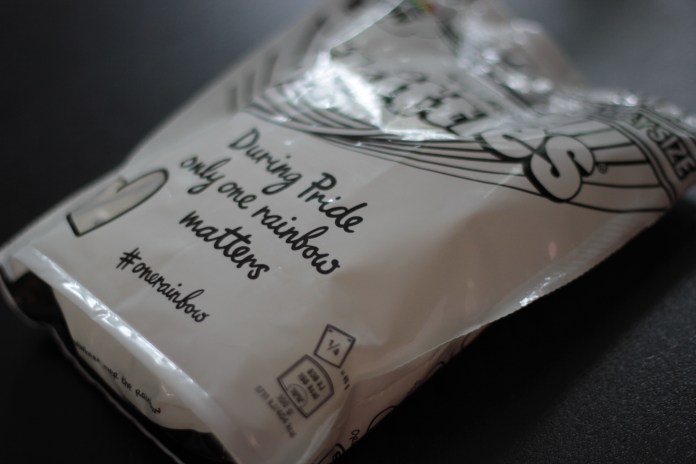
But what does Skittles think about systemic racism?
As every major political figure, pseudo-celebrity dog, and Instagram influencer feels compelled to say something about the dreadful injustices of racism and the disproportionate numbers of people of colour who die in police custody in so called “developed” countries like the US and the UK, even organizations are beginning to chime in. Ben and Jerry’s, for example, loudly proclaims that “Silence is not an option” in a definitive statement that suggests that the organization will not stand idly by as racial injustice continues. In response to this resurgence of “brand activism” we are encouraged to play a perverse game of “count the coloured people” on corporate boardrooms to determine if the activism is genuine or empty and performative. At this time of great social and political uncertainty, we look to great leaders like Seth Rogen (whose #Instagramactivism is covered in international newspapers) in the absence of satisfying action from our elected officials and ask the most pressing of questions: What does Ja Rule think?
I would like to take this opportunity to remind readers of this blog that I am most likely an idiot.
But what does Ja Rule think? The meme goes back to an old Dave Chappelle routine where he critiques celebrity-culture. He challenges us to reflect on why at a moment of national tragedy like the destruction of the World Trade Centre in 2001, or a moment of political import like the 2016 American presidential election, we would even begin to pretend to care what a celebrity like Ja Rule thinks. The filmed murder of George Floyd has become a much needed catalyst for the Black Lives Matter movement but it has also led to every celebrity or person of vague public interest feeling compelled to perform their disgust as solidarity on social media or write overly poignant opinion pieces in The Guardian. Importantly for someone who studies organizations, it has led to a wave of similarly performative pronouncements from major organizations, decrying the horrors and injustices of racism and posting #BLM on their social media pages. Even Nike is on board. As though their care and concern, genuine or empty, matters at all.
This isn’t new. For years, LGBTQ+ people have been complaining about the co-optation of pride by corporations, as the radical nature of the event is lost and it is increasingly commodified by the presence of brands in the unfolding dynamics of ‘pink-’ or ‘rainbow capitalism’ which much more articulate people than I have tried to weigh up the pros and cons of. Even if some might see it as disrupting heteronormativity in the long term, that doesn’t make it any less disturbing, as the same corporations whose interview panels reflect biases against the LGBTQ+ community or invest in the economies of countries where being gay is a punishable crime, put rainbow flags all over the social media page and pass out rainbow themed merchandise at pride. This kind of transparent pandering is often unintentionally funny. Earlier this month, I laughed out loud to myself in the supermarket for around 10 minutes at the realization that Skittles had made an all white bag of Skittles to support the LGBTQ+ community, saying “During Pride only one rainbow matters” and had in the process accidentally made what could be called a white-supremacist bag of candy – a beautiful evidencing of the reality that, as it always has, capital will say and do absolutely anything that it thinks will maximize profitability.
While there are many ways to think about this problem of co-optation – from the pragmatist argument that says that this kind of public performance of solidarity as marketing-tactic is important as it lets marginalized groups know in what stores they’d be safe, to the critical argument that calls into question the moral decay under contemporary capitalism that leaves us so unable to reaffirm ourselves as “good people” that consumption decisions become less about function and more about constructing an “ethical self”, and even the odd argument that there must be LGBTQ+ people/BLM supporters in the organizations themselves who want to use their platform to vocalize support and solidarity – the one that I want to focus on is corporate personhood.
The moral and ethical implications of corporate personhood have been the subject of academic debate for some time with various iterations of it cropping up – most recently Ken Greenwood’s argument that if corporations are people, they should act like it. That is, they should be responsible and accountable to the same standards to which we would hold other people. People like Ja Rule. It is here that my personal comedy is apparent as after reading every tweet, every newspaper report of another organization affirming BLM, every gesture by an organization trying to show solidarity, I laughed to myself and thought yes, but what does Ja Rule think about this? A way perhaps of vocalizing the absurdity of a corporation which actively benefits from the colonialist histories and mores of capital, claiming to care about the lives of people of colour, but also because, I am apparently an idiot who thinks in memes.
But this is how Ja Rule thinks. Repeatedly throughout his oeuvre, Ja Rule extols the virtue of the pursuit and agglomeration of money as an end in itself rather than a means to happiness. In the hit song Always on Time, he reminds the listener that he lives by the credo of MOB or “Money Over Bitches”. In Race against time he says: “For every lock, there’s a key. The only thing that ever made me click was cash money”. Indeed, there is a certain religiosity to his preoccupation with money. In the context of the extended Christian imagery of Only Begotten Son, he proudly proclaims: “I won’t cry cause I live to die, with my mind on my money and my guns in the sky.” Capitalism itself is nothing more than the machinic multiplication of money through the processes of investment and the production of commodities. Infinite replication. Everything else is incidental.
While there is certainly more to Ja Rule thinking than just an obsessive pursuit of money, it is in this kernel of insight that we can garner understanding of why organizations try to insert themselves into activist conversations. Inserting yourself into a conversation that has nothing to do with you would be (if done by an actual person) rude and discourteous but for a ‘corporate person’ it makes perfect sense that they should chime in on the discussion because their only desire for doing so could be monetary replication. The mythologies surrounding this are dense and convoluted. In fact, the corporate person believes their audience to actively wonder what they think and so chime in the belief that “the public care what they have to say” because of course we do. We’d be lost without the marketing machine. Many of us would have believed that white supremacy was perfectly acceptable until Ben and Jerry’s told us that it was bad. Indeed, even Ja Rule tweeted out his idea for reducing the incidences of police killing unarmed people of colour (one of the first replies is the Dave Chappelle clip).
Yet this is not done out of malice or ill will. Rather, there are a broader set of technosocial conditions that produce in the corporate person the idea that the audience cares what they have to say, produce in the news media the idea that what the corporate person has to say is worth reporting, and produce in the audience a desire to hear what the corporate person has to say, as though it could be anything other than a transparently shallow and calculated marketing tactic. Blizzard tweeting in support of BLM after their stance on the Hong Kong protests is the best example of this; Blizzard are here ‘clicking with cash money’ calculating that BLM support with net them fiscal gains, and angering the Chinese government with “Free Hong Kong” rhetoric would bring disastrous losses. Yet perhaps Blizzard does not even know that it is calculating this. Perhaps that’s what Ja Rule thinking actually is: a cynical calculation that is not even apparent to the one doing the calculating.
Does the corporate person know that it is just adopting the pretence of care in order to maximize revenues, or does it believe itself to be acting authentically? I wonder what Ja Rule would think about this?
 Sideeq Mohammed