The UK is still in COVID-19 induced lockdown. I’ve been resisting writing anything about it because I didn’t want to contribute to the deluge of non-commentary and other “hot takes” that we can see about it on various outlets or say anything that might be understood to preemptively critique the extensive array of publications that we’ll likely see in the next 12-24 months about the impact of the lockdown on work-life balance, identity work, human-technology relations, gendered work, and so on. I have however been interested to chart something over the last few months – various kinds of collective sentiments and iterations of shared emotional experience. Mostly in response to people not following the rules of the lockdown.
Recent news items have been filled with the “scandal” of people hoarding and panic buying or breaking the rules of the lockdown and failing to social distance. I have followed with great interest recent comment threads on Reddit and Twitter (see #lockdownuknow) which chronicle no small degree of hatred for individuals involved in such practices.
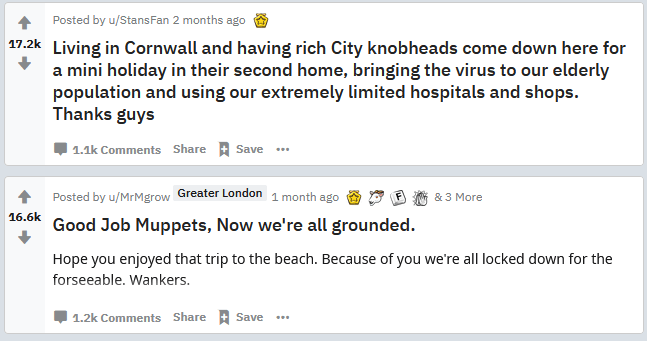
Lockdown outrage on r/britishproblems
At first I thought that these types of reactions were easily readable as what Tim Kreider called “outrage porn”. The intoxicating nature of anger, particularly when it’s collectively felt. As he says, “it sometimes seems as if most of the news consists of outrage porn, selected specifically to pander to our impulses to judge and punish and get us all riled up with righteous indignation.” We look at these “evil” people, going to the beach, hoarding toilet paper, buying up all the fresh fruit and vegetables, visiting their second homes, continuing to go out to parties, sunbathing, and so on, and we hate them. We are enamoured by that hatred, it excites us. At some point in our enjoyment of this vilification it occurs to us that it might be envy, that we wished that it was us still “out and about”, but the idea that we are actually just jealous is far too dangerous and self-reflexive a thought, so we have to quickly quash it.
While there are many great examples of outrage porn foregrounded by British newspapers recently (for example, the nerd community turning on Neil Gaiman for breaking lockdown and travelling internationally), let’s take the following example, which I wanted to include in case anyone ever asks me why certain newspapers are recommended on my modules at the University of Kent and others are treated as unreliable.
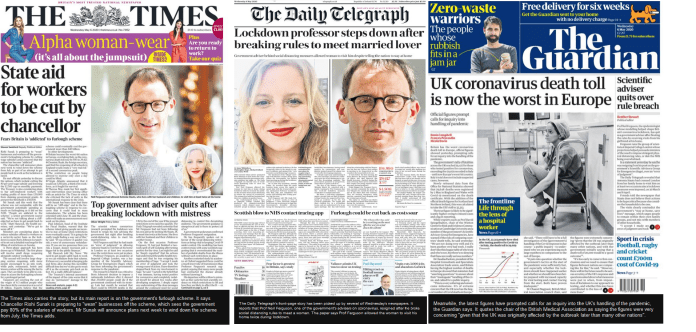
6th May, 2020 newspaper headlines (clipped from the BBC News’ newspaper blog)
Note which papers chose to have the Neil Ferguson story on the 6th of May and which ones chose to highlight that the UK now has the worst death toll in Europe. What is important and in “the national interest” is not the story of a potentially malicious degree of incompetence by a democratically elected government leading to the needless deaths of tens of thousands of Britons, but the story of one professor who broke the rules in order to have a tryst with their a romantic partner. The titillation. The scandal. The cheap amusement and banal thrill. How could we not put that on the front page?
Lest I be accused of being a naive Guardian reader, the paper has certainly not resisted the temptation to have its share of outrage porn on the front page of its website.
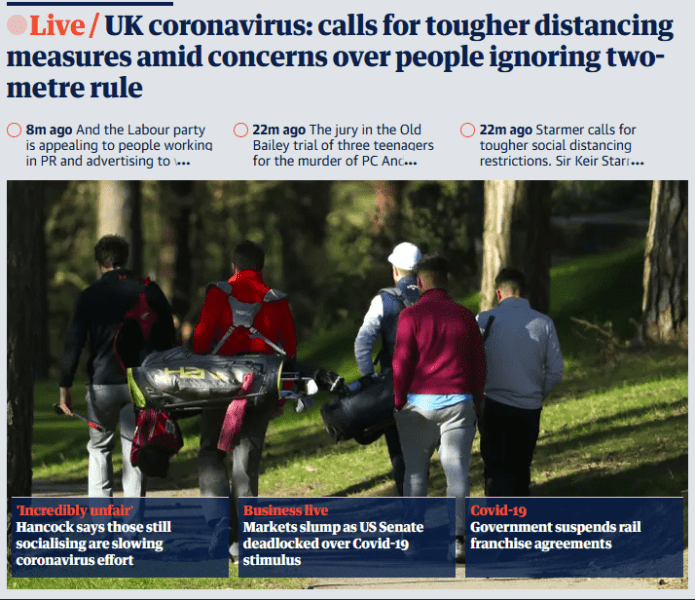
Front page of the Guardian’s website: 23rd March 2020.
Look at these golfing bastards not social distancing when we have to. We hate them and that hate makes us feel good. It excites us in a way that we cannot quite describe. We get a particularly perverse joy from joining in the hating of them in comments sections and social media threads. How dare they do this? It is the thrill of outrage porn that I kept coming back to, the enjoyment of the hate.
The more that I thought about this peculiar thrill of stimulated outrage, the more that I could see it connected to Deleuze and Guattari’s concept of “microfascism” which I’ve written about before on this blog and in print. Specifically, I remembered the following quote from A Thousand Plateaus (p.215).
“Leftist organizations will not be the last to secrete microfascisms. It’s too easy to be antifascist on the molar level, and not even see the fascist inside you, the fascist you yourself sustain and nourish and cherish with molecules both personal and collective.”
The microfasist impulse presents itself most clearly when we not only want others to follow the same rules that we do, but we want them to want to follow the rules. It should not occur to them to question them or to challenge them; that thought should not exist in the horizons of possibility. In doing so, they pose a threat to the images of conformity, unity, and homogeneity which fascists always invoke in order to justify their palingenetic ultranationalism. Some part of us enjoys participation and complicity in these kinds of fascisized formations. As Deleuze and Guattari comment in Anti-Oedipus (p.29): “the masses were not innocent dupes; at a certain point, under a certain set of conditions, they wanted fascism.” Desire becomes so perversely contorted that it comes to desire its own repression, seeking out fascist formations, seeking out (in this case) a simplified other to hate and the comforting voice of a trusted newspaper telling us who “the bad guys” are. We thus transform ourselves into judge, jury, and “neighbourhood SS man” in order to mobilize this feeling of hate for the other who doesn’t desire in the same way that the desire which constitutes us desires. Yet in so doing we showcase our own insecurity and lust for power. In breaking the rules, these others make us question whether we are following the right rules, their difference or deviance is itself a threat to us (Ian Danskin talks about this in his video series on “Angry Jack”), we become uncertain about our own choices at the same time as they are reaffirmed by the vitriol of a self-righteous and self-important anger that we can join in an be a part of. This is how microfascism aggregates and agglomerates itself creating a kingdom of petty fuhrers who all loathe the lockdown-breakers.
Edit: 25th May, 2020. I almost never edit these blog entries after the fact but rarely have I ever been proved so prophetic. Over the last few days Dominic Cummings has been dragged through the mud by both left and right wing presses for breaking the rules that he helped to set out. The horrible lockdown-breaker, it feels good to hate him. As I watch him become a scapegoat for all of the stored vitriol and anger that people have over the government’s handling of the pandemic, I reflect on the image of a magician doing a sleight of hand act. Owen Jones expresses my sentiments:
 Sideeq Mohammed