May you always live in interesting times. This piece of apocrypha reads like a blessing and a curse, a disbarring of the joys of an uneventful peace in favour of a condemnation to always be busy, to always live in times of tumult and change. Between Brexit, rising business uncertainty, and the assorted harbingers of economic recession, the broader macro system seems to be in “interesting” states indeed, but there are many interesting little things going on in my life at the moment. While none of them might inspire a full entry in this research log, as an agglomeration they indicate a cross-section of my life, and by virtue of this indicate the kinds of experience that I think are important to chronicle because what it is that an “academic” does is still a nebulous and difficult to fathom thing for many people. This is perhaps not helped by the fact that I often fascetiously say that my job is to spend the majority of my waking time reading alone and then occasionally talk to people about what I read and/or tell them to go read things that I read. Perhaps in trying to enumerate some of the things that I’ve been doing recently, some of this might become clearer.
Think Kent Lecture
So in April this year, I accepted an invitation to do a recorded lecture about my research as part of the “Think Kent” series. I still have no idea why I did this. At the time I remember putting myself forward, thinking that there would be some kind of screening process during which someone would say, “We’re not sure that your research is the right fit for this kind of thing.” These are public facing videos that reflect the University trying to put on a good face and show its importance and competencies to the world, so surely (I reasoned) they’d pick someone whose work doesn’t sound like a hallucinated fever-dream, an intentionally maddened play of concepts and nihilistic provocation based on the work of an obscure French philosopher. They would certainly pick someone who doesn’t refuse to make their work “business relevant”. Surely, someone who will neither confirm nor deny that they go out of their way to try to produce work that is difficult for management to co-opt wouldn’t get chosen? Clearly, I was mistaken because I soon found myself in an empty lecture theatre being filmed.
There is a perplexing surrealism to speaking to an empty room. I’ve gotten used to “performing” from doing Not Above Evil videos but this wasn’t pretending to play a piece of music that I’d obsessively recorded. It was one shot at saying something vaguely coherent. Looking at the finished product, I can tell that I am some kind of odd mixture of nervous and uncomfortable because of the space that I’m in and the curious way that the empty room is making my voice echo. Anyone who knows me will know how slowly I’m speaking here because I’m hyper-aware of the fact that my words are being recorded to be viewed in perpetuity. However, if for whatever mad reason, someone is looking for information on Deleuzian ethnography, or working with concepts, then this is not a bad start. I ended up speaking about the two papers that I’ve already published, going on a bit of a tirade on time as a concept and a bit of a tangent on microfascism. Things certainly could have gone worse.
Msc HRM marketing video.
I’ve also been showing up in the school’s marketing material for the Msc Human Resource Management– which is again perplexing because technically I’m not a permanent employee and didn’t sign a release but perhaps it’s best not to think too hard about these things. Indeed, I know that I was chosen because I was the only person around on the day of filming who couldn’t think of a good enough reason to say no when asked, rather than because they picked an intentional diversity tickbox/the youngest member of staff, or indeed because I’m a particularly good lecturer. In fact, as I watch myself autistically spin my clicker and giggle to myself – clearly enjoying my own humour regardless of anyone else’s experience – I pity every student who’s had to do the same thing.
Organization in the Anthropocene.
I’m still working on my paper on the Anthropocene. I haven’t submitted it yet and am toying with the idea of turning it into a book. I need to come to a decision soon because a) the deadline for conferences is coming up and I need to get my abstracts in and b) I only have one paper in review at the moment and need to start getting things in so that they can be published before the end of 2020. Still, I reflect on my Anthropocene paper more than other things that I’m interested in at the moment, not because of the excellent books that I’ve read since the start of November, including:
- On Fire: The Burning Case for a Green New Deal by Naomi Klein
- The Uninhabitable Earth by David Wallace-Wells
- The Great Derangement: Climate Change and the Unthinkable by Amitav Ghosh
- Down to Earth: Politics in the New Climatic Regime by Bruno Latour
- Climate Machines, Fascist Drives, and Truth by William E. Connolly
- Staying with the Trouble by Donna J. Haraway
Nor indeed because I have stopped laughing to myself at the absurdity of Sir Tim ‘I did not believe in climate change until they got a little girl to explain it to me’ Clark (an oversimplification of his comments, but still if they’re not going to try to scale back on the number of flights then I’m going to make jokes). Rather, my interest lies in a niggling thought related to a Guardian report from early this year where an Extinction Rebellion protest clashed with a working class driver just trying to do his job. Frustrated at being held up, the driver said “Nothing changes anyway, we’re fucked, none of this will work, mate,” I admire the driver’s optimism. He says what we are all scared to: that the rallying cry that I’ve heard from environmentalists over the last decade of “It’s not too late to change!” is the greatest marketing slogan ever invented. A company that can tap into the environmental market stands to make millions, while preserving the very system of capitalism that is rendering the planet uninhabitable. Nothing about this analysis is new. Wright and Nyberg were telling us in 2017that corporations can’t lead the fight against climate change, but the confrontation of the climate protesters interested in the future of the human race versus the man driven by precarity to have difficulty caring about anything beyond the present is one that I can’t stop thinking about.
Leadership and Schizoanalysis
I greatly dislike contemporary leadership research. Whenever I discuss it, its desperately difficult to avoid using words and phrases like self-flagellation, circle-jerking, fellatio- scholarship, and useless wank. So much of it is borne out of a crass and intensely problematic kind of tendency to deify particular individuals as great leaders or is a product of the desire to be such reflected in a chronicling the traits, behaviours, language habits, fashion sense, gender, and so on, of the great leader. While the psychosexual politics of our continued hero-worshiping of leaders does interest me, the pseudo-intellectual pontification and grandstanding of “this is what it takes to be a great leader” is desperately dull. At times, I narcissistically feel that I’m the only person who can see that, for example, Enron’s Jeffery Skilling and Theranos’s Elizabeth Holmes, are exactly the same – not in terms of their traits, or style and so on, but in terms of the ways in which their behaviours are not only produced and legitimated but necessitated by the mores of contemporary capitalism; taking advantage of capitalism’s own hubris to construct a reality that people can invest in; one that they will believe because a great leader sold it to them. History repeats itself; we keep going in circles and doing the same thing. I had an idea to write a paper about this, ostensibly chastisizing the CMS community for being complicit in the production of a social fabric that was not only amenable to the whims to toxic leaders but which required these individuals because they are the means by which contemporary capitalist organization generates profits.
I did not, however, think that any journal would take that kind of polemic so I was stuck with it sitting on the shelf until I could find some way to publish it. Then Gerardo Abreu Pederzini, a colleague here at Kent, approached me and asked me to write a chapter for an edited book on thinking about leadership in new ways. The rest is history. I’ve put the chapter on my academia.edu page, but it’s available on Google Books, Amazon and so on. I’m really surprised by how quickly the book was put together and I’m grateful to Gerardo, not only for including me, but for placing my mic-drop on leadership scholarship as the last chapter of the book.
CB312 – Introduction to Management
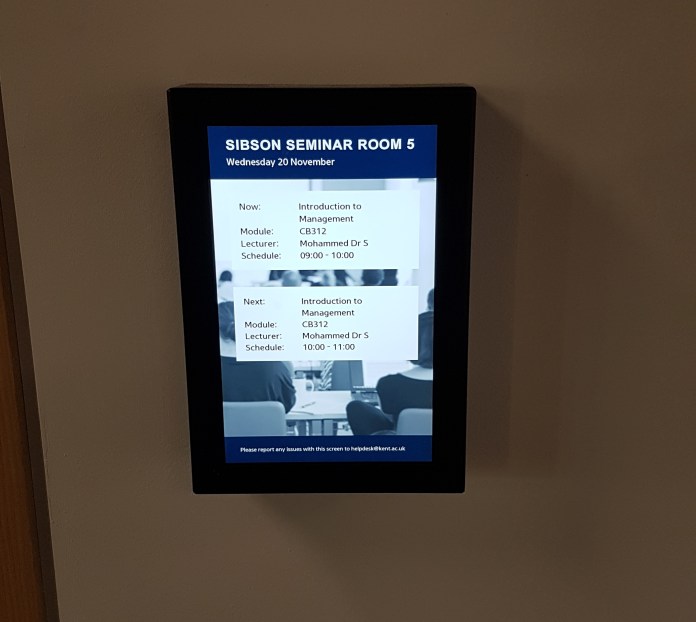
For reasons that I don’t understand, seeing my name on the door makes me unreasonably happy.
An update on what I’m doing at the moment wouldn’t be complete without discussing CB312, my first year undergraduate module. My first taste of what it was going to be like to deal with this course came early in September when administrative staff got in touch to tell me that the course was oversubscribed. There were 500 enrolled and the largest lecture theatre only sat 471. What I wanted to say was that we’d never have all 500 students present, but I let myself get convinced to do two lectures, a smaller on for 30 students and the main one for the others. It’s currently Week 10 and attendance at both is around 50%. Moral of the story: trust your instincts.
It’s more work than one would think to manage such a large and ultimately unruly group of students; all of the little questions and queries add up to a lot of emails. Still, more work than them are my own anxieties and desires for control. While I’m teaching 8 of the 24 seminars seminars, on a module of this size I have to rely on seminar leaders to teach the rest. I want to instruct them on what to do but I know that I should be respecting these ambitious and indeed very bright young researchers by letting them do their own thing and figure out their own ways of teaching, but my obsessive tendency to want things to be a particular way has proved to be a lot to constrain and I’m constantly trying to make what I say to them sound more like advice and less like instructions – difficult given that all that I want to do is give instructions.
Fortunately, I can still give instructions in my classroom. I often reflect that my classroom is one of the few places where I belong by default, where my rules are the correct modes of conduct, my interests justified by my curriculum, and my prejudices are legitimated throughout the marking criteria. The problem with first year undergraduates, of course, is that they don’t have enough of a sense of what they’re supposed to be doing in order to listen to instructions. Indeed, few things in academia make one more cynical than having to deal with first year undergraduates.
A few weeks ago, CB312 sat a formative exam consisting of one of three fairly basic essay questions. The number of dead family members, sudden cases of diarrhoea, period pains, generic illness, broken alarm apps, pets in distress, and other excuses that I’ve had to deal with over the was mind boggling. It’s difficult to not become cynical (as many colleagues do) and to see them all as individual people with legitimate problems and needs. What I find particularly difficult, of course, is when they inevitably ask me whether they can sit the exam at a different time or place and I have to say no. This hurts not just because I have to be the “bad guy” and fall back on a bureaucratic impersonality that is unconcerned for their difficulties, but because the Module Guide explicitly says:
Please note that if you miss your allocated test time for any reason you will be marked as absent and receive a grade of zero for this assessment. You will not be able to sit the test at any other time or place.
There are instructions there. Why can’t they just read them?
Actually marking these essays has been equally disheartening. There is a corporeality to marking that is unacknowledged. My neck and shoulders are sore because of the way that I tend to hunch over the student’s essay paper and my jaw hurts from the way that I grind my teeth when I’m under stress. Most concerningly, I gave a series of instructions – or rather a list of things that I expected every essay to include. The number of students who didn’t pay attention to these directives, or read them and ignored them, or couldn’t do them, is an inducement to the most acute form of despairing. Every 2:2 that I’ve given out so far has been accompanied by a comment which tried to hide my sadness that I gave a list of requirements (e.g. has a definition, is able to discuss the key principles of the topic, contains a discussion of a case study example) that the essay was not able to include.
Such are, I think simply the burdens of teaching a course like this. I love my classroom and it is unquestionably where I belong but delivering the big lecture is psychologically draining in ways that are difficult to articulate. Something about the knowledge that any slip-up, any misremembered detail, any ambiguity will be memorized and reproduced on a final year exam creates an ineffable air of pressure. I can’t say that I won’t be glad when it’s over, but I am indeed looking forward to my much more relaxed final-year undergraduate course next semester.
Things that aren’t reading
I’ve continued to go out with the IMC and a couple of weeks ago we went out to Snowdonia for a training/assessment weekend.
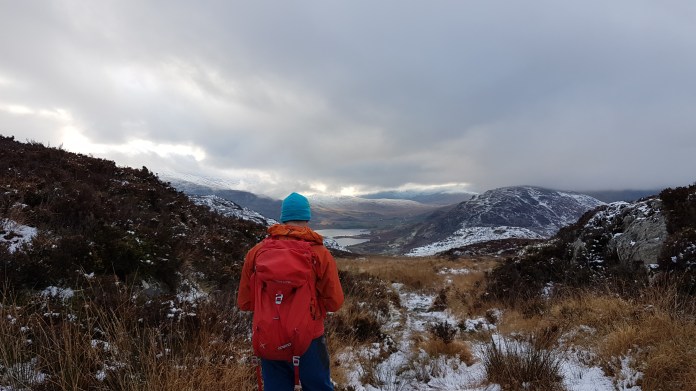
November 2019: Training with the IMC near Llyn y Coryn.
I reflect on how guilty I used to feel about taking “time off” from work (even weekends) in order to hike or practice with my band in what is perhaps the most troubling reflection of how overwork gets legitimated in the academic community. The guilt of not reading is informed by the fear that someone in the room tomorrow will be cleverer than you are, having read more books, thought more about a given social or political problem and so on, and I’ve never been able to get over it. However, a combination of factors – not the least of which is me getting too old to give a shit – have meant that I don’t worry about that as much any more and I’m all too happy to spend the weekend wandering around the hills and continuing to develop my topographical understanding.
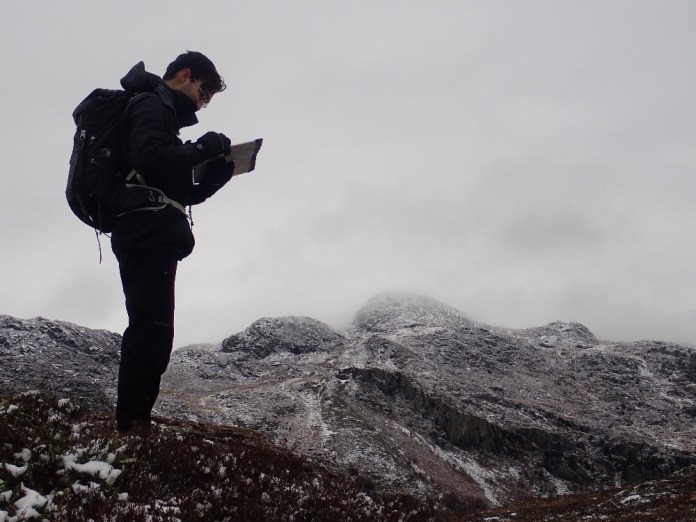
Photo Credit: Neil Pickford
Special thanks to Neil Pickford who seems all too willing to continue to take impressive pictures of me staring at maps.
Time in my office
I finally achieved a long standing dream of mine of having an upside-down backwards clock. There are now two ticking clocks in my office and I refuse to syncronize them, their mildly off-time (ha) ticking reminds me of a heartbeat and I pretend that the Dark Lady of the sonnets has pulled me into her bosom and I am listening to the tumultuous beating of her heart – some kind of primal rhythm beyond understanding or comprehension. This is a small and at least vaguely absurd thing to be passionate about, but I don’t care. Look at how cool my clock is.
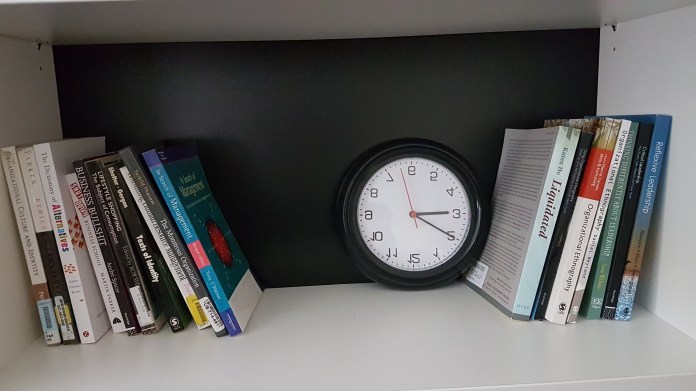
Look at this clock.
I spend a lot of time in my office at the present. Reading, writing, marking papers, responding the emails, filling out forms, and so on – all of the things that constitute an academic job but there never seems to be enough time to do all of the things that I want to and there’s always another book to read. Still, since time is upside down and backwards, it means that everything is ok.
 Sideeq Mohammed