I have been getting back into hiking. I never really fell out of love with it, but didn’t get much time to do it while I was doing my PhD.
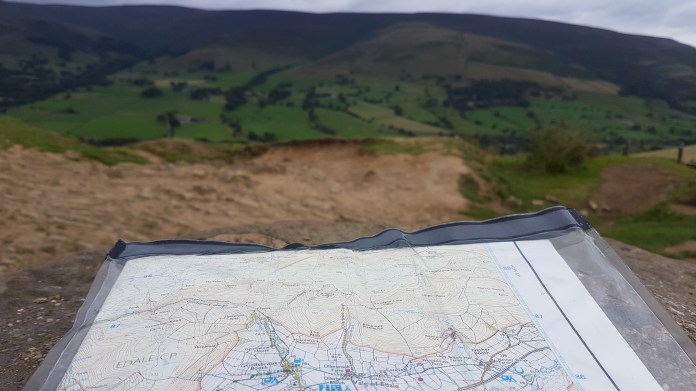
My trusty battered map-case on Hollins Cross – August 2019.
Recently, however, I’ve had great weekends in the Peak District, Snowdonia, and the Brecon Beacons with transport and company supplied by the IMC. Indeed, though I don’t usually celebrate birthdays, I spent my 30th on the top of Kinder Scout, with a book and a hip-flask of Lagavulin. It was the happiest that I’ve been in some time. Being alone on a mountain with no one around for several kilometres, fits into a perverse fantasy that I have of myself as retiring to be a “wise man on a mountain top”, who people come to ask what the secret of happiness is, to which I respond with by quipping “the secret of happiness is when people leave you alone on your mountain…”
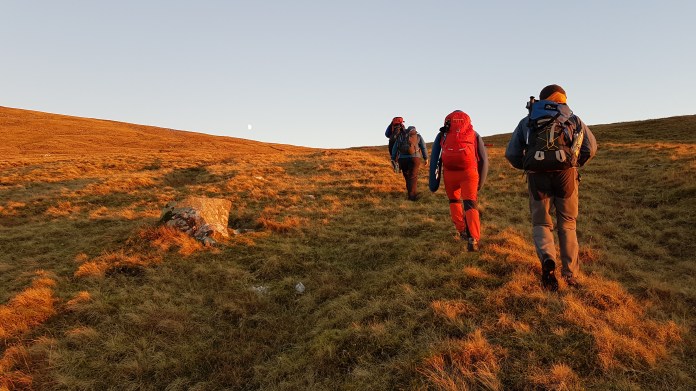
Hiking near Drosgl with the IMC – November 2018.
I’ve also been working on my micro-navigation skills, and have forgotten how much detail of a landscape one can elaborate out of the cartographic lines on a map. I enjoy staring at maps more than I used to (thanks to Neil Pickford for what is now one of my favourite photos of myself: me staring at a map). A small bump in a contour line on a 1:25000 map is a dip in the side of the mountain that confirms direction – the corner of a fence line a way to recognize a bearing. The map-world-eye interface is something that I regard with increasing curiosity, not just because it is a thing that I enjoy in which I lack expertise, but also because it is breathtaking in its nuance and complexity; an exercise in of lineological divination. Rather than reading a world that is already there, the map-eye-world assembly is continuously birthing itself; terrain and endless undulating gradients constituted from the significations of lines.
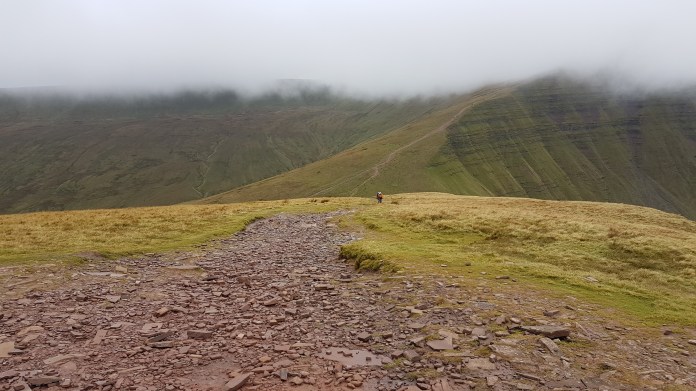
Pen-y-fan seen from Cribyn – September, 2019.
Predictably (or at least thematically given the nature of this research log) this made me reflect on some of Deleuze and Guattari’s commentary on cartography. At several points in A Thousand Plateaus they make reference to works of classic psychoanalysis and comment that Melanie Klein or Freud himself lacked a full understanding of cartography but perhaps the most fruitful way to understand the importance of the cartographic to Deleuze and Guattari is to consider their commentary on the educator Fernand Deligny. They say the following:
Fernand Deligny transcribes the lines and paths of autistic children by means of maps: he carefully distinguishes “lines of drift” and “customary lines.” This does not only apply to walking; he also makes maps of perceptions and maps of gestures (cooking or collecting wood) showing customary gestures and gestures of drift. The same goes for language, if it is present. Deligny opened his lines of writing to life lines. The lines are constantly crossing, intersecting for a moment, following one another. A line of drift intersects a customary line, and at that point the child does something not quite belonging to either one: he or she finds something he or she lost— what happened?—or jumps and claps his or her hands, a slight and rapid movement—and that gesture in turn emits several lines.’ In short, there is a line of flight, which is already complex since it has singularities; and there a customary or molar line with segments; and between the two (?), there is a molecular line with quanta that cause it to tip to one side or the other. As Deligny says, it should be borne in mind that these lines mean nothing. It is an affair of cartography. (A Thousand Plateaus. p.222-223)
Thinking about lines, cartography, and schizoanalysis, is of course nothing new (indeed, I’m currently excited to see what Barbara Glowczewski’s new book is going to say in this regard). Even I went through a period of being almost obsessively interested in lines and what Tim Ingold calls “lineology“. Here the question of the line returns as that of trajectory, movement, and life. A life composed of and by lines, trajectories, vectors, and various moving offshoots. This, we note is a radically different way to how most of us will think about questions of who we are. Most of us imagine ourselves to be stable things that change little over time, points on a complex social map (to dredge up a dated image from the sociology of Peter Berger) that intersects with various identities and demographics.
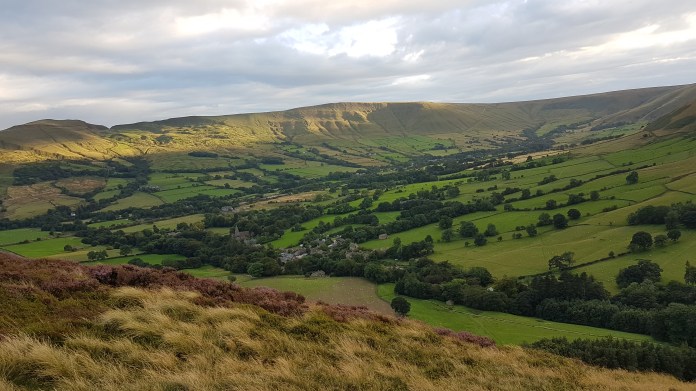
Edale seen from near Ringing Roger – August 2019.
Thinking through the logic of lines, life is not understood as a static thing, something with a truth, or an identity to be defined, discovered, or connected to a place, a people, or a collective. It is a line shooting through time, “constantly crossing, intersecting for a moment,” running across various gradients and through various spaces. Deleuze and Guattari thus ask: “What are your lines? What map are you in the process of making or rearranging? […] Which lines are you severing, and which are you extending or resuming?” (A Thousand Plateaus, p.203), in other words, what are you becoming? They are asking a question about what your life will have looked like, once all of the trajectories, connections, criss-crossings and revolutions have been made known, inscribed on a diagram like Deligny’s that showcases how lines come alive.
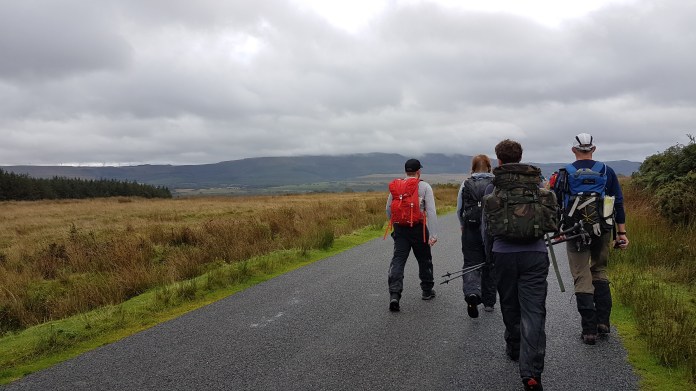
Walking with the IMC on the way back from Sqwd yr Elra – September, 2019.
I view this with fascination in the most banal sense whenever I view my Google Timeline which will often chart my movements between home, scout meetings, The University, and Sainsbury’s, carving a blunt trajectory of my moving around. I would love to see a system that accurately does this while I am hiking, mapping out the criss-crossings as I move over different footpaths, contour lines, and landmarks in a curious mirroring of the different subjects, ideas, and lines of thought through which I pass as I get older, “my lines” involved in more and more messy criss-crossings with those of the other people in my life.
This entanglement/disentanglement interests me for obvious reasons; not the least of which are existential. A community that you leave behind and never interact with is an entanglement which one’s life radically tangents from, a romantic tryst over the summer is a brief convergence or period of time in which you run in parallel followed by a spiralling and jettisoning. A vocation becomes a predictable series of knots and tangles that are familiar to others, a series of knowable notches that can be read like a map. What mad patterns would we end up scrawling out if we could diagram our lines. There is almost a poetry to this kind of lineology, one that we’ve yet to be able to fully find in words.
 Sideeq Mohammed
