In L’Abécédaire de Gilles Deleuze, Claire Parnet presses Deleuze to explain his and Guattari’s concept of desire; challenging him to explain it in clearer terms. He says “you don’t desire someone or something, you always desire an aggregate. It’s not complicated.” This formulation of desiring-production has always stuck with me and I often think about it in the course of everyday life. Desire is not about lacking or wanting an object or a person, desire desires an assemblage. I had cause to reflect on this when I was in Edinburgh for EGOS and got sick of eating breakfast at the hotel. Having had to travel more than I’d have liked to over the past few weeks, I was quite literally fed up with eating Premier Inn buffet breakfasts and wanted something better.
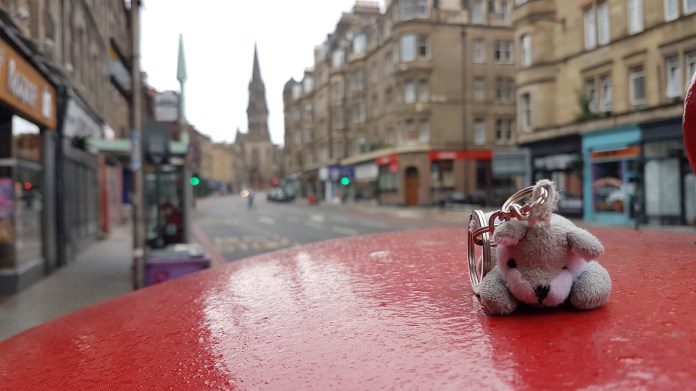
Pictures with Penny near the outside of the Quick and Plenty Cafe.
I chose the Quick and Plenty cafe, precisely because it looked like a tiny hole in the wall on Google Maps. It was the best breakfast that I’ve had in a long time. I couldn’t have made it better myself (which anyone who knows my fondness for things done my way would know is high praise). Friends will know that I like simple food done competently, which is precisely what this was. I reflect that I enjoyed the meal, because I didn’t just desire an “authentic” Scottish breakfast (or some hyperreal simulacra in construction of authenticity) and I didn’t just want to get out of the hotel. It was the assemblage that was important. The desire was for sitting somewhere with dingy yellow lighting, on a cushion that had become so worn from use that it had to be covered over by a blanket which itself looked to be as old as I am. The desire was to order a Scottish breakfast off of a speckled, laminated menu while staring at the tangle of power cables and wires that was supporting their payment/online order/music system. The desire was to come in out of the light Scottish drizzle and feel awash with the warmth of a running stove. The desire was for watching the chef cook my breakfast in cheap looking pans on a small kitchen hob while bantering with his assistant in a thick Scottish accent, occasionally taking a phone call in which he would yell at someone (perhaps a mother, wife, or a girlfriend) that he was too busy to talk and needed to be left alone. The desire was for listening to the great care that he had for the food and to speak to him in exceptional detail about the long-standing local bakery that the rolls came from or the history of the company from which he sourced the haggis. The desire was for the glass-eyed sterility of the polished customer service interaction in my hotel to be completely upended by a space dominated by a kind of professional-unprofessional, an intermingling of diligent, conscientious care and that special kind of not giving a shit that is an artefact of Scottish dourness. This disconnect from a multinational semiocapitalist machine and reconnect to a smaller capitalist machine, one not yet alienated from itself, is a key part of this assemblage and its remobilization of consumer/tourist discourses. The desire was for reflecting on all of this while drinking instant coffee and thinking about how desire was being machined in that moment. I did not know how much I needed the food until it arrived, served in a rambunctious and unpretentious space. But this “I” invites further consideration.

Definitely not day drinking at The Bow Bar.
As Deleuze and Guattari say in Anti-Oedipus:
“Desire does not lack anything; it does not lack its object. It is, rather, the subject that is missing in desire, or desire that lacks a fixed subject; there is no fixed subject unless there is repression. Desire and its object are one and the same thing: the machine, as a machine of a machine. Desire is a machine, and the object of desire is another machine connected to it. Hence the product is something removed or deducted from the process of producing: between the act of producing and the product, something becomes detached, thus giving the vagabond, nomad subject a residuum.” (p.26)
What is important to say is not only that this desire did not pre-exist the assemblage, I did not preexist the assemblage, the subject was machined along with everything else as a by-product or residuum of the machinations of desire. Subjectivity is here not that from which desire emerges, but a residuum, a by-product made in the small pub assemblage or the used-bookshop assemblage.
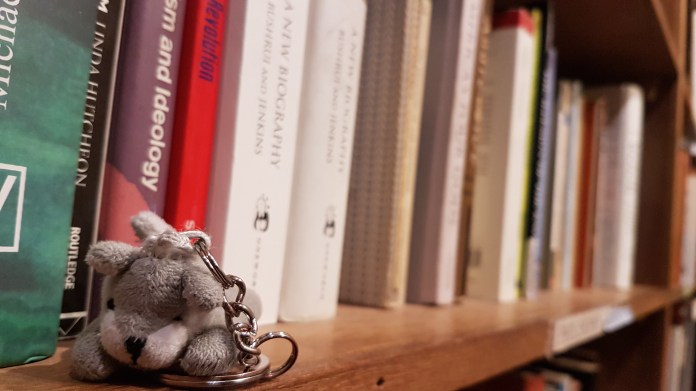
Edinburgh had several used bookshops that we visited because they had books and I am a simple man.
In most readings, Deleuze and Guattari’s understanding of desire is thought in a way focuses on the affirmative and the joyous connections that desire brings about. Recent work (like Culp’s Dark Deleuze) has, however, begun to popularize an alternative reading to which I am partial, the darker understandings of desire, not productive and prudent, but destructive and apocalyptic; desire tearing itself apart. Desire for annihilation, for destruction, for even death. Perhaps that’s why desire was producing a person with high cholesterol and mild liver damage…
Breakfast at Quick and Plenty was the start to the best morning that I’ve had (outside of my house) in a long time. I want to go back to Edinburgh as soon as I can, and I know where I’m having breakfast when I do.
 Sideeq Mohammed