I had one of the most amazing and surreal experiences of my adult life this week.
Through a set of circumstance that I can’t quite explain, I somehow volunteered/was volunteered to present my work on Deleuze and Guattari’s concept of microfascism (and how this is mobilized, preyed upon, and has a role in legitimating management gurus) to a mostly business practitioner audience at the beautiful Turner Contemporary. I’ve posted about this work before in this research log and hopefully it will be formally published soon.
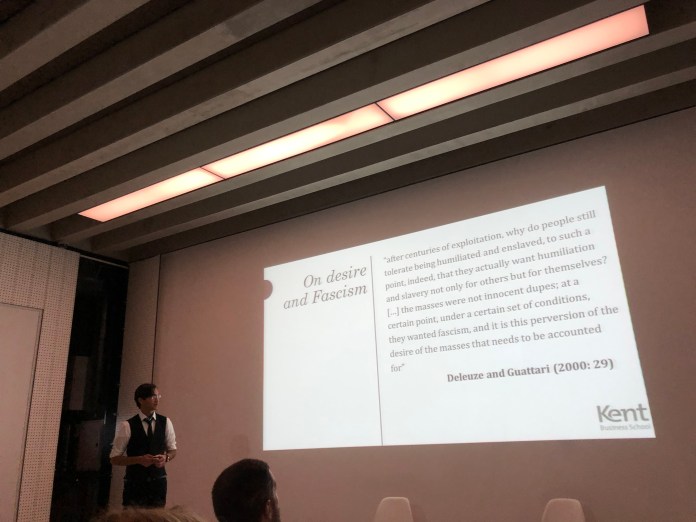
Presenting at Turner Contemporary – Photo Credit: Felicity Heathcote Marcz
The full presentation is available here. It conflates terms like guru, consultant, and over-includes or over-reads the history of management ideas (and various fads and fashions which have come and gone) around “involvement” but I think it worked for the audience; cultivating a scepticism towards the idea that perhaps the proposition that employees should be involved in decision making/creativity.
I don’t know how much the audience took away – and I say this not as a critique of their intelligence so much as a commentary on my inability to explain well enough. While I think that some definitely engaged with the premise of critical scepticism towards the ideas that might be sold by a management guru, I think that many in the audience balked from the first sentence: “My name is Dr. Sideeq Mohammed and I’m a critical management scholar; what that means is (among other things) that I have no interest in making your organizations more profitable, efficient, creative, innovative, or productive.” I think that that definitely got their attention. I may also have described myself as a “professional rain-cloud” during the Q&A – I think that that was imprudent but I’m not sure why.
The truly surreal part of the presentation came when immediately after, a management consultant stood up and did exactly what I just described, i.e. attempted to sell the audience the idea that making their employees more curious was a potentially magical cure for their organization’s ills. It was hard not to stare open-mouthed. A good friend and colleague who attended the presentation kept looking at me as if to say “Behave yourself” but it was too strange an encounter. O my prophetic soul! In a way I was slightly envious of his confidence, because I don’t think that I’d have been able to present in his position, particularly not able to laugh it off with a joke like “Well, I guess its my turn to speak; the embodiment of fascism in the room.” Perhaps I am overestimating how much critique I was able to vocalize.

Afterwards, however, I was not reflecting on the well-established literature on the management guru’s charisma or the presentations of demagoguery. Rather, I was thinking about l’appel du vide., the call of the void. There’s interesting research on this strange phenomenon, often described as the high place phenomenon or “intrusive thoughts”. It’s the feeling of wanting to jump when on a high place. I relate it to Kierkegaard’s definition of “anxiety” and think about it in those terms, a primal fear of the freedom to die.
I was thinking about it because the Turner was also hosting an exhibition of the work of Patrick Heron at the time. I spent some time before the presentation staring at the enormous Cadmium with Violet, Scarlet, Emerald, Lemon and Venetian.
I really was quite awestruck by it, the yawning maw of the violet blob (An umbrella seen from above? A plum on a table? Cancer cell in the blood?, it is crude to speculate…) seeming to become a gaping hole into which I might slip and fall forever. A black hole eating time and space. An unrelated piece from outside the Turner, depicting the figure of a man, stoic and still, facing the roiling tide also put the call of the void in my brain.
There’s a passage from Hamlet that I often reflect on in this regard, a line from Horatio in Act 1:
What if it tempt you toward the flood, my lord,
Or to the dreadful summit of the cliff
That beetles o’er his base into the sea,
And there assume some other horrible form,
Which might deprive your sovereignty of reason
And draw you into madness? think of it:
The very place puts toys of desperation,
Without more motive, into every brain
That looks so many fathoms to the sea
And hears it roar beneath.
The toys of desperation thrown into the brain, that’s the call of the void. I thought about this passage on the train ride home. I wondered if I could connect this experience of the yearning to fall into a purple abyss or be washed away by the waves to the question of the desire for fascism and the tendency of people to act against their interests but I’m not sure how it might be done. I’ll keep thinking about it.
 Sideeq Mohammed
