Who owns your local shopping centre and why should you care?
Earlier this month, property giant Hammerson announced plans to acquire Intu in a £3.4bn deal. Unless you’re an investor in or an employee of either of these companies, however, you probably didn’t hear about it.
Millions of us have spent many hours in retail spaces over the last month getting ready for our annual consumerist festivities; summoning the real three “wise men” of the holiday season: debt, stress and anxiety. Indeed, despite the ever increasing popularity of online retailing, shopping centres across Britain report incredible foot traffic at this time of year. However, most of us do not notice the shopping centre’s branding, the corporate infrastructure that facilitates something as simple as having all of our favourite shops in one climate controlled, well-lit and comfortable space.
When Manchester’s Trafford Centre was sold by the Peel Group to Capital Shopping Centres (which would later rebrand itself as Intu Properties) in January 2011 for a reported £1.6 billion, for example, visitors noticed little more than cosmetic changes to staff uniforms, signage etc.. For the most part, things seemed to stay the same, with the Trafford Centre evoking the same timeless, unchanging facade that it will always have portrayed allowing most to go on with their shopping unencumbered.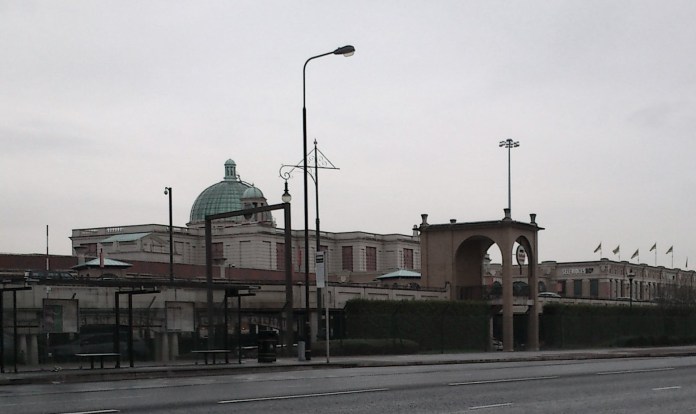
However, shopping centres are more than just retail spaces. Many of them serve as places of collective gathering, home to community groups like mall walkers who do not visit for the purpose of purchasing, but instead function as support structures for kindly retirees and upbeat suburban housewives. Shopping centres are sites of political protest over the killing of unarmed African American men by police, spaces where animal rights debates are brought to the fore of public consciousness, and unfortunately, places where we live out the worst effects of terrorist or social violence (real or simulated). Researchers from Stockholm University have even found them to be sites of resistance to urban planning initiatives that seek to organized the homeless out of built-up areas.
Shopping centres, it seems, play an increasingly central role in our social and civic lives. It is worth remembering, however, that unlike the town squares of the past which they seek to emulate, shopping centres are not public spaces, even if they look that way. All of the importance that we attach to the shopping centre as a site of collective meeting, protest, gathering and civic conversation, a polis, becomes problematic once we remember that a private corporation controls who has and does not have access, who can and cannot afford to shop there. In this sense, shopping centres reflect broader social inequalities, income gaps, racial and gender biases etc. that our society struggles under the weight of.
It is thus that we return to reflect on the Hammerson buyout which brings with it, as all mergers of this kind do, increased power through the elimination of competition and thus an increased ability for agenda setting, shaping of behavioural and disciplinary norms, exclusion of fringe groups, naturalization of particular brands, shopping behaviours and communal mores etc. It is worth remembering thereby that shopping centres control most everything within their walls, from smell to sound, from light to temperature, all in order to elicit particular responses from shoppers.
In the context of what many are calling “the death of the British High Street”, however, consolidation is perhaps one of the reasons that shopping centres are surviving the current period while across Britain, storefronts in local shopping districts sit empty. Over a year on, there are still huge outlets vacated by the collapse of BHS that have yet to be filled. Small towns across the country are witnessing the realities of urban decay as only large chain stores can hold up against escalating rents and falls in foot-traffic.
It would seem then, that merging and consolidating- the agglomeration of corporate power- would be the order of the day for firms and retail spaces that wish to survive, but we, as a public, should be increasingly wary of who is in charge of the spaces that we frequent, what they do with them and how they shape our behaviour.
 Sideeq Mohammed